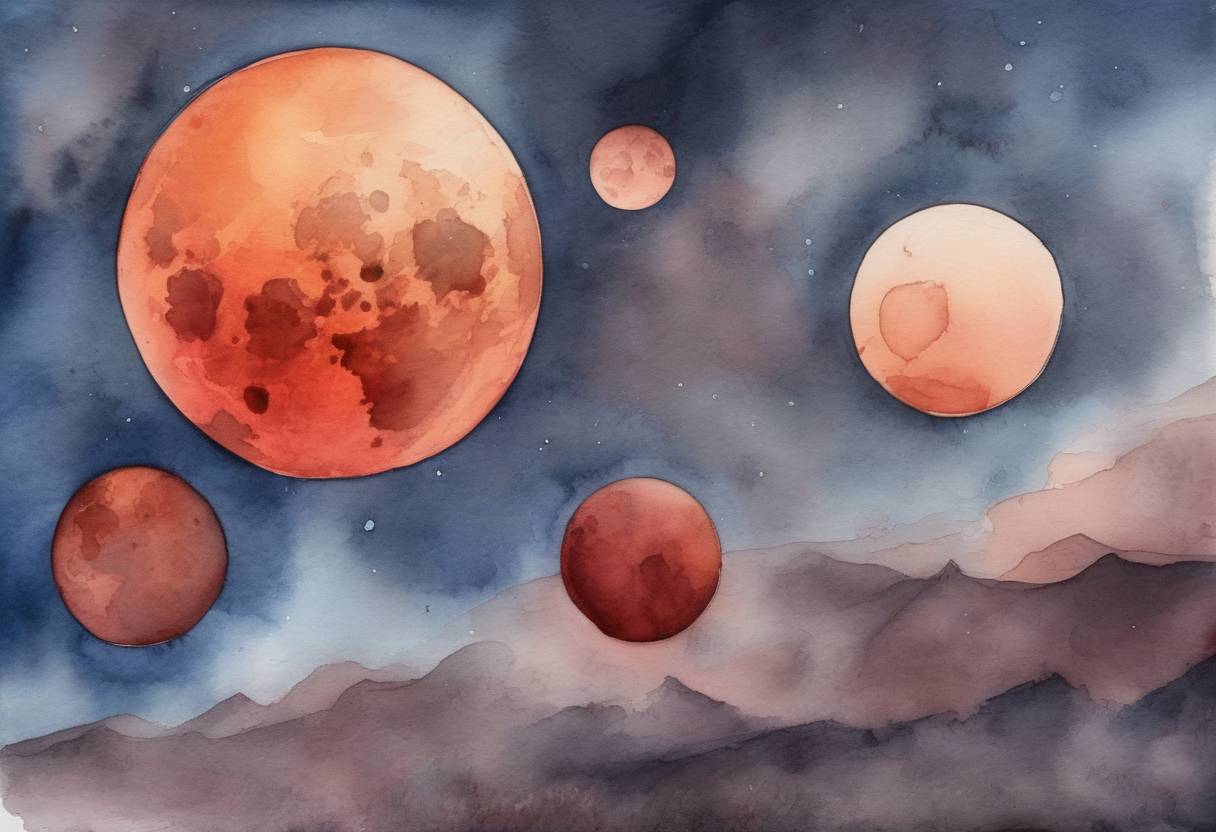
The Rare “Super Blue Blood Moon” of January 31, 2018
On January 31, 2018, a rare astronomical event known as the “super blue blood moon” occurred, captivating skywatchers across parts of North America, Asia, and Australia. This event was a unique convergence of three lunar phenomena: a supermoon, a blue moon, and a total lunar eclipse.
Key Components of the Event
1. Supermoon
A supermoon happens when a full moon coincides with the moon’s closest approach to Earth in its elliptical orbit, known as perigee. This makes the moon appear larger and brighter than usual. On January 31, 2018, the moon was approximately 223,000 miles from Earth, making it about 14% larger and 30% brighter than a typical full moon.
2. Blue Moon
The term “blue moon” refers to the second full moon occurring within a single calendar month. The first full moon of January 2018 occurred on January 1, and the second on January 31, thus qualifying it as a blue moon. Despite the name, the moon does not actually appear blue.
3. Total Lunar Eclipse
A total lunar eclipse occurs when the Earth comes directly between the sun and the moon, casting a shadow over the moon. During the eclipse, the moon can take on a reddish hue due to the Earth’s atmosphere scattering sunlight, an effect known as “Rayleigh scattering.” This phenomenon is often referred to as a “blood moon.”
Visibility and Observations
The super blue blood moon was visible in its entirety across the western United States, Alaska, Hawaii, and parts of Asia and Australia. Observers in these regions experienced the full sequence of the eclipse, from the penumbral phase to the total eclipse. In other parts of the world, the event was partially visible, with some regions witnessing only the supermoon or the blue moon aspects.
Historical and Cultural Significance
While each of these lunar events is not uncommon on its own, the combination of all three occurring simultaneously is rare. The last time a super blue blood moon was observed was on December 30, 1982, for the Eastern Hemisphere, and March 31, 1866, for the Western Hemisphere.
The event sparked widespread interest and excitement, drawing attention from both amateur and professional astronomers. It also highlighted the intricate dynamics of celestial mechanics and the beauty of astronomical phenomena.
Aftermath and Legacy
The super blue blood moon of January 31, 2018, served as a reminder of the wonders of the universe and the ongoing fascination with celestial events. It provided an opportunity for educational outreach and inspired many to learn more about astronomy. The event was widely covered by media outlets and shared extensively on social media, further amplifying its impact and reach.
In summary, the super blue blood moon of January 31, 2018, was a remarkable celestial event that combined the spectacle of a supermoon, the rarity of a blue moon, and the dramatic visuals of a total lunar eclipse, leaving a lasting impression on those fortunate enough to witness it.