The Polish November Uprising of 1830
1830 · Warsaw, Poland
The Polish November Uprising against the Russian Empire began, aiming to restore Polish independence.
August 21, 1772
The first Partition of Poland was ratified by the Polish Sejm, dividing Polish territories among the Russian Empire, the Kingdom of Prussia, and the Habsburg Monarchy.
Warsaw, Poland | Polish Sejm
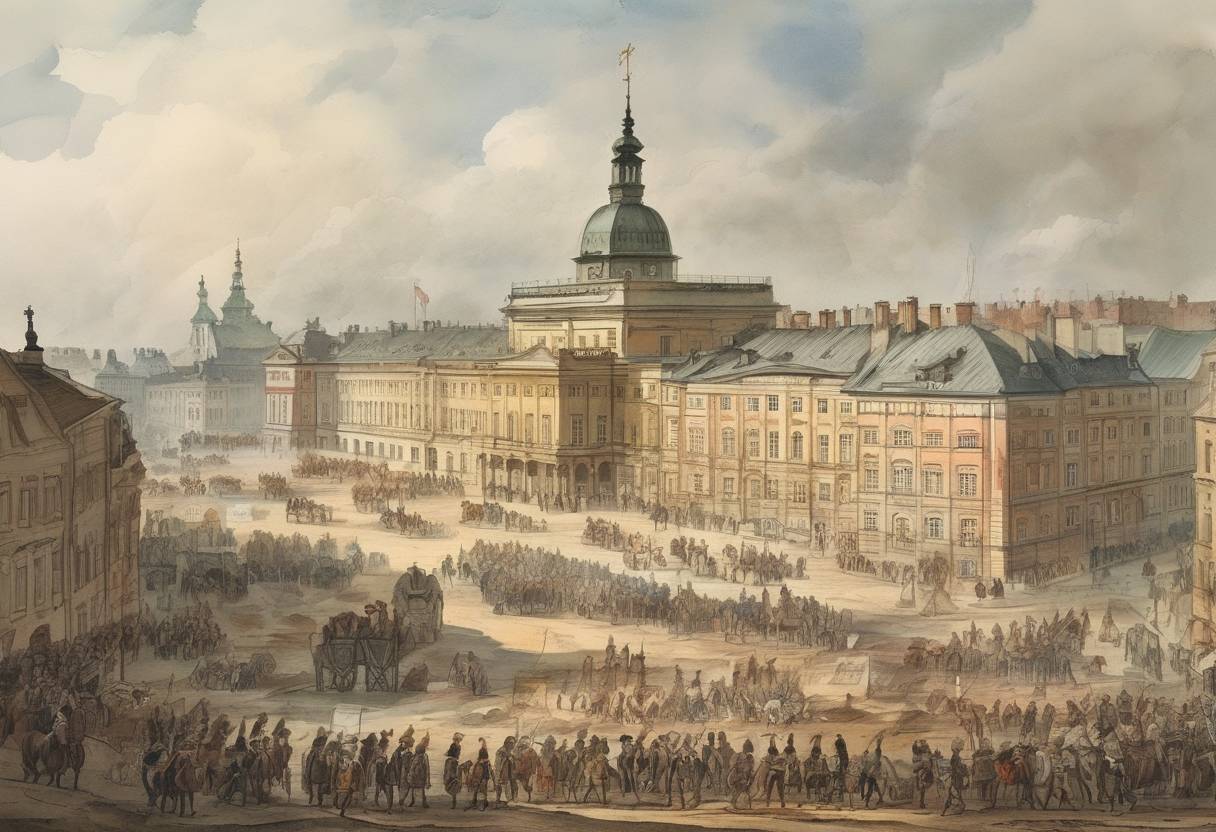
On August 21, 1772, the Polish Sejm ratified the first partition of Poland, a significant event that marked the beginning of the end for the Polish-Lithuanian Commonwealth. This partition was orchestrated by three powerful neighboring states: the Russian Empire, the Kingdom of Prussia, and the Habsburg Monarchy (Austria). The partition resulted in the division and annexation of large swathes of Polish territory, significantly reducing the size and influence of the Commonwealth.
The Polish-Lithuanian Commonwealth, once a major European power, had been in decline due to internal strife, weak central authority, and external pressures. The political system, known as the “Golden Liberty,” allowed any member of the nobility to veto legislation, leading to governmental paralysis. This internal weakness made Poland an attractive target for its more powerful neighbors.
The partition was formalized through a series of treaties between the three powers, with each state annexing portions of Polish territory:
The Polish Sejm, under immense pressure from the partitioning powers and facing the reality of military occupation, ratified the partition on August 21, 1772. This ratification was essentially a formality, as the Polish government had little choice but to acquiesce to the demands of the more powerful states.
The first partition of Poland set a precedent for further partitions, ultimately leading to the complete dissolution of the Polish-Lithuanian Commonwealth by 1795. The partitions had profound consequences for the region:
The first partition of Poland is a poignant example of how geopolitical ambitions and internal weaknesses can lead to the dismemberment of a once-powerful state. It remains a significant event in Polish history, symbolizing the challenges of maintaining sovereignty in the face of external pressures.
Source: en.wikipedia.org