The Battle of the Sit River: March 4, 1238
1238 · Near the Sit River, Russia
The Battle of Sit River took place where the Mongol Empire under Batu Khan defeated the forces of Yuri II of Vladimir, during the Mongol invasion of Rus'.
April 11, 1241
The Battle of Mohi took place, where the Mongol Empire, led by Batu Khan and Subutai, defeated the Kingdom of Hungary. This battle was part of the Mongol invasion of Europe.
Mohi, Hungary | Mongol Empire
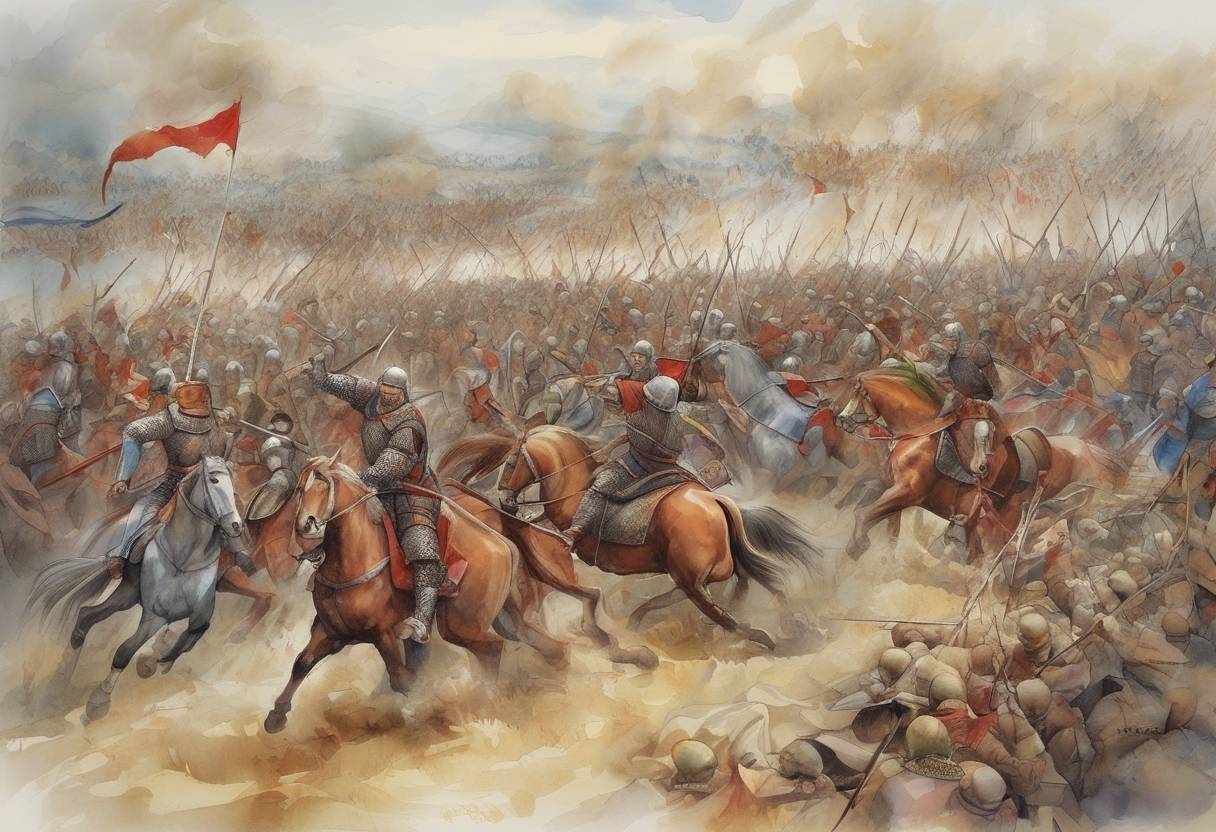
The Battle of Mohi, also known as the Battle of the Sajó River, was a pivotal confrontation during the Mongol invasion of Europe. It took place on April 11, 1241, and saw the forces of the Mongol Empire, commanded by Batu Khan and the renowned general Subutai, decisively defeat the Kingdom of Hungary.
The Mongol invasion of Europe was part of a broader campaign initiated by Genghis Khan’s successors to expand the empire’s reach. Following the successful conquest of the Rus’ principalities, the Mongols turned their attention to Central Europe. The invasion was meticulously planned and executed by Subutai, one of the most skilled military strategists of the Mongol Empire.
In early 1241, the Mongols launched a multi-pronged invasion into Europe. The Hungarian Kingdom, under King Béla IV, became a primary target due to its strategic location and potential as a base for further incursions into Western Europe.
The Hungarian forces, numbering between 15,000 to 25,000, were assembled to confront the Mongol threat. King Béla IV attempted to consolidate his forces and sought assistance from neighboring European powers, but the response was limited and slow.
The battle unfolded near the Sajó River, close to the village of Mohi. The Mongols employed their typical tactics of mobility and deception. On the night of April 10, Subutai orchestrated a surprise attack by crossing the river using a temporary bridge, catching the Hungarian forces off guard.
On April 11, the Mongols launched a full-scale assault. They utilized their superior cavalry and archery skills to encircle and decimate the Hungarian army. The use of psychological warfare, including the infamous “feigned retreat” tactic, further disoriented the Hungarian troops.
The defeat at Mohi was catastrophic for Hungary. The Mongols pursued the fleeing Hungarian forces, causing widespread devastation across the kingdom. King Béla IV narrowly escaped capture and sought refuge in Austria and later in Dalmatia.
The Mongol victory at Mohi opened the path for further incursions into Central Europe. However, the Mongols did not establish a permanent presence in Hungary. The sudden death of the Great Khan Ögedei in 1241 necessitated Batu Khan’s return to Mongolia to participate in the succession process, halting the Mongol advance into Europe.
The Battle of Mohi demonstrated the effectiveness of Mongol military strategies and their ability to defeat larger, less mobile European armies. It also highlighted the vulnerabilities of European kingdoms to the Mongol threat, emphasizing the need for greater unity and military reform.
While the Mongol invasion of Europe was ultimately curtailed, the battle had lasting impacts on European military tactics and fortifications. The fear of further Mongol invasions lingered for decades, influencing political and military developments across the continent.
In summary, the Battle of Mohi was a critical event in the Mongol invasion of Europe, showcasing the might of the Mongol Empire and leaving a profound mark on European history.
Source: en.wikipedia.org