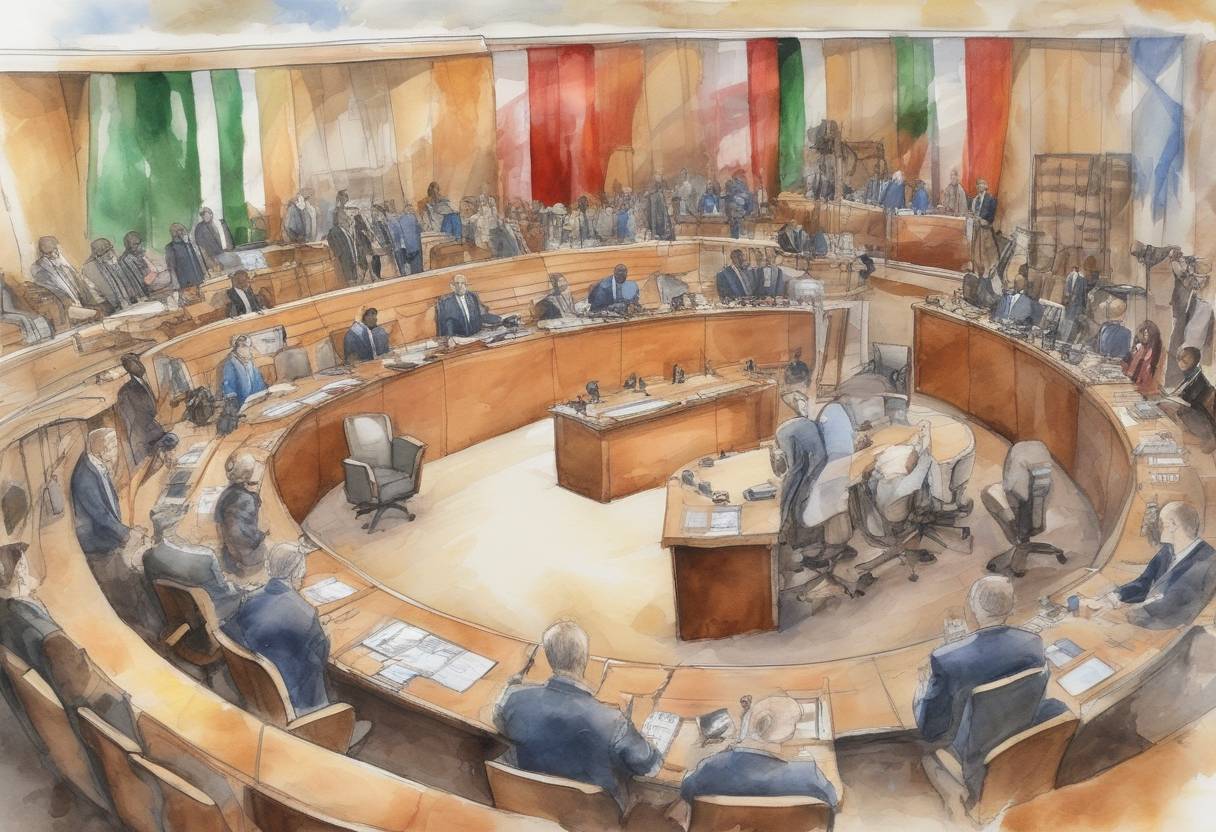
United Nations Security Council Election - June 4, 2014
On June 4, 2014, the United Nations General Assembly elected Jordan, Lithuania, and Nigeria as non-permanent members of the United Nations Security Council (UNSC). This election was part of the regular process to fill the rotating seats on the Council, which are held for two-year terms.
Background
The United Nations Security Council is one of the six principal organs of the United Nations, charged with ensuring international peace and security. It is composed of 15 members: five permanent members (China, France, Russia, the United Kingdom, and the United States) and ten non-permanent members elected for two-year terms by the General Assembly.
Election Process
- Non-permanent Members: The ten non-permanent seats are distributed among regional groups: three for Africa, two for Asia-Pacific, two for Latin America and the Caribbean, two for Western Europe and Others, and one for Eastern Europe.
- Voting: To be elected, a country must receive a two-thirds majority of the votes cast in the General Assembly.
Significance of the 2014 Election
Jordan
- Context: Jordan was elected to fill the seat vacated by Saudi Arabia, which declined the position in 2013, citing the Council’s failure to effectively address issues in the Middle East, particularly the Syrian Civil War.
- Role: Jordan’s election was significant due to its strategic position in the Middle East and its role in regional diplomacy, especially concerning the Syrian refugee crisis.
Lithuania
- Context: Lithuania’s election marked its first time serving on the Security Council. As a member of the Eastern European Group, Lithuania’s presence was seen as an opportunity to bring attention to Eastern European issues.
- Role: Lithuania’s tenure was expected to focus on strengthening international law and human rights, reflecting its post-Soviet transformation and integration into European structures.
Nigeria
- Context: Nigeria was elected as a representative of the African Group. This was Nigeria’s fifth term on the Security Council, highlighting its significant role in African and global diplomacy.
- Role: Nigeria’s priorities included addressing regional security challenges, such as the Boko Haram insurgency, and promoting African development and peacekeeping initiatives.
Broader Implications
The election of these countries to the UNSC underscored the diverse geopolitical interests represented within the Council. Each member brought unique perspectives and priorities, contributing to the Council’s deliberations on international peace and security. The inclusion of countries from different regions also highlighted the importance of regional representation in addressing global issues.
Overall, the election of Jordan, Lithuania, and Nigeria to the UNSC in 2014 demonstrated the dynamic nature of international diplomacy and the ongoing efforts to address complex global challenges through multilateral cooperation.