Posthumous Execution of Oliver Cromwell's Remains - January 30, 1661
1661 · London, England
Oliver Cromwell's remains were exhumed and subjected to a posthumous execution.
December 16, 1653
Oliver Cromwell becomes Lord Protector of England, Scotland, and Ireland.
London, England | English Commonwealth
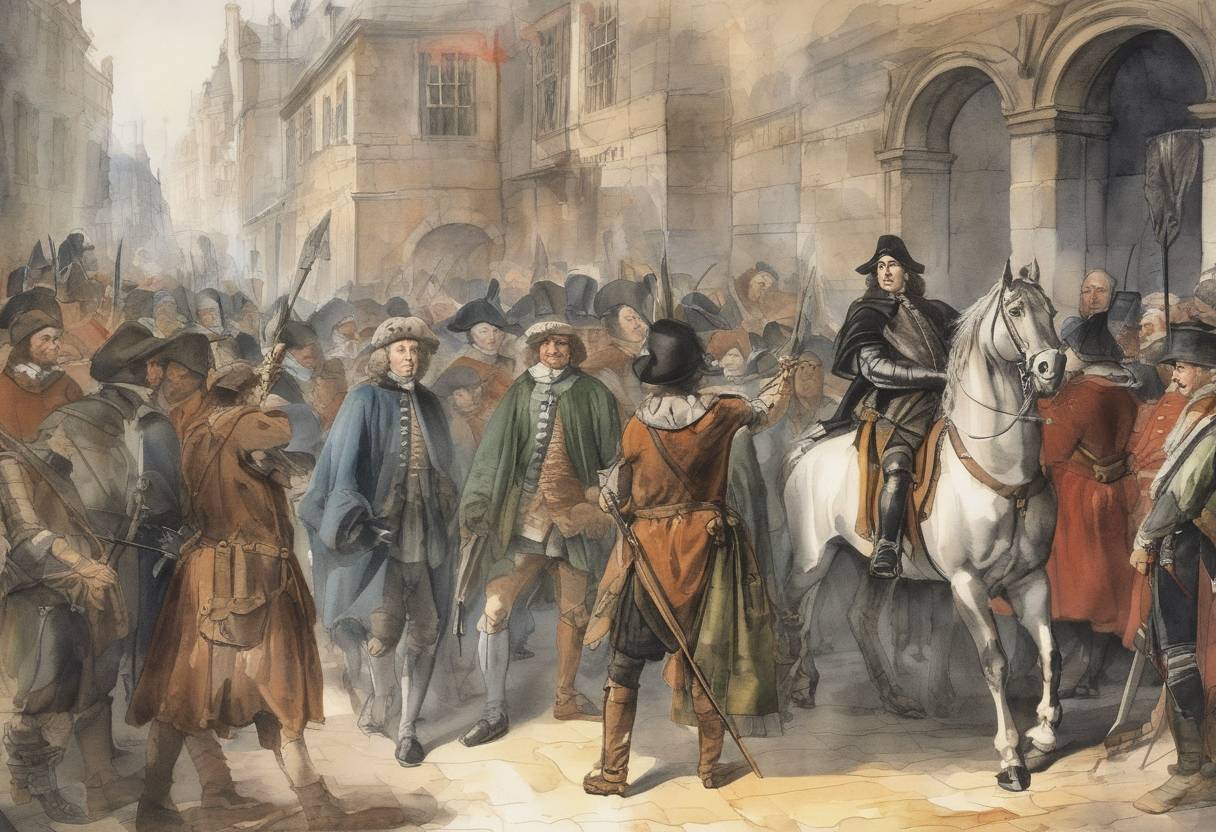
On December 16, 1653, Oliver Cromwell was appointed as the Lord Protector of England, Scotland, and Ireland, marking a significant shift in the governance of the British Isles. This event was a pivotal moment in the history of the British Isles, occurring during a period of intense political upheaval and transformation.
The appointment of Cromwell as Lord Protector came in the aftermath of the English Civil War (1642–1651), a series of armed conflicts and political machinations between Parliamentarians (“Roundheads”) and Royalists (“Cavaliers”). The war culminated in the trial and execution of King Charles I in 1649, leading to the abolition of the monarchy and the establishment of the Commonwealth of England.
Following the execution of Charles I, England was declared a republic, and the Rump Parliament governed the nation. However, this government struggled with internal divisions and inefficiencies. In April 1653, Cromwell, frustrated with the Rump Parliament’s inability to govern effectively, dissolved it by force, leading to the establishment of the Barebone’s Parliament, which also proved ineffective.
The political instability prompted the drafting of the Instrument of Government, the first written constitution of England, which laid the foundation for Cromwell’s new role. The Instrument of Government was adopted on December 15, 1653, and the following day, Cromwell was installed as Lord Protector.
As Lord Protector, Cromwell held significant executive power, although he was not a monarch. His role was akin to that of a head of state, with the authority to summon and dissolve parliaments, command the army, and oversee foreign policy. The government was structured as a Protectorate, with Cromwell ruling alongside a Council of State and a single-chamber Parliament.
Cromwell’s tenure as Lord Protector was marked by efforts to stabilize the nation, promote religious tolerance for various Protestant sects, and expand England’s influence abroad. His administration pursued military campaigns in Ireland and Scotland, consolidating control over the British Isles.
Cromwell’s rule as Lord Protector lasted until his death on September 3, 1658. His leadership was characterized by a mix of military dictatorship and attempts at reform. After his death, the Protectorate struggled to maintain stability, leading to the eventual restoration of the monarchy in 1660 under Charles II.
The period of Cromwell’s rule remains a subject of debate among historians, with some viewing him as a champion of liberty and others as a tyrant. His appointment as Lord Protector marked a unique experiment in republican governance in England, influencing future constitutional developments.
In summary, Oliver Cromwell’s ascension to the role of Lord Protector on December 16, 1653, was a defining moment in British history, reflecting the complex interplay of power, governance, and ideology during a transformative era.
Source: en.wikipedia.org