Glenn Curtiss and the First Successful Seaplane Flight - January 26, 1911
1911 · San Diego, United States
Glenn Curtiss achieves the first successful seaplane flight, taking off and landing on water, marking a pivotal moment in aviation history.
March 28, 1910
Henri Fabre becomes the first person to make a successful powered seaplane flight with his Fabre Hydravion.
Martigues, France
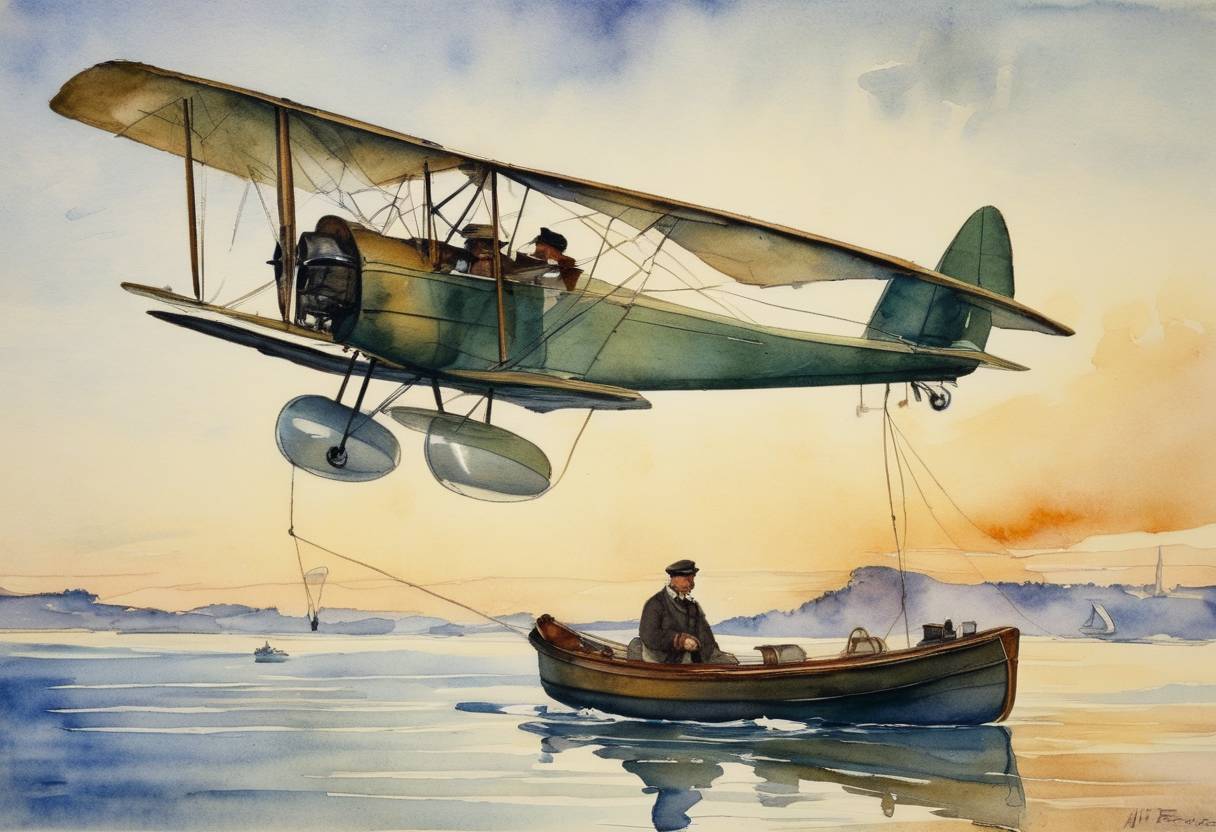
On March 28, 1910, French aviator and engineer Henri Fabre achieved a groundbreaking milestone in aviation history by becoming the first person to make a successful powered flight with a seaplane, known as the Fabre Hydravion. This historic event took place on the Étang de Berre, a large body of water near Martigues, France.
Henri Fabre was born in 1882 and came from a family with a maritime background, which influenced his interest in watercraft and aviation. He devoted several years to studying aeronautics and hydrodynamics and worked on designing an aircraft capable of taking off and landing on water—a significant engineering challenge at the time.
The Hydravion, meaning “water plane,” was a monoplane floatplane, which Fabre constructed mainly out of wood. It featured a singular wing design and was equipped with three floats for buoyancy. The aircraft was powered by a 50-horsepower Gnome Omega rotary engine, which was advanced for its time.
On the morning of March 28, 1910, after a series of tests and adjustments, Fabre piloted the Hydravion into history. The successful flight covered a distance of about 500 meters (approximately 1,640 feet). This inaugural flight proved the feasibility of operating an aircraft on and over water, heralding a new era in aviation that expanded the potential for aircraft to operate in maritime environments.
The success of Fabre’s Hydravion had a profound impact on the development of marine aviation technology. It demonstrated the potential for seaplanes to operate in regions lacking traditional airfields, thereby contributing to the future of military and civilian aviation in remote or coastal environments.
Following the success of his initial flight, Fabre’s design and approach influenced subsequent seaplane advancements by engineers and aviators worldwide. Although Henri Fabre did not continue to develop more aircraft, his pioneering work laid foundational principles still used in the design of seaplanes today.
Henri Fabre lived until 1984, witnessing nearly a century of aviation progress that his early achievements helped catalyze. The Fabre Hydravion remains a celebrated artifact of aeronautical innovation, with replicas displayed in museums, affirming its place in the history of aviation technology.
Source: en.wikipedia.org