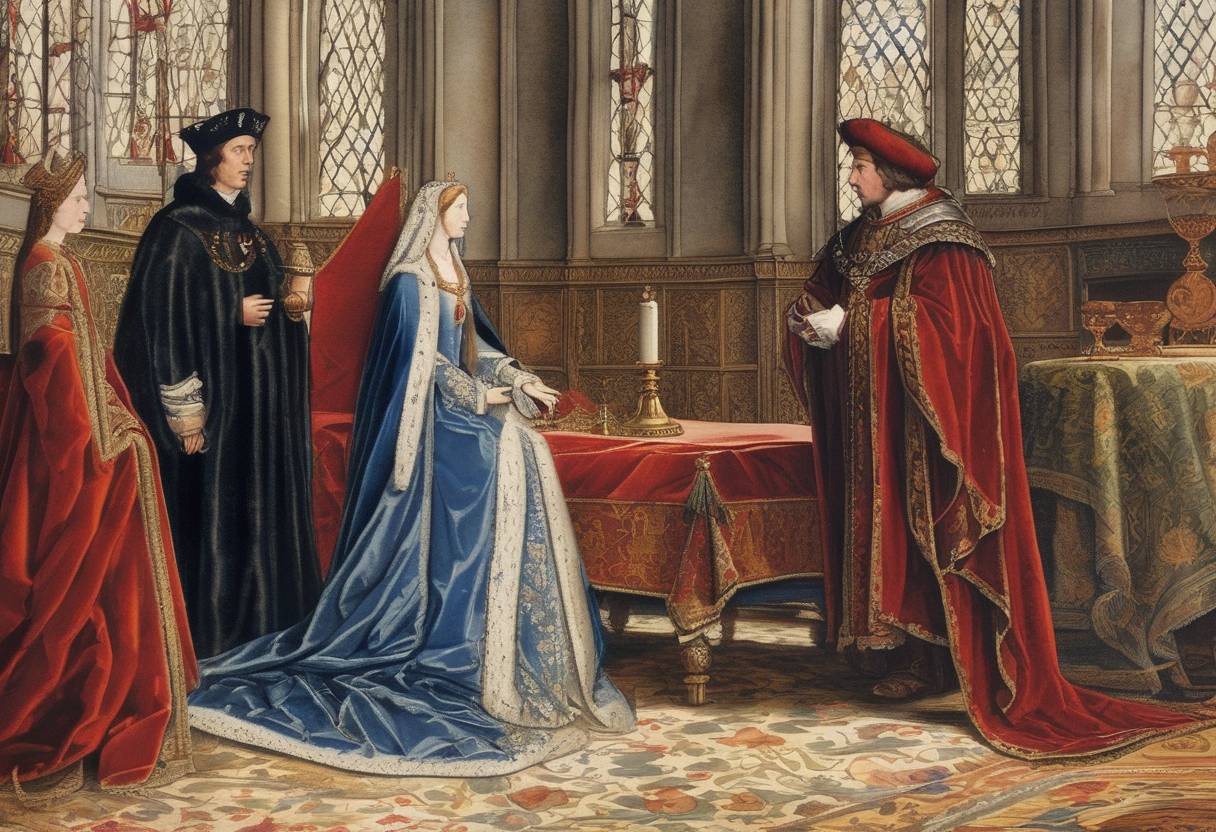
Marriage of Catherine of Aragon and Arthur, Prince of Wales by Proxy
On May 19, 1499, a significant event took place in the Wessex city of Winchester: the marriage by proxy of Catherine of Aragon to Arthur, Prince of Wales. This union was orchestrated as a strategic alliance between the Kingdom of England and the Kingdom of Spain, reflecting the political landscape of late 15th-century Europe.
Background
Catherine of Aragon was the daughter of the formidable Spanish monarchs, Ferdinand II of Aragon and Isabella I of Castile. The union with the English heir, Arthur, Prince of Wales, aimed to cement ties between England and Spain, creating a powerful coalition against France, a common adversary of both nations at the time.
Arthur, born on September 20, 1486, was the eldest son of King Henry VII of England and Elizabeth of York. As the Prince of Wales, he was the heir apparent to the English throne, and his marriage to Catherine was seen as a significant diplomatic maneuver.
The Proxy Ceremony
The marriage by proxy was a common diplomatic practice in the late Middle Ages, allowing political unions to proceed even when the physical presence of the bride or groom was not possible. In Winchester, this meant that a stand-in represented Prince Arthur during the ceremony. The event was characterized by customary rituals, observed to uphold the traditions and legitimacy of the marriage.
Historical Significance
The marriage was part of the broader Treaty of Medina del Campo, ratified in 1489, which laid the groundwork for mutual defense and economic benefits between England and Spain. Although the marriage by proxy was a preliminary step, it set the stage for Catherine’s subsequent voyage to England in 1501, where she met and formally married Arthur in person on November 14, 1501, in St. Paul’s Cathedral.
Aftermath
Tragically, Arthur’s life was cut short when he died at the age of 15 in April 1502, just months after the formal marriage ceremony. This unexpected event disrupted political and dynastic plans for both nations. Catherine was eventually married to Arthur’s younger brother, Henry VIII, which had profound consequences for the future of England, including the eventual English Reformation and the establishment of the Church of England.
In conclusion, the marriage of Catherine of Aragon to Arthur, Prince of Wales, by proxy on May 19, 1499, was a key moment in European diplomacy, symbolizing the intricate alliances and shifting power dynamics of the period. It had lasting repercussions, influencing the course of English and Spanish history for generations.