The Departure of the Whaling Ship Essex
1820 · Nantucket, United States
The American whaling ship Essex, which would later inspire Herman Melville’s novel ‘Moby-Dick’, departs Nantucket for the Pacific Ocean.
November 20, 1820
An 80-ton sperm whale attacks and sinks the Essex, a whaling ship from Nantucket, Massachusetts, an event that inspired Herman Melville's novel Moby-Dick.
Pacific Ocean, United States | Whaling Industry
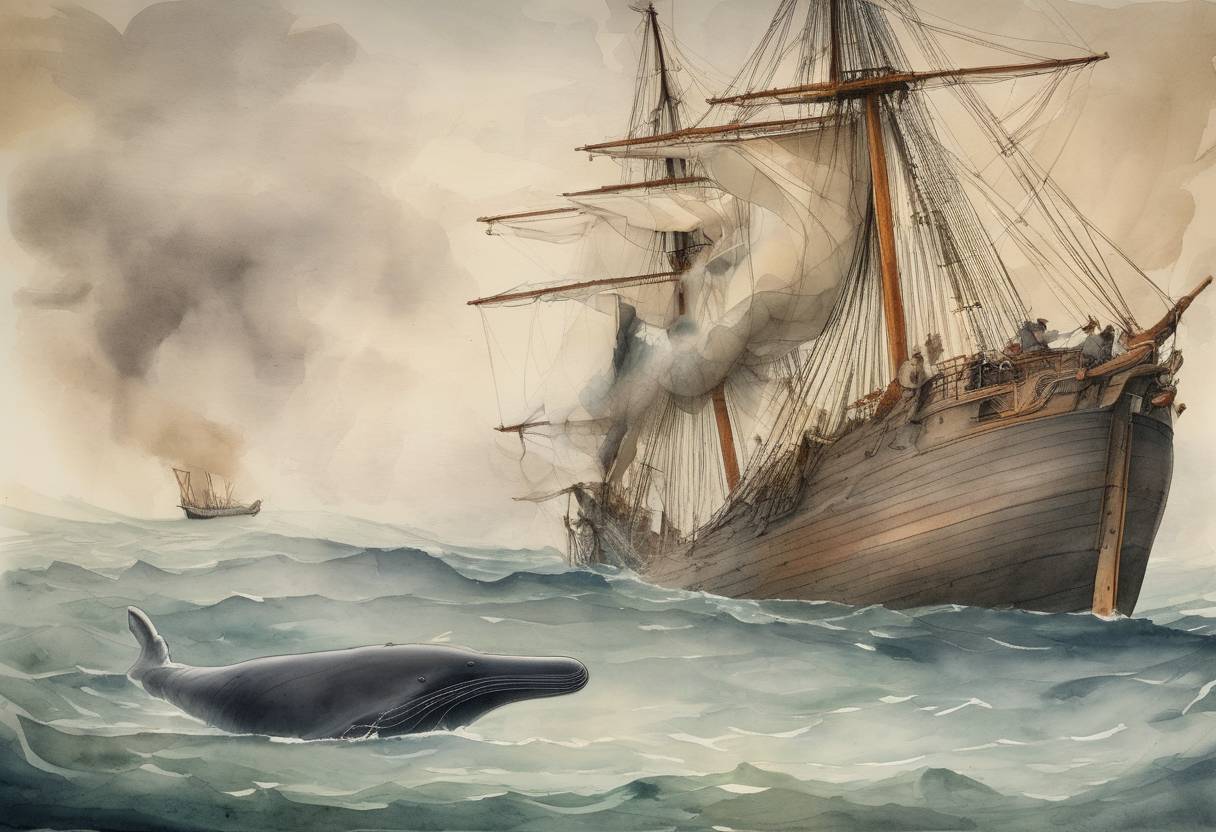
On November 20, 1820, a dramatic and catastrophic event unfolded in the Pacific Ocean that would later inspire one of the most famous novels in American literature. The whaleship Essex, hailing from Nantucket, Massachusetts, was attacked and sunk by a massive sperm whale, an incident that would become a pivotal moment in maritime history and serve as the inspiration for Herman Melville’s “Moby-Dick.”
The Essex was a 238-ton whaling ship that set sail from Nantucket on August 12, 1819, under the command of Captain George Pollard Jr. The ship’s mission was to hunt sperm whales in the Pacific Ocean, a lucrative but perilous endeavor during the height of the American whaling industry. The crew consisted of 21 men, including first mate Owen Chase and cabin boy Thomas Nickerson.
On the fateful day of November 20, 1820, the Essex was approximately 2,000 nautical miles west of South America. The crew had already encountered several whales that day, and they were in the process of pursuing them when disaster struck. An enormous sperm whale, estimated to be about 85 feet long and weighing around 80 tons, rammed the ship twice. The first impact caused significant damage, but the second strike was catastrophic, breaking the ship’s hull and causing it to take on water rapidly.
With the Essex sinking, the crew was forced to abandon ship and take refuge in the ship’s three small whaleboats. The men faced dire circumstances, adrift in the vast Pacific Ocean with limited supplies. Over the following weeks, they endured starvation, dehydration, and exposure. In a desperate bid for survival, the crew resorted to cannibalism, a grim reality that haunted the survivors.
Eventually, after more than three months at sea, the remaining crew members were rescued. The first mate, Owen Chase, and two others were picked up by the British ship Indian, while Captain Pollard and another crewman were rescued by the American ship Dauphin. In total, only eight of the original 21 crew members survived the ordeal.
The harrowing tale of the Essex became widely known, largely due to the accounts written by Owen Chase and Thomas Nickerson. Chase’s narrative, “Narrative of the Most Extraordinary and Distressing Shipwreck of the Whale-Ship Essex,” published in 1821, provided a detailed account of the tragedy and its aftermath.
Herman Melville, who worked on whaling ships himself, was deeply influenced by the story of the Essex. In 1851, he published “Moby-Dick,” a novel that explores themes of obsession, revenge, and the destructive power of nature, with Captain Ahab’s relentless pursuit of the white whale echoing the real-life events of the Essex.
The sinking of the Essex remains a poignant reminder of the perils faced by whalers in the 19th century and continues to captivate the imagination of readers and historians alike.
Source: en.wikipedia.org