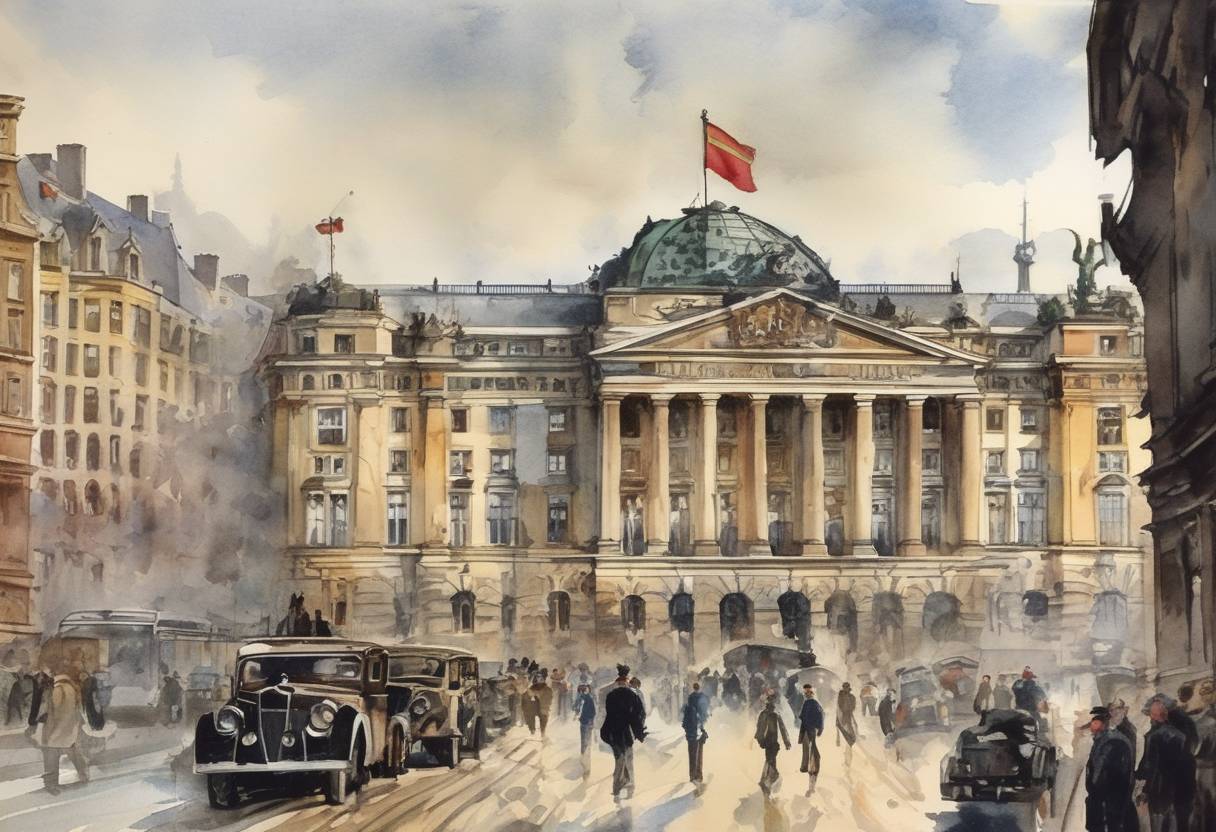
Abolition of the State of Prussia - February 25, 1947
On February 25, 1947, the Allied Control Council officially abolished the State of Prussia, marking the end of a significant historical entity in Germany. This decision was formalized through Control Council Law No. 46, which declared the dissolution of Prussia, citing its historical association with militarism and reactionary politics as a justification for its abolition.
Historical Context
Prussia had been a dominant force in German and European politics for centuries. Established as a duchy in 1525 and later becoming a kingdom in 1701, Prussia played a crucial role in the unification of Germany in 1871 under the leadership of Otto von Bismarck. The Kingdom of Prussia was the largest and most influential state within the German Empire, and its militaristic and bureaucratic traditions significantly shaped German national identity.
Key Events Leading to Abolition
World War I and the Weimar Republic: Following Germany’s defeat in World War I, the German Empire was dismantled, and the Weimar Republic was established. Prussia continued to exist as a state within the republic, but its power was significantly reduced.
Nazi Era: During the Nazi regime, Prussia’s administrative structures were further eroded as the Nazis centralized power. Hermann Göring, a prominent Nazi official, was appointed as the Prussian Minister-President, effectively integrating Prussian governance into the Nazi state apparatus.
World War II Aftermath: After Germany’s defeat in World War II, the Allied powers sought to dismantle the structures that had supported German militarism and expansionism. Prussia, with its historical association with these elements, was a primary target for dissolution.
The Abolition
The Allied Control Council, composed of representatives from the United States, the Soviet Union, the United Kingdom, and France, issued Control Council Law No. 46 on February 25, 1947. The law stated:
“The Prussian State, which from early days has been a bearer of militarism and reaction in Germany, has de facto ceased to exist. Guided by the interests of maintaining peace and security of peoples, the Allied Control Council enacts as follows: Article I. The Prussian State together with its central government and all its agencies are abolished.”
Aftermath and Significance
Territorial Changes: The territories that once comprised Prussia were divided among several countries. Parts of eastern Prussia were annexed by Poland and the Soviet Union, while the western regions were integrated into the newly reorganized German states.
Impact on German Federalism: The abolition of Prussia paved the way for a restructured German federal system. The Federal Republic of Germany (West Germany), established in 1949, was organized into smaller federal states (Länder), none of which held the dominance Prussia once did.
Historical Legacy: The dissolution of Prussia marked the end of an era in German history. While Prussia’s legacy in terms of culture, architecture, and historical influence remains, its political and military structures were dismantled to prevent the resurgence of militarism in post-war Germany.
The abolition of Prussia was a significant step in the Allies’ efforts to reshape Germany and ensure a peaceful and democratic future for the country.