The Battle of Fiorenzuola: March 16, 934
934 · Fiorenzuola, Italy
The Battle of Fiorenzuola took place between the forces of King Hugh of Italy and those of the rebellious Margrave of Ivrea, Berengar II.
August 15, 0927
The Saracens capture and sack the city of Taranto in Southern Italy, part of their ongoing raids and incursions into the Italian Peninsula during the 10th century.
Taranto, Italy | Saracens
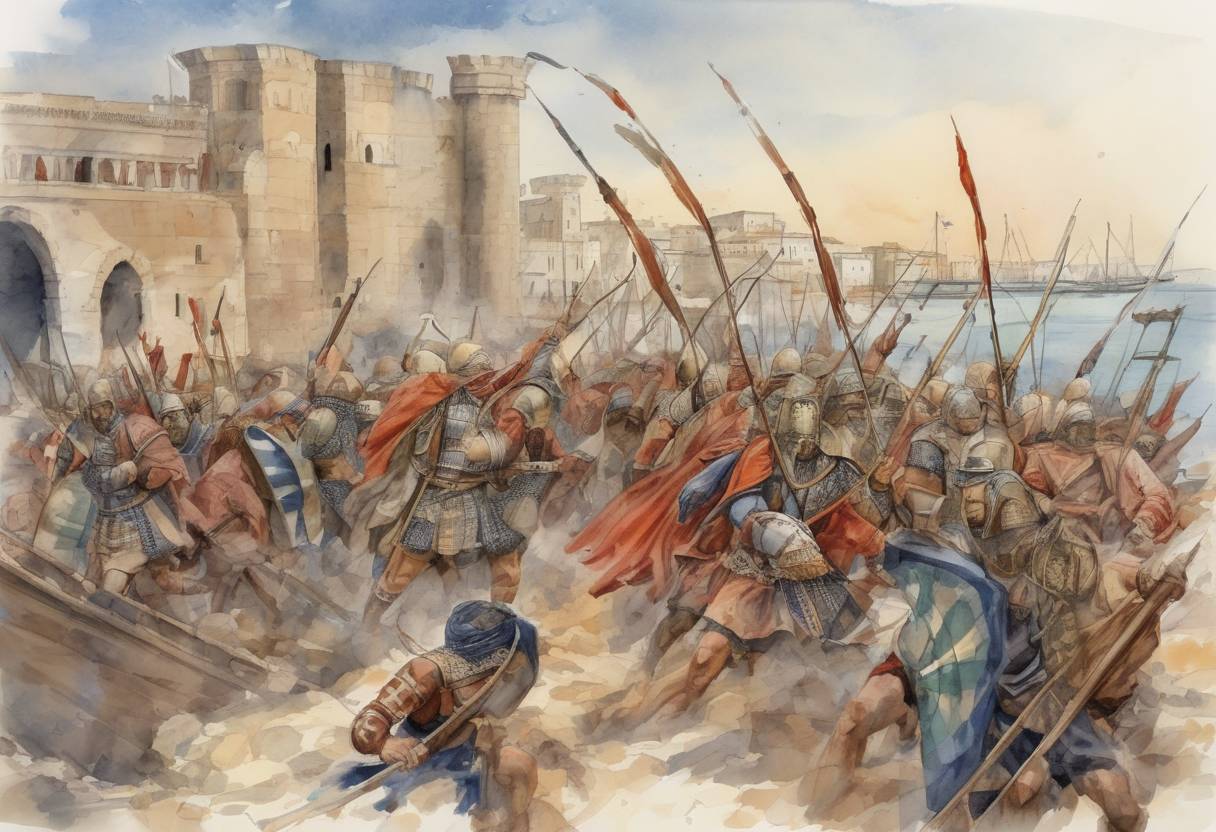
On August 15, 927, the city of Taranto in Southern Italy fell to the Saracens, marking a significant event in the series of raids and incursions that characterized the 10th-century Mediterranean landscape. This event is a part of the broader context of Saracen activities in the Italian Peninsula during this period.
The Saracens, a term used in medieval Europe to refer to Muslim Arabs, were active in the Mediterranean from the 7th century onwards. By the 9th and 10th centuries, they had established bases in Sicily and Southern Italy, from which they launched raids into the Italian mainland. These incursions were part of their efforts to expand influence and control trade routes across the Mediterranean.
Taranto, a strategically significant port city located on the Ionian Sea, was a prime target for the Saracens. Its capture on August 15, 927, was a result of the Saracens’ strategic planning and military prowess. The city’s fall was not an isolated incident but part of a series of attacks that saw the Saracens exerting pressure on the Italian Peninsula.
The sack of Taranto had several immediate and long-term consequences:
The capture of Taranto by the Saracens is emblematic of the broader geopolitical dynamics of the Mediterranean during the 10th century. It highlights the challenges faced by European territories in defending against well-organized and strategically adept adversaries. Moreover, it reflects the complex interactions between different cultures and the shifting power dynamics of the medieval world.
In conclusion, the fall of Taranto on August 15, 927, serves as a reminder of the turbulent history of Southern Italy and the enduring impact of the Saracen presence in the region.
Source: en.wikipedia.org