Dissolution of the Soviet Union: December 31, 1991
1991 · Moscow, Soviet Union
The Soviet Union was officially dissolved, marking the end of the Cold War and the beginning of a new era in Eastern Europe and Central Asia.
January 31, 1990
The first McDonald's in the Soviet Union opens in Moscow, symbolizing the thawing of Cold War tensions.
Moscow, Soviet Union | McDonald's Corporation
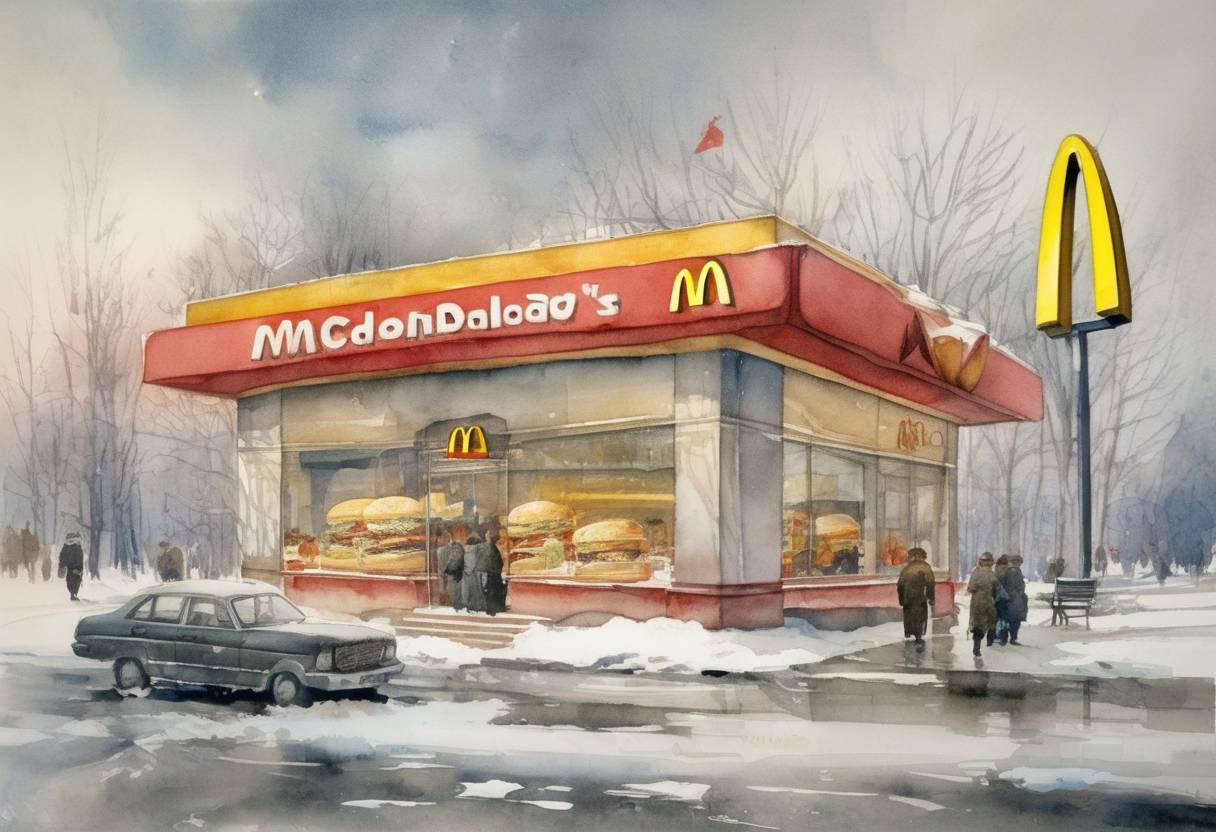
On January 31, 1990, a significant cultural and economic event took place in Moscow, marking a symbolic moment in the thawing of Cold War tensions: the opening of the first McDonald’s in the Soviet Union. This event was not just about the introduction of a fast-food chain; it represented broader shifts in international relations and economic policies.
Cold War Era: The Cold War, a period of geopolitical tension between the Soviet Union and the United States along with their respective allies, had been ongoing since the end of World War II. By the late 1980s, however, the Soviet Union was undergoing significant changes under the leadership of Mikhail Gorbachev, who introduced policies of glasnost (openness) and perestroika (restructuring) aimed at reforming the Soviet political and economic system.
Economic Reforms: These reforms were part of an effort to revitalize the Soviet economy, which was struggling with inefficiencies and stagnation. Opening the economy to foreign businesses was seen as a way to bring in new ideas, technologies, and investments.
Location and Scale: The first McDonald’s was opened in Pushkin Square, Moscow. It was the largest McDonald’s in the world at the time, with seating for 700 people inside and 200 outside.
Public Reception: The opening attracted enormous attention, with thousands of people lining up to experience the American fast-food phenomenon. On the first day alone, the restaurant served over 30,000 customers, a testament to the curiosity and enthusiasm of the Soviet public.
Symbolism: The event was symbolic of the easing tensions between the East and West. It represented a cultural exchange and a step towards greater openness and cooperation. For many, it was a tangible sign of the changing times and the potential for improved relations between the superpowers.
Economic Impact: The success of McDonald’s in Moscow paved the way for other Western businesses to enter the Soviet market, contributing to the gradual integration of the Soviet economy into the global market.
Cultural Influence: The presence of McDonald’s and other Western brands introduced new cultural elements to Soviet society, influencing tastes, lifestyles, and consumer habits.
Historical Significance: The opening of McDonald’s in Moscow is often cited as a milestone in the decline of the Cold War, illustrating the power of cultural diplomacy and economic engagement in bridging ideological divides.
In summary, the opening of McDonald’s in Moscow on January 31, 1990, was more than just a business venture; it was a landmark event that symbolized the beginning of a new era in East-West relations, highlighting the potential for peaceful coexistence and mutual benefit through cultural and economic exchange.
Source: en.wikipedia.org