Creation of a Synthetic Yeast Chromosome: A Milestone in Synthetic Biology
2013 · New York, United States
Scientists announce the creation of a synthetic yeast chromosome, a significant step in synthetic biology.
May 16, 1960
Theodore Maiman operates the first laser at Hughes Research Laboratories in Malibu, California.
Malibu, United States | Hughes Research Laboratories
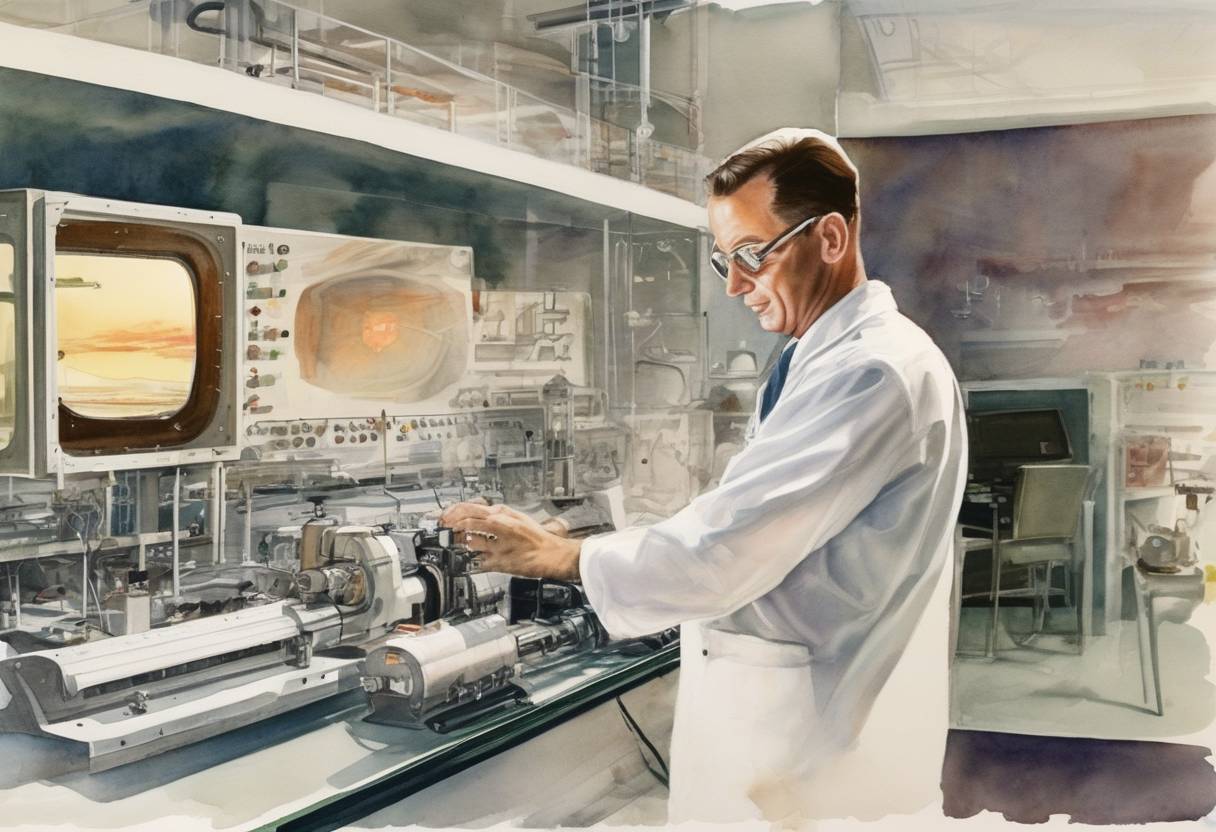
On May 16, 1960, Theodore Maiman successfully operated the first laser at Hughes Research Laboratories in Malibu, California. This groundbreaking event marked a pivotal moment in the field of optics and photonics, laying the foundation for numerous technological advancements that followed.
The concept of the laser, which stands for “Light Amplification by Stimulated Emission of Radiation,” was first theorized by Albert Einstein in 1917. However, it wasn’t until the mid-20th century that scientists began to explore practical applications of this theory. Prior to Maiman’s achievement, other researchers, including Charles Townes and Arthur Schawlow, had developed the maser, a similar device that amplified microwaves instead of visible light.
Theodore Maiman’s laser was constructed using a synthetic ruby crystal as the gain medium. He chose ruby because of its ability to produce a bright red light when stimulated. The setup involved a flashlamp that surrounded the ruby rod, providing the necessary energy to excite the atoms within the crystal. When these atoms returned to their ground state, they emitted photons, which were then amplified through stimulated emission, producing a coherent beam of light.
Maiman’s successful operation of the laser demonstrated the feasibility of creating a device that could emit a concentrated beam of light with high precision and intensity. This innovation opened up a myriad of possibilities across various fields, including:
Theodore Maiman’s achievement was initially met with skepticism by some in the scientific community, but it quickly gained recognition as the significance of the laser became apparent. Maiman’s work earned him numerous accolades, and he continued to contribute to the field of laser technology throughout his career.
The development of the laser is considered one of the most important technological advancements of the 20th century, with its impact continuing to grow as new applications are discovered. Maiman’s pioneering work laid the groundwork for innovations that have transformed industries and improved countless aspects of daily life.
In summary, the operation of the first laser by Theodore Maiman on May 16, 1960, was a landmark event that not only validated theoretical predictions but also ushered in a new era of technological progress and innovation.
Source: en.wikipedia.org