André-Jacques Garnerin's First Recorded Parachute Jump
1797 · Paris, France
André-Jacques Garnerin makes the first recorded parachute jump from a hot air balloon over Paris.
November 13, 1907
The first helicopter flight is made by Paul Cornu in Lisieux, France.
Lisieux, France | none
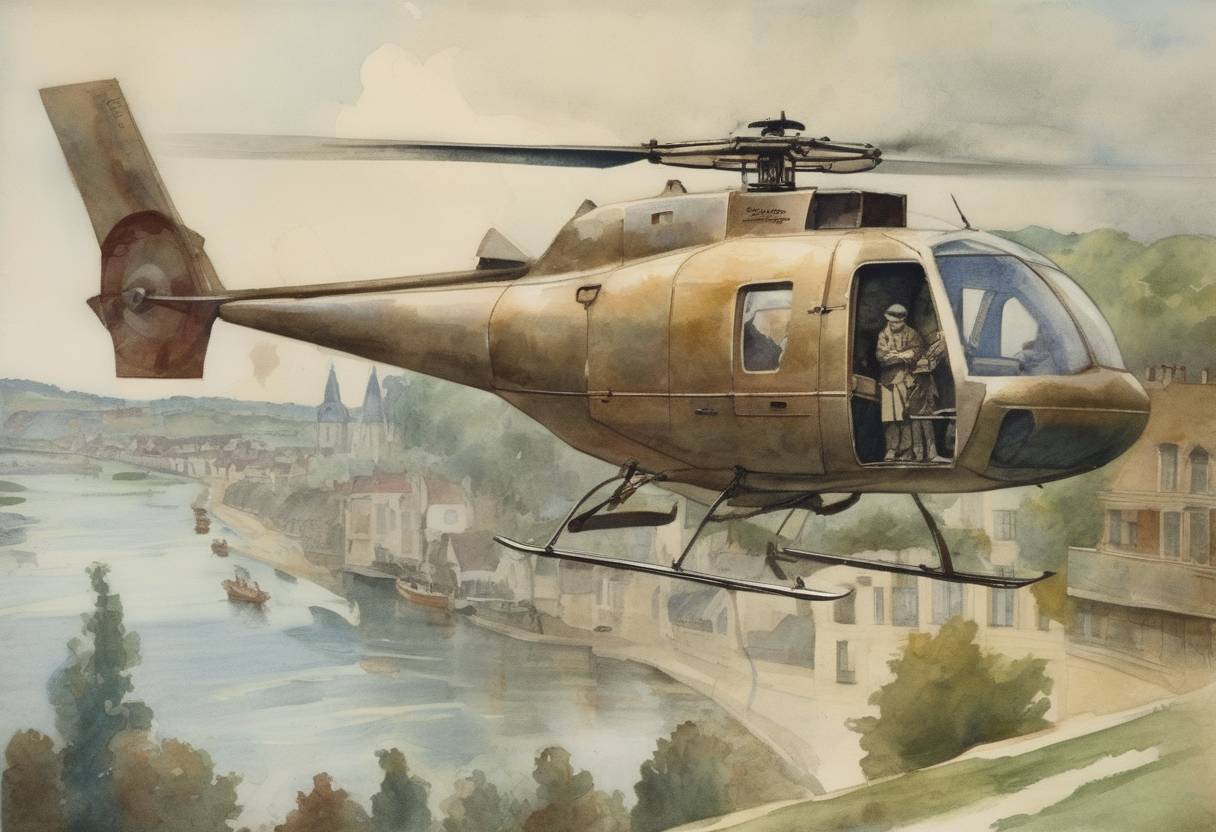
On November 13, 1907, a significant milestone in aviation history was achieved when Paul Cornu, a French engineer and inventor, conducted the first free flight of a rotary-wing aircraft, or helicopter, in Lisieux, France. This event marked a pivotal moment in the development of vertical flight technology.
Before Cornu’s achievement, the concept of vertical flight had intrigued inventors and engineers for centuries. The idea of a machine that could take off and land vertically, without the need for a runway, promised new possibilities for transportation and exploration. However, the technical challenges of achieving controlled, sustained flight with a rotary-wing aircraft were substantial.
Paul Cornu’s helicopter was a rudimentary design compared to modern standards. It featured:
Twin Rotors: The aircraft was equipped with two counter-rotating rotors, each measuring approximately 6 meters (20 feet) in diameter. This design was intended to counteract the torque effect that typically causes a single-rotor helicopter to spin uncontrollably.
Engine: The helicopter was powered by a 24-horsepower Antoinette engine, which was a notable engineering feat for its time, given the weight and power constraints.
Structure: The frame of the helicopter was constructed from lightweight materials to minimize weight and maximize lift.
On the day of the flight, Cornu’s helicopter managed to lift off the ground to a height of about 30 centimeters (approximately 1 foot) and remained airborne for around 20 seconds. Although the flight was brief and the altitude modest, it was a controlled, free flight without any tethers, distinguishing it from previous attempts.
Paul Cornu’s flight did not immediately lead to practical helicopter designs, as the technology and understanding of rotary-wing flight were still in their infancy. However, his successful demonstration provided valuable insights and inspiration for future inventors and engineers.
Technical Challenges: Cornu’s helicopter struggled with stability and control, issues that would take decades to resolve fully. These challenges highlighted the need for further research into rotor dynamics and control mechanisms.
Legacy: While Cornu’s design did not evolve into a practical aircraft, it laid the groundwork for subsequent developments in helicopter technology. Innovators like Igor Sikorsky and others would build upon these early experiments to create the first practical helicopters in the 1930s and 1940s.
In conclusion, Paul Cornu’s pioneering flight on November 13, 1907, represents a foundational moment in the history of aviation. It demonstrated the feasibility of rotary-wing flight and set the stage for the eventual development of helicopters as we know them today.
Source: en.wikipedia.org