Reopening of the Suez Canal: March 8, 1957
1957 · Suez, Egypt
Egypt reopened the Suez Canal after the Suez Crisis.
January 9, 1960
Construction work began on the Aswan High Dam in Egypt.
Aswan, Egypt | Egyptian Government
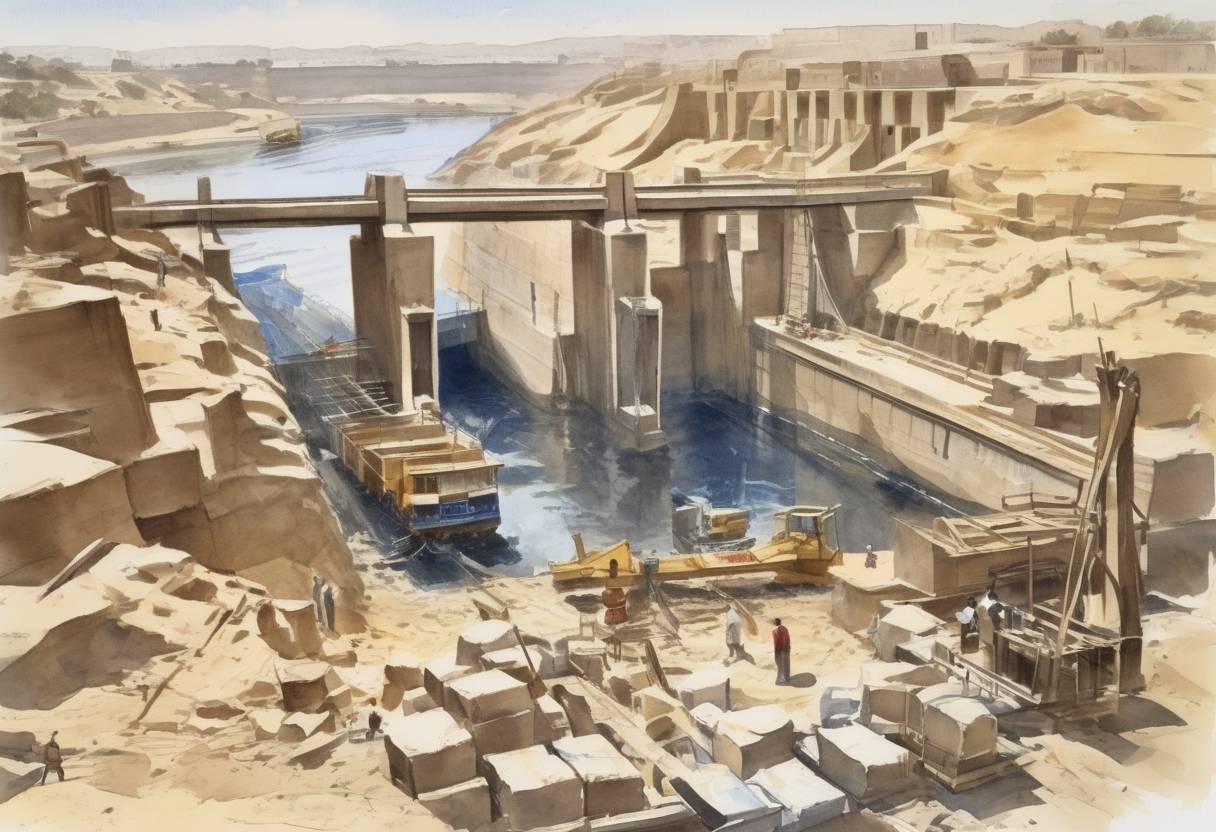
On January 9, 1960, construction work officially began on the Aswan High Dam in Egypt, marking a significant milestone in the country’s modern history. This monumental engineering project was designed to control the annual flooding of the Nile River, provide increased water storage for irrigation, and generate hydroelectric power to support Egypt’s growing industrial needs.
The idea of building a dam at Aswan dates back to the early 20th century, with the construction of the original Aswan Low Dam completed in 1902. However, as Egypt’s population and agricultural demands grew, the need for a more substantial solution became apparent. The Aswan High Dam was conceived as a means to harness the Nile’s resources more effectively.
1952 Egyptian Revolution: The revolution led by the Free Officers Movement, which included future president Gamal Abdel Nasser, resulted in the overthrow of the monarchy and the establishment of a republic. This political shift paved the way for ambitious national projects like the Aswan High Dam.
Funding and International Politics: Initially, the United States and the United Kingdom offered to finance the dam’s construction. However, geopolitical tensions, particularly Egypt’s growing ties with the Soviet Union and the nationalization of the Suez Canal in 1956, led to the withdrawal of Western financial support. Subsequently, the Soviet Union stepped in to provide funding and technical assistance.
Design and Engineering: The Aswan High Dam is a rock-fill dam with a core of cement and clay. It stretches approximately 3,830 meters (12,565 feet) across and stands 111 meters (364 feet) high. The reservoir created by the dam, Lake Nasser, is one of the largest man-made lakes in the world.
Construction Timeline: The construction of the dam took over a decade, with completion in 1970. It involved significant international collaboration, primarily between Egyptian and Soviet engineers and workers.
Economic and Social Benefits: The dam has been instrumental in providing a stable water supply for agriculture, increasing arable land, and generating hydroelectric power, which has been crucial for Egypt’s industrial development.
Environmental and Cultural Consequences: The creation of Lake Nasser led to the displacement of thousands of people, including the Nubian communities, and the submersion of numerous archaeological sites. Efforts were made to relocate some of these sites, most notably the temples of Abu Simbel.
Geopolitical Significance: The Aswan High Dam symbolized Egypt’s post-colonial aspirations and its ability to undertake large-scale projects independently. It also marked a period of closer ties between Egypt and the Soviet Union during the Cold War.
The Aswan High Dam remains a pivotal element in Egypt’s infrastructure, reflecting both the ambitions and challenges of modern nation-building. Its construction was a landmark event that reshaped the Nile’s landscape and had lasting implications for the region’s development.
Source: www.britannica.com