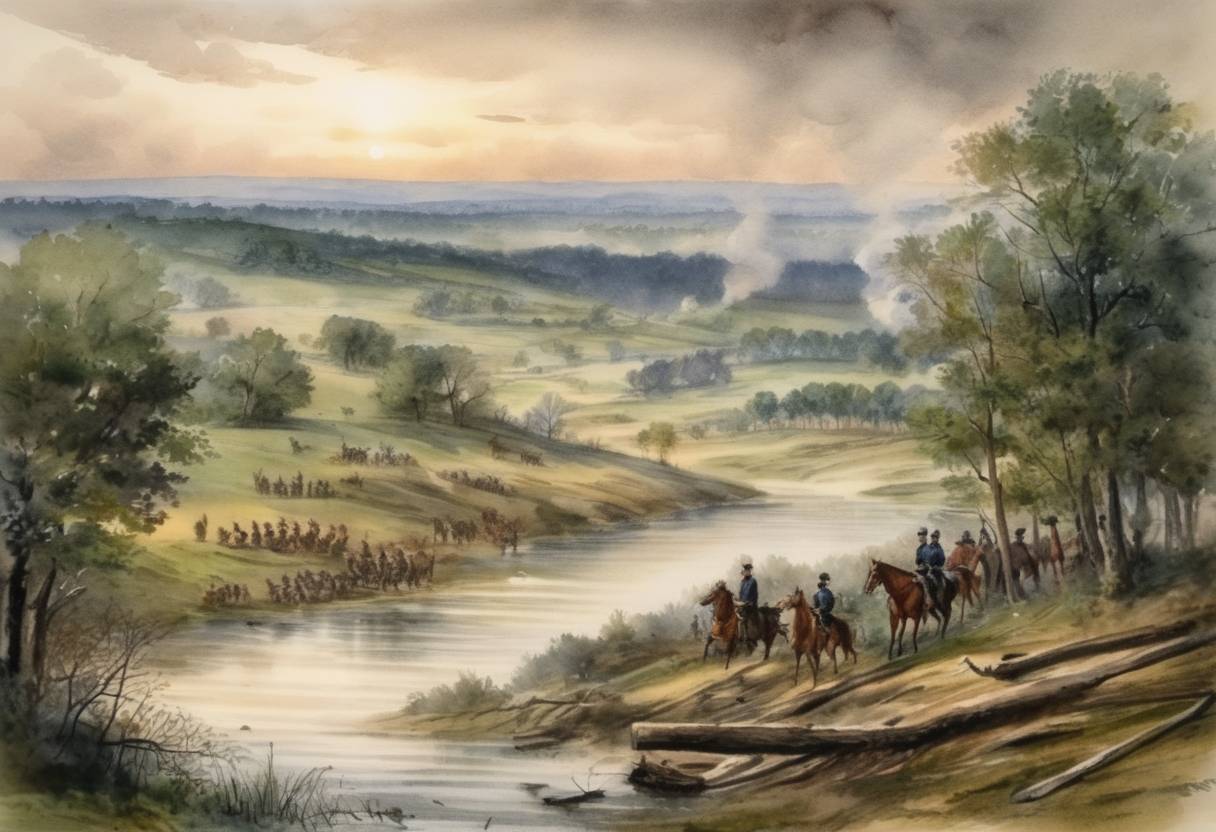
Battle of Wilson’s Creek (Battle of Oak Hills)
Date and Location
- Date: August 10, 1861
- Location: Near Springfield, Missouri
Context
The Battle of Wilson’s Creek, also known as the Battle of Oak Hills, was significant as the first major engagement in the Western Theater of the American Civil War. Command of the Western Theater was divided between Union and Confederate forces trying to gain control over the border state of Missouri, which was strategically crucial for both sides.
Prelude to the Battle
After the Union’s minor victory at the Battle of Boonville in June 1861, Union Brigadier General Nathaniel Lyon worked to secure Missouri for the Union. However, Confederate Brigadier General Ben McCulloch and Major General Sterling Price aimed to secure Missouri for the Confederacy, forming a sizable force with Price’s Missouri State Guard and McCulloch’s troops.
In July, Lyon had taken control of Springfield, but faced supply and manpower challenges. With an estimated 5,400 men, Lyon decided to make a preemptive strike against the larger Confederate force camped near Wilson’s Creek, numbering around 12,000 soldiers.
The Battle
Morning Attack
- Initial Strategy: On the early morning of August 10, 1861, Lyon divided his force. He attacked the Confederate camps along Wilson’s Creek with a surprise maneuver orchestrated by Lyon himself and a flanking maneuver by Colonel Franz Sigel.
- Lyon’s Push: The battle commenced at dawn with a bold attack by Lyon’s forces on the Confederate right flank and Sigel attacking the Confederate rear, which initially threw Confederate forces into confusion.
Midday Struggles
- Counterattacks: Though surprised, the Confederates under McCulloch and Price regrouped. A series of counterattacks pushed the Union forces back from key positions throughout the day, including “Bloody Hill”, where intense fighting occurred.
Casualties and Lyon’s Death
- Lyon’s Death: During the struggle on Bloody Hill, General Lyon, who had already been wounded twice that day, was killed while leading a counterattack. His death left Union forces demoralized and leaderless.
- Union Retreat: With mounting casualties and low ammunition, the demoralized Union troops began a retreat around mid-day. Sigel’s forces were scattered, and coordination broke down, forcing the Union to withdraw.
Outcome
Confederate Victory
- The battle ended in a Confederate victory, maintaining Southern control over southwestern Missouri.
Casualties
- Union casualties: Approximately 1,235
- Confederate casualties: Approximately 1,095
Significance
- Aftermath: While the Confederates didn’t pursue the retreating Union army immediately due to their own exhaustion and losses, the battle solidified Confederate control over southwestern Missouri for a significant period.
- Impact: The death of Lyon was a notable blow to Union morale. However, despite failing to secure Missouri entirely, the battle highlighted the fierce conflict brewing in the West, indicative of the greater struggles ahead in the Civil War’s Western Theater.
Broader Historical Impact
The Battle of Wilson’s Creek demonstrated the strategic importance of Missouri and set the stage for further engagements in the region. It underscored the complexities of wartime allegiance in border states and the severe human cost of maintaining control over these areas.