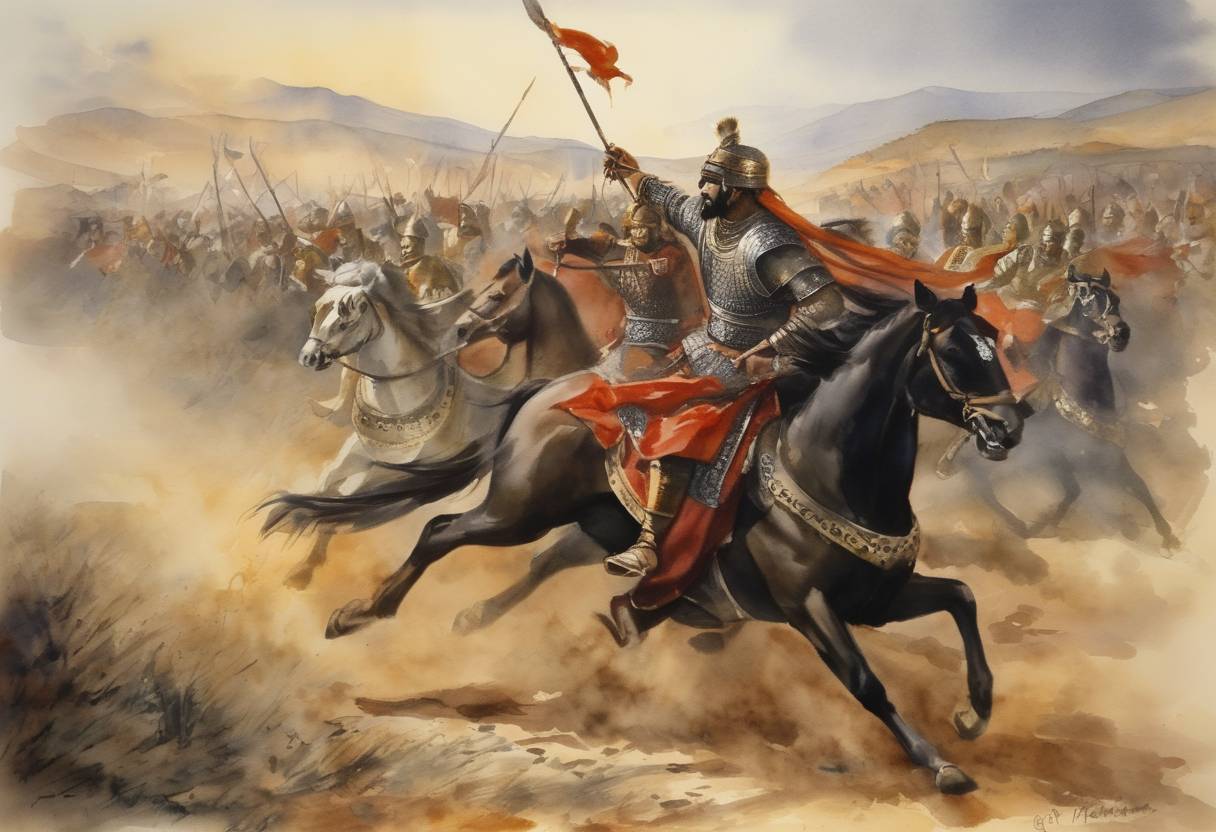
Battle of Gardman - November 2, 619
The Battle of Gardman occurred on November 2, 619, amid the prolonged Byzantine-Sassanian Wars, a series of conflicts between the Byzantine Empire and the Sassanid Empire. This battle was a critical confrontation that further tilted the balance of power in favor of the Sassanids during these hostilities.
Context
During the late 6th and early 7th centuries, the Byzantine Empire, under Emperor Heraclius, was engaged in a strenuous struggle with the Sassanid Empire, which had embarked on ambitious territorial expansions. Shah Khosrow II of the Sassanid Empire sought to capitalize on Byzantine internal disruptions and extend his domain across the Middle East and parts of Europe.
Lead-up to Battle
The Byzantine Empire, suffering from internal strife and the logistical difficulties of waging war on multiple fronts, faced a series of defeats prior to the Battle of Gardman. Its territories in the eastern provinces were under threat, with Persian forces advancing aggressively. The strategic importance of Gardman, located in the Caucasus region, was critical as it controlled several vital routes.
The Battle
On November 2, 619, the Sassanian army, well-supplied and reinforced, engaged Byzantine forces at Gardman. The Sassanians, utilizing their superior cavalry and tactical formations, overwhelmed the Byzantines. Despite the Byzantines’ efforts to hold their position, they were decisively defeated.
Aftermath
The victory at Gardman allowed the Sassanian Empire to consolidate its control over the Caucasus region and further expand into Byzantine territory. This defeat compelled Emperor Heraclius to reconsider his strategies and focus on regrouping his forces, which led to a resurgence in subsequent years. However, the loss at Gardman exemplified the considerable challenge the Byzantines faced against the might of the Sassanids.
Significance
The battle was a testament to the military prowess of the Sassanid army and the strategic challenges confronting the Byzantine Empire during this period. The outcome further strained Byzantine resources and underscored the empire’s vulnerability until Heraclius’s later successful campaigns. This conflict illustrated the dynamic geopolitical struggles of the era, contributing to shaping the historical landscape leading to future developments in both empires.