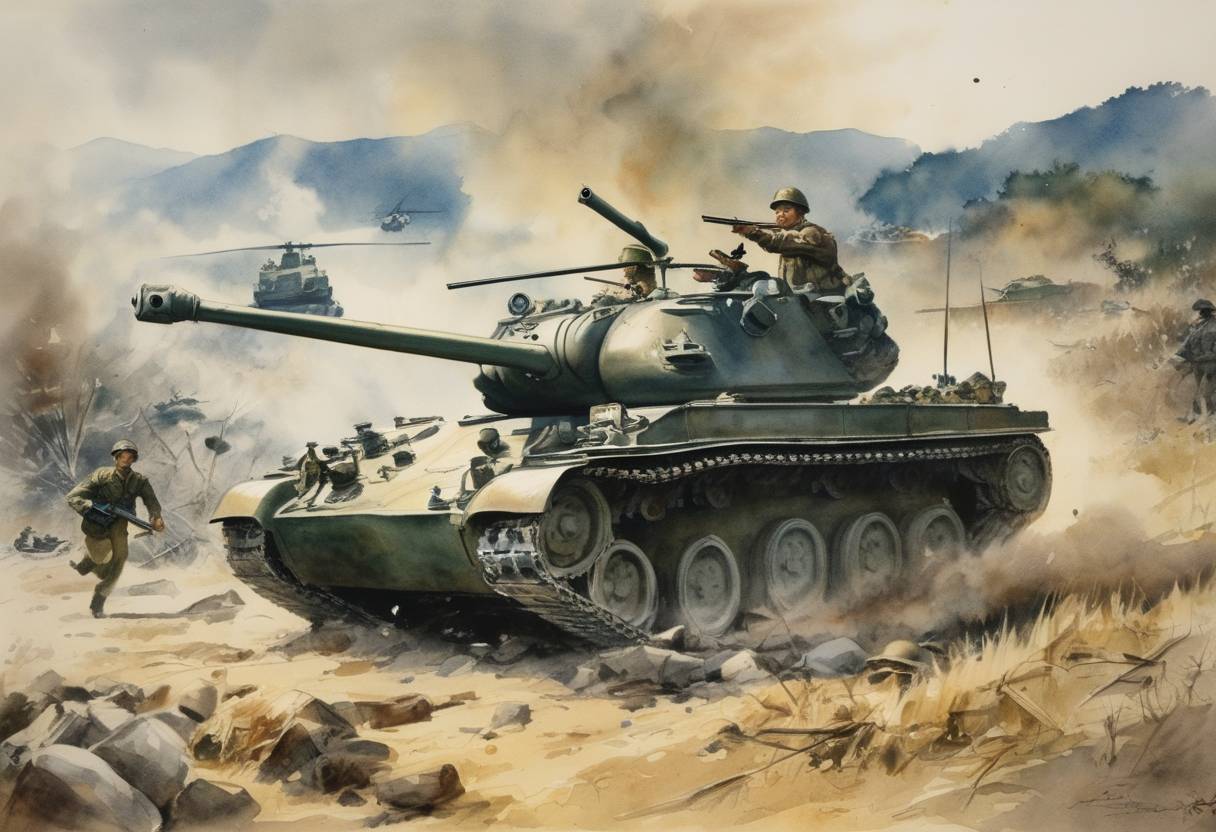
Battle of Osan - July 4, 1950
The Battle of Osan, fought on July 4, 1950, marks the first major American military engagement in the Korean War. It was an early encounter between United States forces and North Korean troops following the latter’s invasion of South Korea on June 25, 1950.
Background
After World War II, tensions on the Korean Peninsula escalated due to ideological divisions between the communist North and the capitalist South. The division solidified along the 38th parallel. On June 25, 1950, North Korean forces, equipped by the Soviet Union, advanced into South Korea, prompting a swift military and political response from the United States and United Nations allies who supported the South.
United States Involvement
President Harry S. Truman and the US leadership, concerned about the spread of communism in Asia, committed military support to South Korea. Task Force Smith, a hastily assembled unit predominantly consisting of American occupation troops stationed in Japan, was deployed under Lieutenant Colonel Charles B. Smith. The goal was to delay the advancing North Korean People’s Army (KPA) until reinforcements could arrive.
The Battle
On July 4, 1950, Task Force Smith took a defensive position near the town of Osan, approximately 30 kilometers south of Seoul. The force consisted of around 540 soldiers equipped with light weapons, limited artillery, and without antitank support, reflecting the challenges of rapid deployment.
Early in the morning, a North Korean advance guard approached, followed by the main force, including Soviet-made T-34 tanks. The lack of heavy anti-tank weaponry rendered the American forces ill-prepared to halt the armored assault. Despite employing their artillery and firing rockets, Task Force Smith could not effectively penetrate the tanks’ armor.
Outcome
The engagement lasted around seven hours. Overwhelmed by superior North Korean numbers and firepower, Task Force Smith attempted to hold back the KPA but was eventually forced to retreat. The unit incurred significant casualties, with about 60 men killed or wounded and dozens missing or captured.
Consequences
The Battle of Osan highlighted the challenges the US faced in halting the well-prepared North Korean advance. It underscored the need for increased military readiness and strategic planning. The defeat influenced subsequent military strategies and logistics, leading to a greater commitment of US and UN forces to the Korean Peninsula in a bid to stabilize the region.
Broader Historical Significance
The engagement signaled the intense nature of the conflict on the Korean Peninsula and laid bare the challenges of intervening in an unfamiliar terrain with inadequate preparation. The Battle of Osan remains a significant study in military strategy, early Cold War geopolitics, and the complexities of international military coalitions in volatile regions.