The Battle of Tangdao - December 15, 1161
1161 · Tangdao, China
The Battle of Tangdao took place, a naval conflict between the Song dynasty and the Jin dynasty.
August 19, 0295
The Battle of Lingbi took place during the War of the Eight Princes, a series of civil wars among the Jin dynasty princes in China. The battle was part of the larger conflict between the forces of Sima Ying and Sima Yong.
Lingbi, China | Jin Dynasty
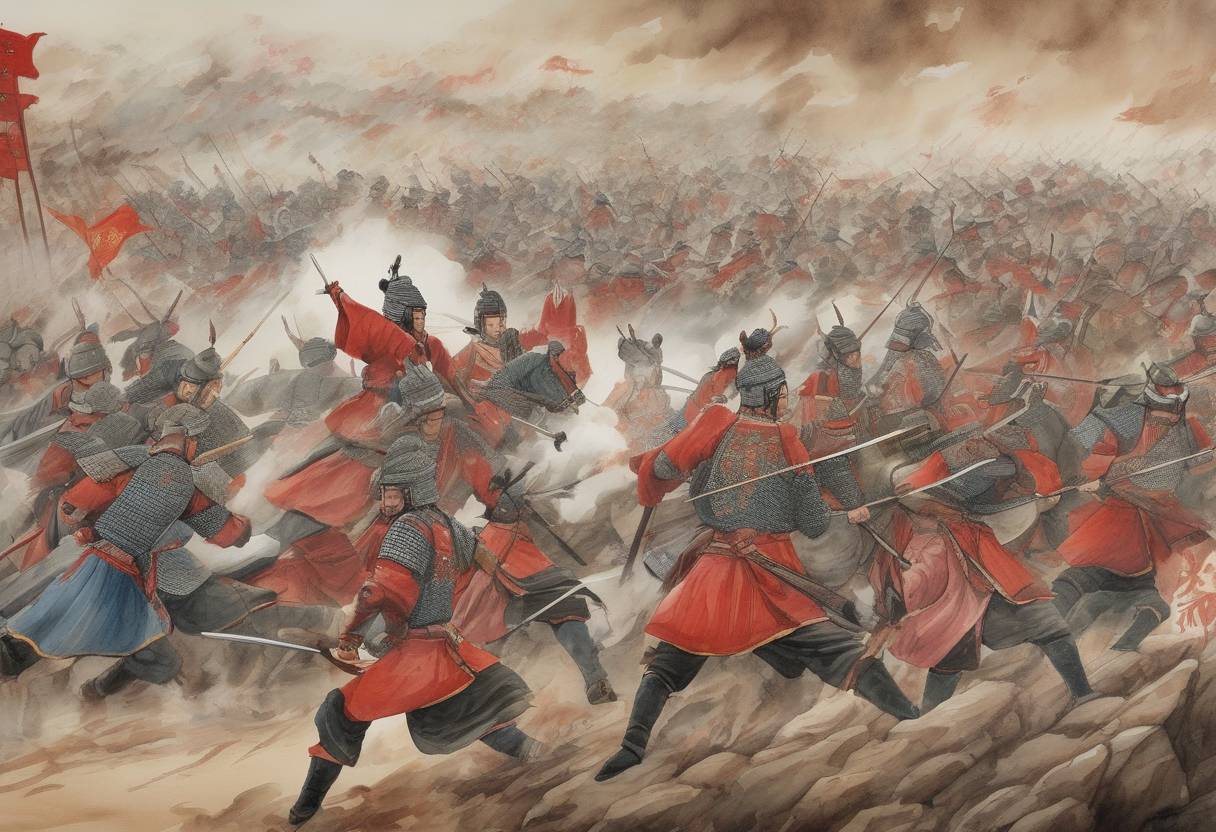
The Battle of Lingbi was a significant military engagement during the War of the Eight Princes, a tumultuous period of civil strife within the Jin Dynasty of China. This conflict, which unfolded on August 19, 295, was part of the larger power struggle between the forces of Sima Ying and Sima Yong, two of the prominent princes vying for control.
The War of the Eight Princes (291–306) was a series of civil wars among the ruling family of the Jin Dynasty, primarily driven by power struggles and political intrigue. The Jin Dynasty, established by the Sima family, was plagued by internal discord following the death of Emperor Wu of Jin. The central authority weakened, leading to a power vacuum that the princes sought to fill.
Sima Ying, the Prince of Chengdu, and Sima Yong, the Prince of Hejian, were two of the key figures in this conflict. Both princes commanded significant military forces and sought to assert their dominance over the Jin court and its territories.
The Battle of Lingbi was a direct confrontation between the armies of Sima Ying and Sima Yong. Lingbi, located in present-day Anhui Province, was strategically important due to its position and resources. The battle was characterized by its intensity and the strategic maneuvers employed by both sides.
Sima Ying’s Forces: Sima Ying had a strong military presence and was known for his tactical acumen. His forces were well-organized and motivated by the prospect of gaining control over the Jin Dynasty.
Sima Yong’s Forces: Sima Yong, on the other hand, was a formidable opponent with a reputation for strategic brilliance. His forces were equally determined to secure victory and expand their influence.
The Battle of Lingbi ended inconclusively, with neither side achieving a decisive victory. However, it significantly weakened both armies and contributed to the prolonged nature of the War of the Eight Princes. The battle exemplified the destructive nature of the civil wars, which drained resources and destabilized the Jin Dynasty.
The ongoing conflict among the princes eventually led to further fragmentation and set the stage for the eventual decline of the Jin Dynasty. The internal strife weakened the central authority, making it vulnerable to external threats, such as invasions by nomadic tribes.
The Battle of Lingbi and the broader War of the Eight Princes highlight the challenges of maintaining a unified empire in the face of internal power struggles. The civil wars not only disrupted the political landscape of the Jin Dynasty but also had long-lasting effects on Chinese history, contributing to the eventual fragmentation during the Sixteen Kingdoms period.
In summary, the Battle of Lingbi was a pivotal moment in the War of the Eight Princes, reflecting the intense rivalries and the complex dynamics of power within the Jin Dynasty.
Source: en.wikipedia.org