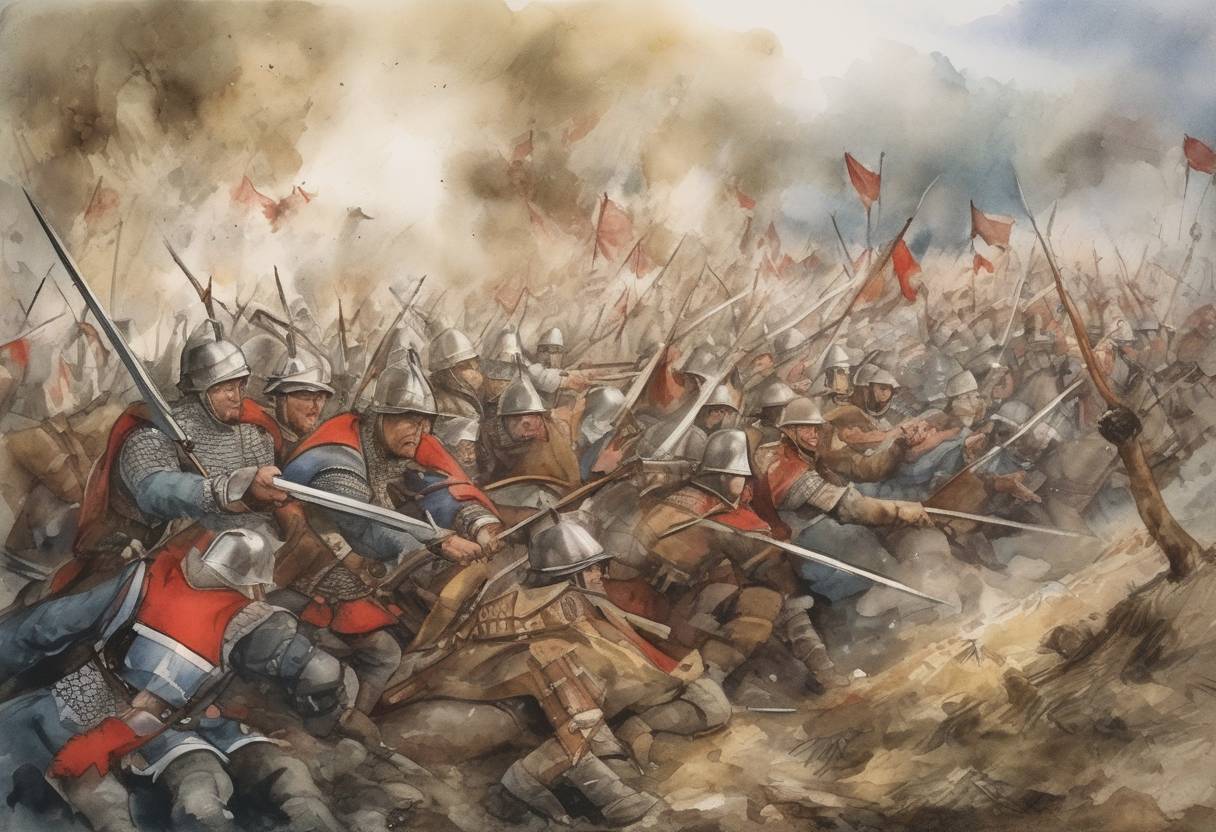
The Battle of Cedynia: June 24, 972
The Battle of Cedynia, fought on June 24, 972, marks a significant event in Polish history as the first documented battle involving the nascent Polish state. This confrontation was between the forces of Mieszko I, the Duke of Poland, and Odo I, Margrave of the Saxon Ostmark. The battle is a pivotal moment in the early consolidation of Polish territories and the assertion of Polish sovereignty.
Historical Context
Mieszko I: As the first historical ruler of Poland, Mieszko I played a crucial role in the formation of the Polish state. He belonged to the Piast dynasty and is credited with unifying various Slavic tribes under his rule. His reign marked the beginning of Poland’s integration into the broader European political and religious landscape, notably through his conversion to Christianity in 966.
Odo I: The Margrave of the Saxon Ostmark, Odo I, was a significant figure in the Holy Roman Empire’s eastern frontier. His role involved defending and expanding the empire’s borders, often leading to conflicts with neighboring Slavic tribes and emerging states like Poland.
Prelude to the Battle
The battle was primarily a result of territorial disputes and the expansionist policies of both Mieszko I and Odo I. The region of Pomerania, strategically important and rich in resources, was a focal point of contention. Mieszko’s efforts to consolidate control over Pomerania brought him into direct conflict with Odo, who sought to extend the influence of the Holy Roman Empire.
The Battle
Location: The battle took place near the town of Cedynia, located in present-day northwestern Poland, close to the Oder River.
Forces: Mieszko’s army comprised primarily of Polish warriors, while Odo’s forces included Saxon troops and possibly other allied contingents from the Holy Roman Empire.
Tactics and Outcome: Mieszko I employed strategic acumen to secure victory. Utilizing the terrain to his advantage, he orchestrated an ambush that caught Odo’s forces off guard. The Polish forces, possibly aided by Mieszko’s brother Czcibor, managed to rout the Saxon army, securing a decisive victory.
Aftermath and Significance
Consolidation of Power: The victory at Cedynia bolstered Mieszko I’s position both domestically and internationally. It affirmed his control over Pomerania and strengthened the nascent Polish state’s territorial integrity.
Diplomatic Relations: The battle’s outcome necessitated diplomatic negotiations between Mieszko I and Emperor Otto I of the Holy Roman Empire. These negotiations eventually led to a peace agreement, stabilizing relations between Poland and the empire.
Historical Legacy: The Battle of Cedynia is celebrated as a foundational moment in Polish history, symbolizing the emergence of Poland as a significant political entity in medieval Europe. It is often regarded as a testament to Mieszko I’s leadership and military prowess.
In conclusion, the Battle of Cedynia was a crucial event in the early history of Poland, reflecting the complex interplay of military, political, and diplomatic factors that shaped the medieval European landscape.