Establishment of the U.S. Department of Agriculture
1862 · Washington, D.C., United States
The U.S. Department of Agriculture was established by an act of Congress, signed into law by President Abraham Lincoln.
May 30, 1922
The Lincoln Memorial was dedicated in Washington, D.C. The monument honors Abraham Lincoln, the 16th President of the United States, and has become a symbol of American ideals.
Washington, D.C., United States | U.S. government
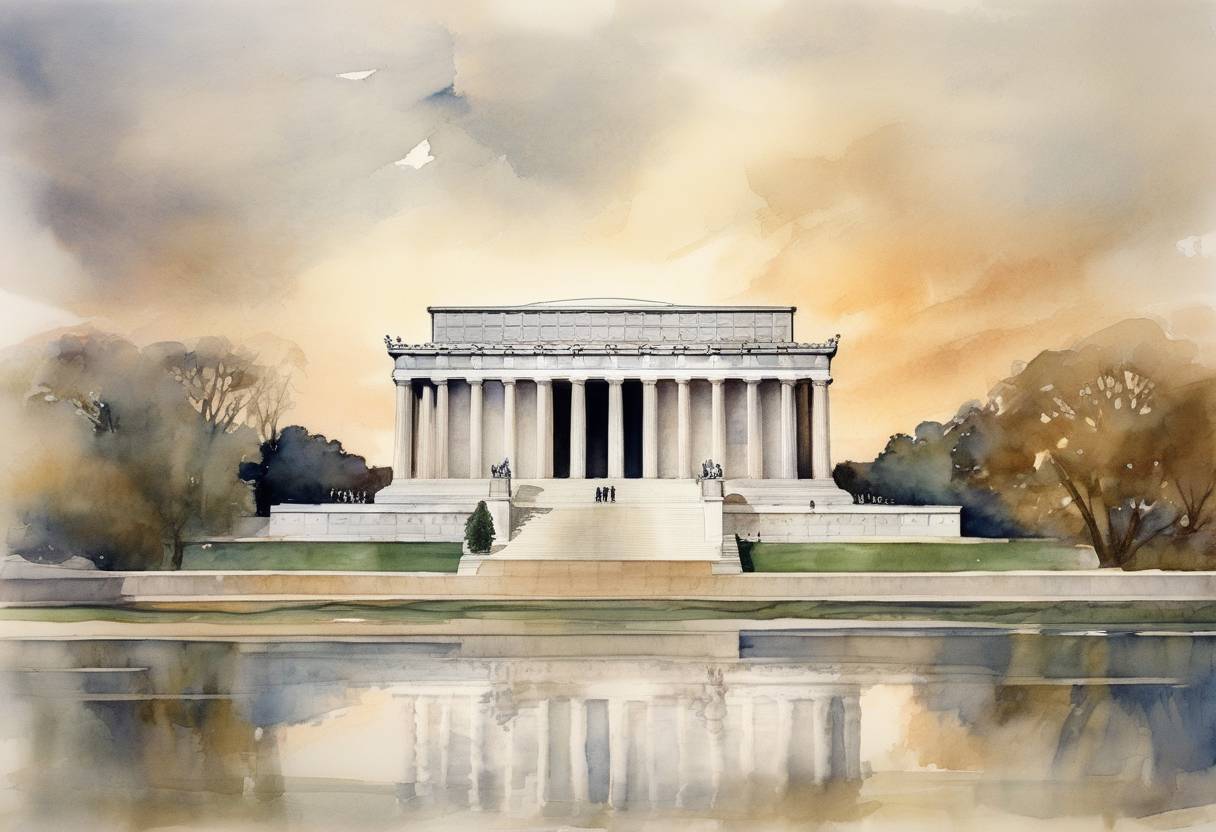
On May 30, 1922, the Lincoln Memorial was officially dedicated in Washington, D.C. This iconic monument honors Abraham Lincoln, the 16th President of the United States, and has since become a symbol of American ideals such as unity, freedom, and equality.
The idea for a national monument to Abraham Lincoln was conceived shortly after his assassination in 1865. However, it wasn’t until 1911 that Congress formally approved the project, establishing the Lincoln Memorial Commission to oversee its creation. The renowned architect Henry Bacon was selected to design the memorial, drawing inspiration from classical Greek architecture, specifically the Parthenon, to symbolize the democratic ideals Lincoln championed.
Construction began in 1914 and was completed in 1922. The memorial features a large seated sculpture of Lincoln, crafted by sculptor Daniel Chester French, which stands at 19 feet tall and is made of Georgia white marble. The statue is housed within a grand neoclassical temple, surrounded by 36 columns, each representing a state in the Union at the time of Lincoln’s death.
The dedication ceremony on May 30, 1922, was a significant event attended by thousands, including dignitaries, government officials, and members of the public. Chief Justice William Howard Taft, who served as the chairman of the Lincoln Memorial Commission, presented the memorial to President Warren G. Harding, who accepted it on behalf of the American people.
One of the most notable aspects of the dedication was the presence of Robert Todd Lincoln, Abraham Lincoln’s only surviving son, who was 78 years old at the time. The ceremony also featured a speech by Dr. Robert Russa Moton, the principal of the Tuskegee Institute, highlighting the ongoing struggle for racial equality—a poignant reminder of Lincoln’s legacy in the context of the racial segregation prevalent during that era.
The Lincoln Memorial has since become a powerful symbol of American ideals and a site for numerous historical events. It has been the backdrop for many significant moments in U.S. history, including the 1963 March on Washington for Jobs and Freedom, where Dr. Martin Luther King Jr. delivered his famous “I Have a Dream” speech.
The memorial continues to serve as a place of reflection and inspiration, reminding visitors of Lincoln’s enduring legacy and the principles he stood for. Its presence on the National Mall in Washington, D.C., alongside other monuments and memorials, underscores its importance in the American historical and cultural landscape.
Source: en.wikipedia.org