North Korea's Fourth Nuclear Test: January 5, 2016
2016 · Punggye-ri, North Korea
North Korea conducted its fourth nuclear test, claiming it was a successful hydrogen bomb test.
May 15, 1957
Britain tested its first hydrogen bomb on Malden Island in the Pacific Ocean, as part of Operation Grapple.
Malden Island, Kiribati | British Government
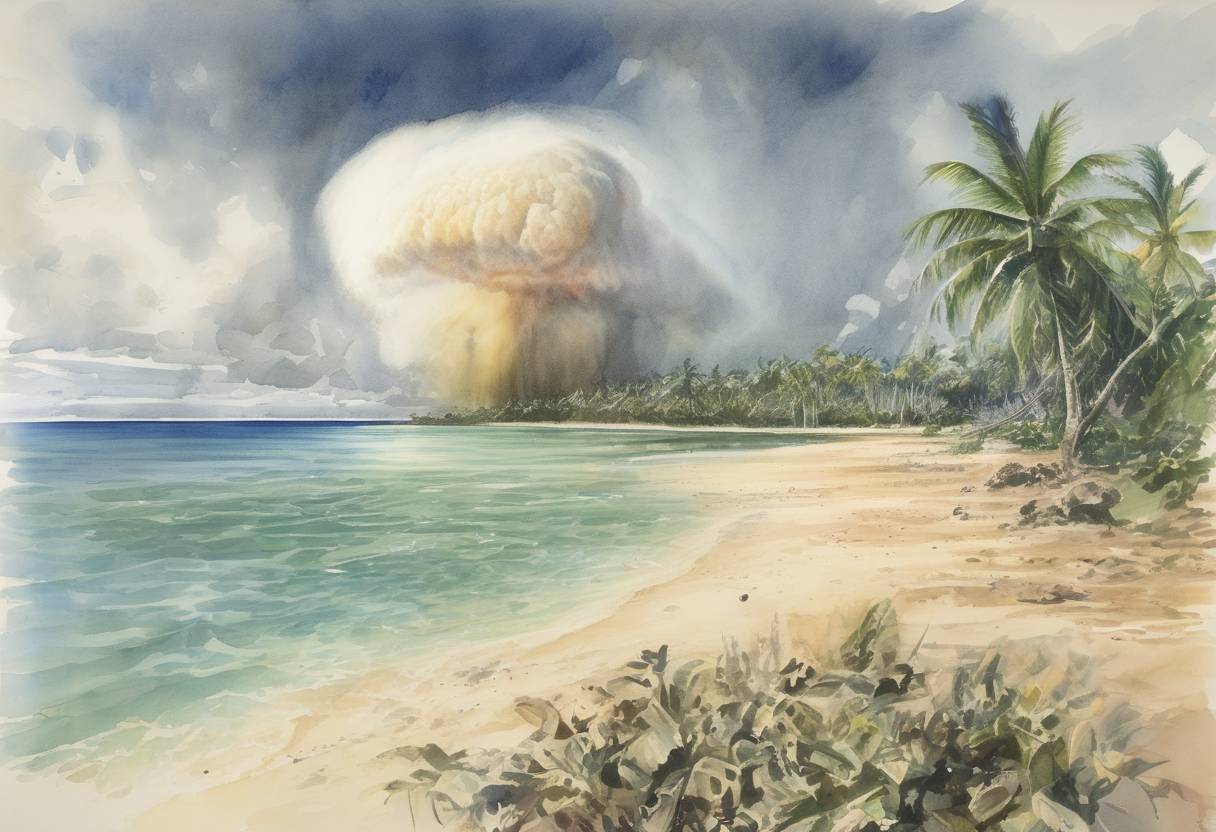
On May 15, 1957, the United Kingdom conducted its first successful hydrogen bomb test as part of Operation Grapple. This significant event took place on Malden Island, a remote and uninhabited atoll in the Pacific Ocean. The test marked a pivotal moment in Britain’s nuclear weapons program, establishing it as the third nation to develop and test a thermonuclear weapon, following the United States and the Soviet Union.
Post-WWII Nuclear Arms Race: After World War II, the geopolitical landscape was dominated by the Cold War, leading to an arms race between the superpowers. The United States had already demonstrated its nuclear capability with the bombings of Hiroshima and Nagasaki in 1945, and the Soviet Union tested its first atomic bomb in 1949.
British Nuclear Ambitions: The UK, determined to maintain its status as a global power, embarked on developing its own nuclear arsenal. The successful detonation of an atomic bomb in 1952 (Operation Hurricane) was a precursor to the more advanced hydrogen bomb tests.
Operation Grapple: Initiated in 1956, Operation Grapple was a series of nuclear tests aimed at developing a viable hydrogen bomb. The operation involved extensive planning and preparation, including the selection of Malden Island due to its isolation and suitability for testing.
Technical Challenges: Developing a hydrogen bomb posed significant scientific and engineering challenges. British scientists worked to overcome these hurdles, drawing on both domestic expertise and insights gained from collaboration with American counterparts prior to the McMahon Act, which restricted nuclear information sharing.
The Detonation: The test, codenamed Grapple 1, involved an air-dropped bomb from a Vickers Valiant bomber. The explosion yielded approximately 300 kilotons, significantly more powerful than earlier atomic bombs but less than initially anticipated for a full thermonuclear device.
Immediate Impact: Although the yield was lower than expected, the test was considered a success and demonstrated Britain’s capability to produce and deploy a hydrogen bomb. It was a crucial step in the UK’s strategy to maintain a credible nuclear deterrent.
Further Tests: Following the initial test, additional tests were conducted under Operation Grapple to refine and improve the design and yield of the hydrogen bomb. These tests continued until 1958.
International Reactions: The successful test reinforced Britain’s position in the nuclear club and had significant diplomatic implications, particularly in its relationship with the United States and within NATO.
Nuclear Policy: The development of a hydrogen bomb solidified the UK’s nuclear policy and its commitment to maintaining an independent nuclear deterrent, which continues to be a cornerstone of British defense strategy.
Operation Grapple and the successful hydrogen bomb test on May 15, 1957, underscored the intense competition of the Cold War era and the lengths to which nations would go to secure their strategic interests. It highlighted the technological advancements of the time and set the stage for ongoing debates about nuclear proliferation and disarmament that persist to this day.
Source: en.wikipedia.org