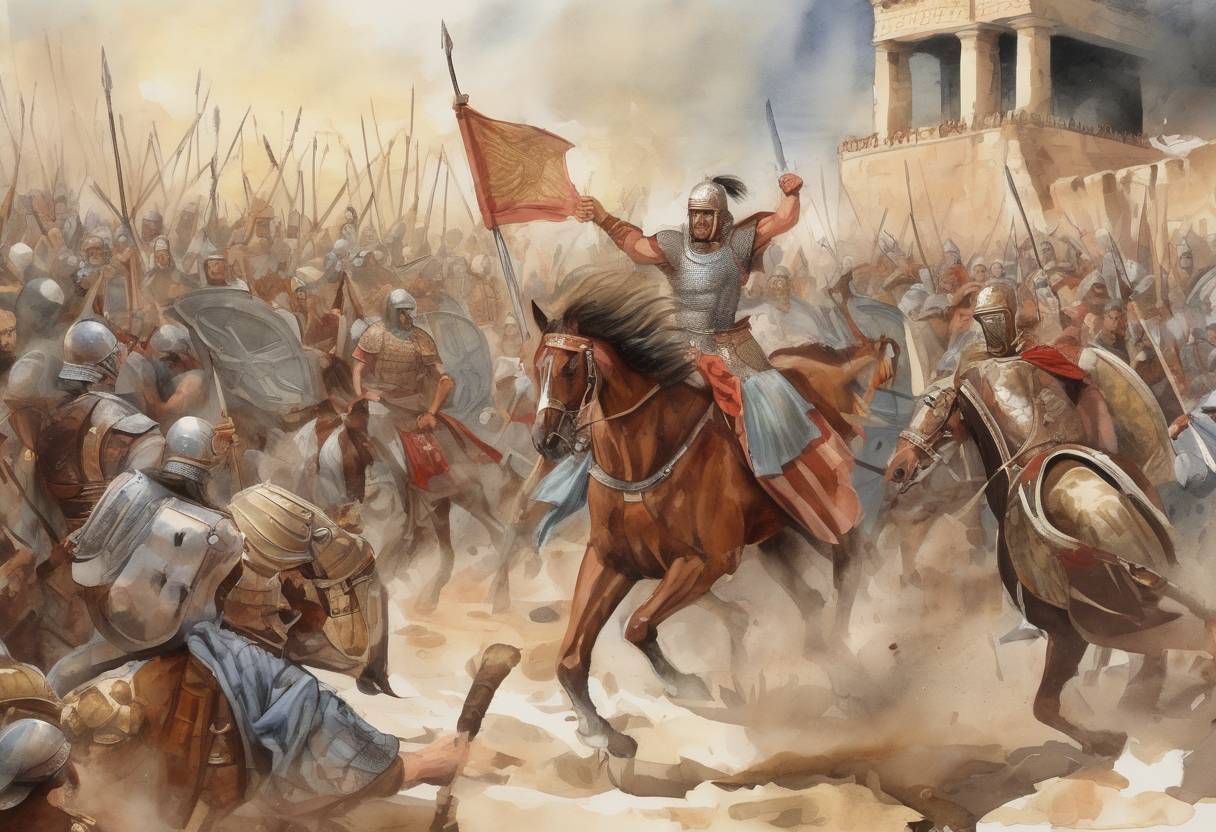
The Battle of Tricamarum: December 15, 533
On December 15, 533, the Byzantine general Belisarius achieved a decisive victory over the Vandals, led by King Gelimer, at the Battle of Tricamarum. This battle was a pivotal moment in the Byzantine Empire’s efforts to reclaim former Roman territories in North Africa and marked the effective end of the Vandal Kingdom.
Context and Background
The Vandal Kingdom: Established in North Africa after the Vandals crossed into the region from Spain in the early 5th century, the Vandal Kingdom had become a significant power. It included territories that are part of modern-day Tunisia and Algeria, with Carthage as its capital.
Byzantine Ambitions: The Byzantine Emperor Justinian I, who reigned from 527 to 565, was determined to restore the Roman Empire’s former glory. Part of his strategy involved reclaiming territories lost to various Germanic tribes, including the Vandals.
Prelude to Battle: Prior to Tricamarum, Belisarius had already secured a major victory at the Battle of Ad Decimum on September 13, 533, which allowed him to capture Carthage. This victory significantly weakened Vandal control and set the stage for the final confrontation at Tricamarum.
The Battle
Location: The battle took place near the town of Tricamarum, approximately 30 miles west of Carthage.
Forces Involved: Belisarius commanded a Byzantine force that, while smaller in number, was well-disciplined and strategically adept. The Vandals, under King Gelimer, were attempting to regroup and counter the Byzantine advance.
Battle Dynamics: The battle was characterized by a series of cavalry charges. The Byzantine cavalry, led by Belisarius’s trusted lieutenant John the Armenian, played a crucial role in breaking the Vandal lines. The disciplined Byzantine forces were able to exploit the disarray in the Vandal ranks, leading to a comprehensive victory.
Aftermath and Significance
End of the Vandal Kingdom: The defeat at Tricamarum effectively ended Vandal rule in North Africa. King Gelimer fled but was eventually captured in early 534.
Byzantine Gains: The victory allowed the Byzantine Empire to reassert control over North Africa, restoring it as a province of the empire. This conquest was a significant achievement in Justinian’s campaign to restore Roman territories.
Legacy: The fall of the Vandal Kingdom marked the beginning of the Byzantine Empire’s reconquest efforts, which would later extend to parts of Italy and the Western Mediterranean. It also demonstrated the effectiveness of Belisarius as a military commander and solidified his reputation as one of the greatest generals of the Byzantine Empire.
The Battle of Tricamarum stands as a testament to the strategic prowess of Belisarius and the ambitious vision of Emperor Justinian I, marking a turning point in the history of the Mediterranean region during the 6th century.