The Battle of Cerignola: A Turning Point in the Italian Wars
1503 · Cerignola, Italy
The Battle of Cerignola occurs, marking a significant turning point in the Italian Wars. Spanish forces under Gonzalo de Córdoba decisively defeat the French army.
July 25, 1467
The Battle of Molinella took place, considered one of the first battles in Italy where firearms were used extensively.
Molinella, Italy
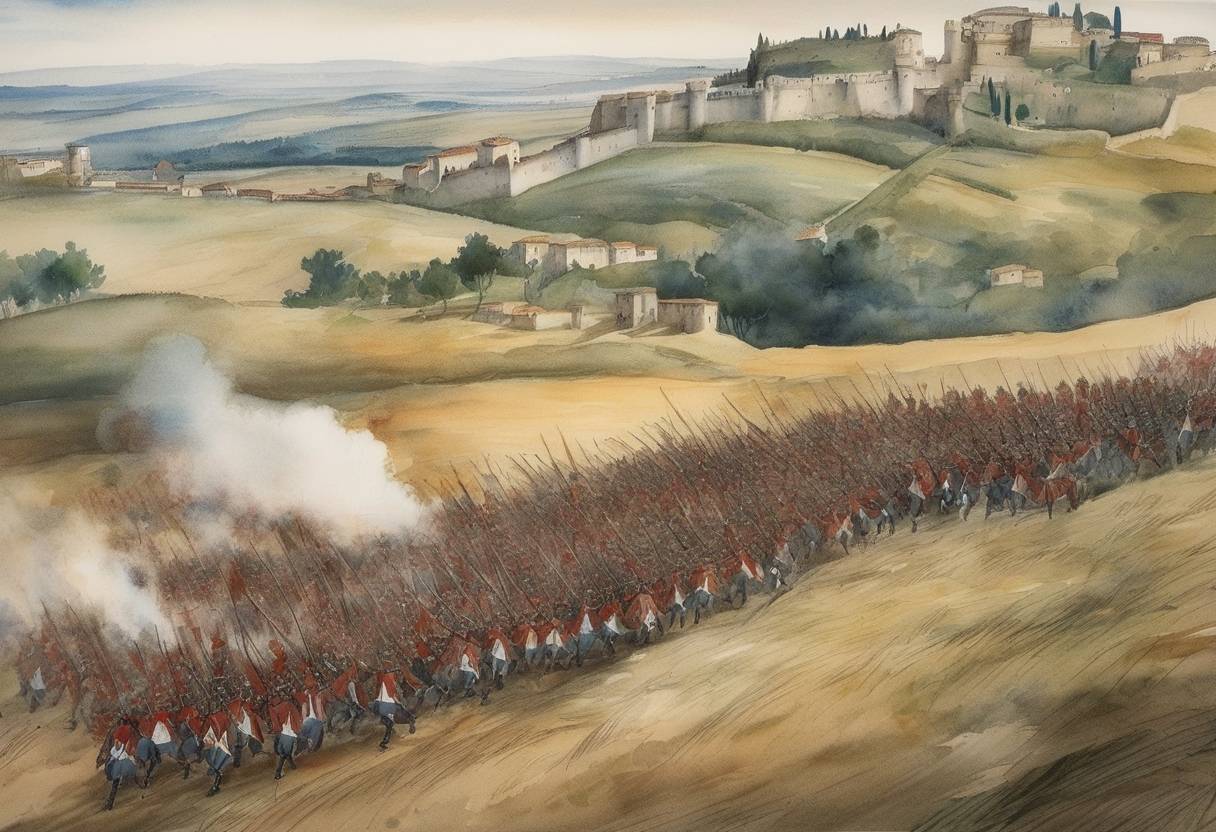
The Battle of Molinella, fought on July 25, 1467, is a significant military engagement in Italian history, noted for being among the first battles in the region where firearms played a major role. This battle was part of the broader conflict known as the Italian Wars, which were characterized by the power struggles among various Italian city-states and foreign powers vying for influence in the region.
The conflict leading to the Battle of Molinella involved the Quattrocento Italian politics, which included a delicate interplay of alliances and enmities among principalities. The battle pitted the forces of the Republic of Florence, led by the accomplished condottiero Bartolomeo Colleoni, against an alliance led by the Duke of Milan, Francesco Sforza, which included the Papal States and the Republic of Venice.
Colleoni, who was serving under the Venetian banners but had a history marked by shifting allegiances, led his forces in an attempt to assert Florentine interests and challenge Sforza’s hegemony in the region. The strategic objective was to control key territories and undermine opposing powers, thereby altering the balance of power within the Italian Peninsula.
One of the defining aspects of the Battle of Molinella was the extensive use of firearms. While artillery had gradually become a fixture of European warfare, the battle’s scale and reliance on gunpowder weapons marked a transition in military tactics, representing a movement away from traditional medieval methods of combat towards early modern warfare. Firearms began to supplement and, in some instances, replace traditional weaponry, setting precedents for future engagements.
The battle took place near the village of Molinella in the Emilia-Romagna region. Colleoni’s troops, bolstered by innovations in artillery and gunpowder usage, faced off against a similarly equipped Milanese military. Despite the challenging terrain and the complexity of executing coordinated assaults with the relatively new firearm technology, both sides engaged vigorously.
The battle ended inconclusively, with no decisive victor emerging from the fray. However, the use of firearms showcased the growing importance of technological advancements in warfare, influencing subsequent military confrontations across Europe. Furthermore, the inconclusive nature of the battle did little to resolve the underlying tensions and rivalries among the Italian states, which would continue to shape Italian and European politics for decades.
The widespread implementation of firearms and artillery at the Battle of Molinella and similar conflicts underscored the dawn of a new era in martial strategy, underscoring innovations that would eventually redefine the nature of warfare in Europe and beyond.