Avitus Proclaimed Emperor of the Western Roman Empire
455 · Toulouse, Western Roman Empire
The Roman military commander Avitus is proclaimed Emperor of the Western Roman Empire by the Visigoths after the assassination of Emperor Petronius Maximus.
May 15, 0392
Emperor Valentinian II is found dead in his residence in Vienne, Gaul, under suspicious circumstances. His death leads to political instability in the Western Roman Empire.
Vienne, Roman Empire (modern-day France) | Western Roman Empire
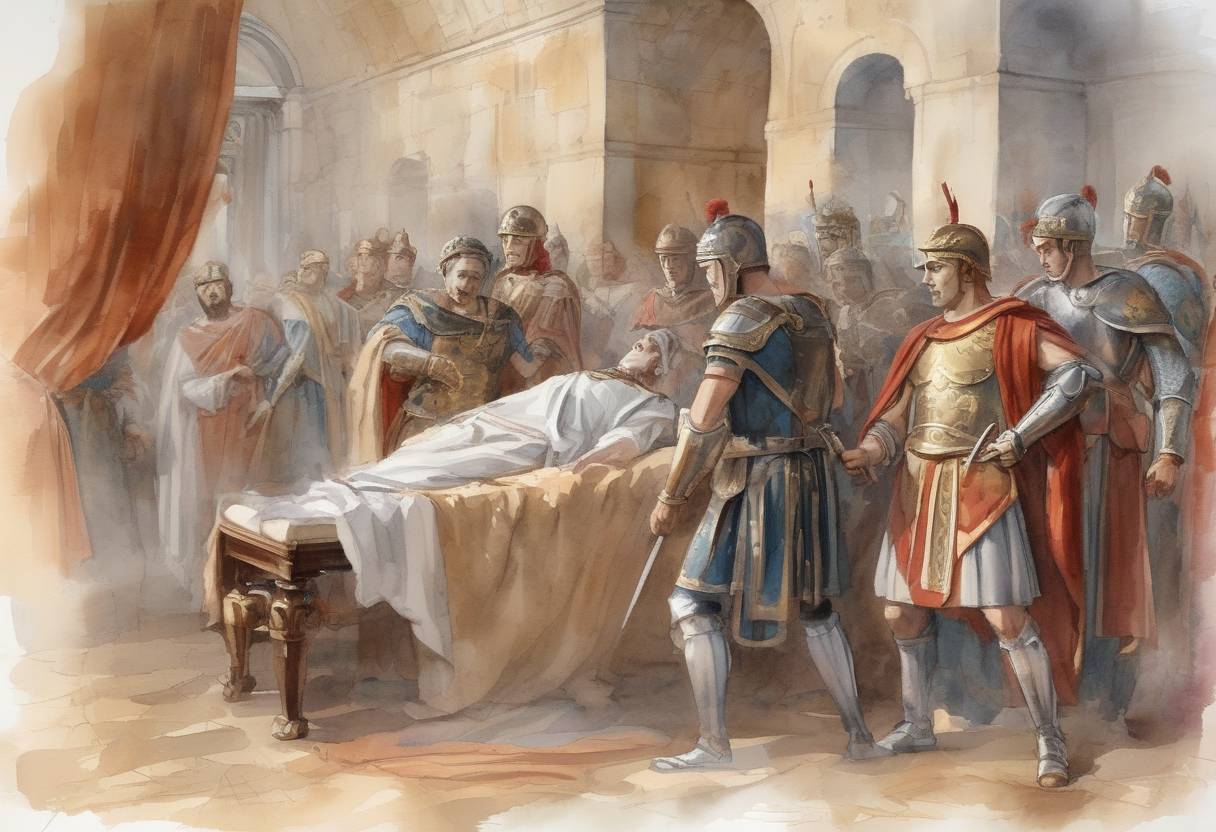
On May 15, 392, Emperor Valentinian II was found dead under suspicious circumstances in his residence in Vienne, Gaul. His untimely death at the age of 21 marked a significant turning point in the history of the Western Roman Empire, leading to a period of political instability and power struggles.
Valentinian II was born in 371, the son of Emperor Valentinian I and his second wife, Justina. He ascended to the throne in 375 at the tender age of four, following the sudden death of his father. Due to his youth, his reign was initially overseen by his mother and a series of regents, including the powerful general and statesman, Magnus Maximus, and later, the influential Frankish general, Arbogast.
Valentinian II’s death occurred under mysterious conditions. He was found hanging in his residence, leading to widespread speculation about the nature of his demise. While some sources suggest suicide, others imply foul play, possibly orchestrated by Arbogast, who had a contentious relationship with the young emperor. Arbogast had effectively sidelined Valentinian II, reducing him to a figurehead while he wielded real power.
The death of Valentinian II plunged the Western Roman Empire into chaos. Arbogast, lacking the legitimacy to claim the throne himself, installed Eugenius, a former teacher and bureaucrat, as emperor. This move was not recognized by Theodosius I, the Eastern Roman Emperor, who viewed Eugenius as a usurper.
The ensuing power struggle culminated in the Battle of the Frigidus in 394, where Theodosius I defeated the forces of Eugenius and Arbogast, reuniting the Roman Empire under his sole rule. This victory, however, was short-lived, as Theodosius died in 395, leading to the permanent division of the Roman Empire into Eastern and Western halves.
Valentinian II’s death underscored the fragility of the Western Roman Empire during this period. It highlighted the tensions between military leaders and the imperial family, as well as the challenges of maintaining stability in a realm beset by internal divisions and external threats. The events following his death set the stage for the eventual decline of the Western Roman Empire, which would culminate in its fall in the late 5th century.
In summary, the death of Valentinian II on May 15, 392, was a pivotal moment that exacerbated existing political tensions and contributed to the eventual fragmentation of Roman imperial power in the West.
Source: en.wikipedia.org