Execution of Maximilien Robespierre: July 28, 1794
1794 · Paris, France
Maximilien Robespierre, a leading figure in the French Revolution, was executed by guillotine, marking the end of the Reign of Terror.
April 25, 1792
The guillotine was first used in France to execute highwayman Nicolas Jacques Pelletier.
Paris, France | French Revolutionary Government
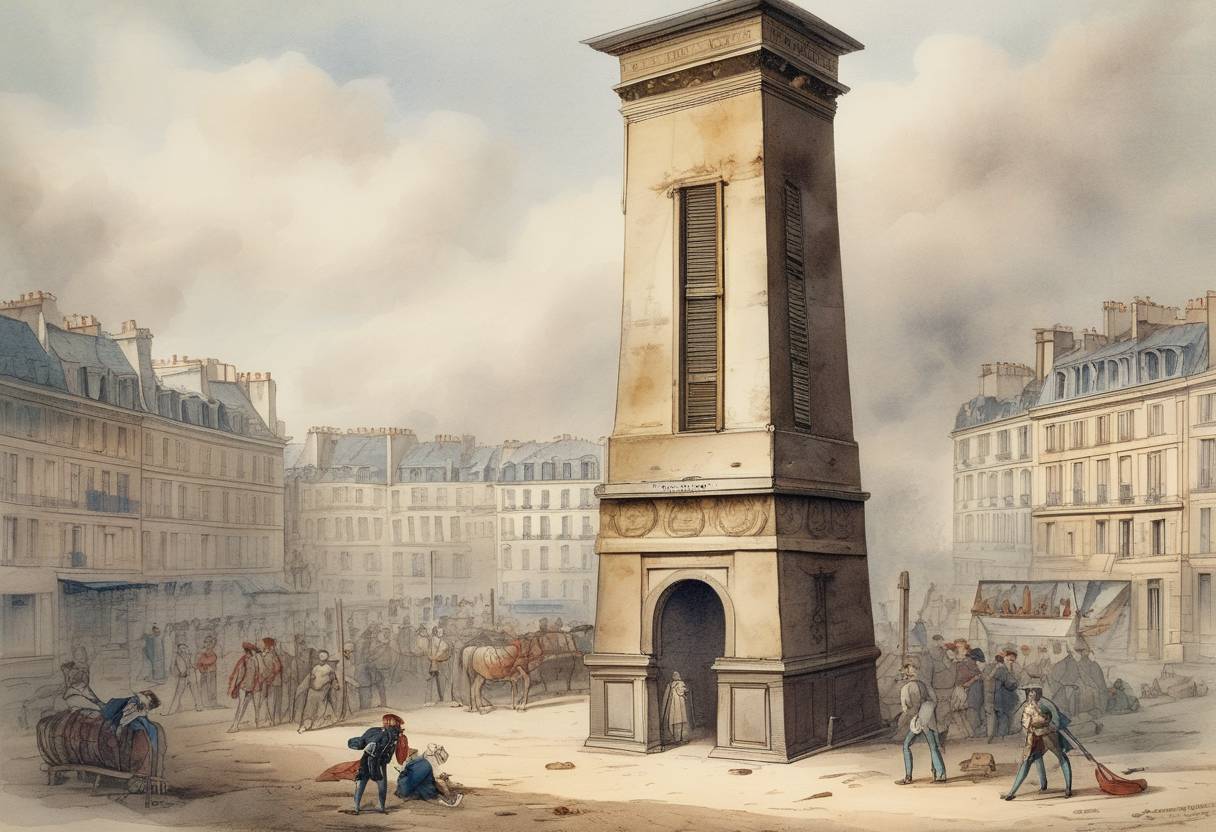
On April 25, 1792, the guillotine was used for the first time in France to execute Nicolas Jacques Pelletier, a highwayman. This event marked a significant moment in the history of capital punishment, as the guillotine would become a symbol of the French Revolution and its approach to justice.
The guillotine was developed as a more humane method of execution during a time when France was undergoing significant social and political upheaval. Prior to its introduction, executions were often carried out using methods that were considered brutal and inconsistent. Dr. Joseph-Ignace Guillotin, a French physician, proposed the device as a way to ensure a quick and less painful death, advocating for its use as a more egalitarian form of capital punishment.
The design of the guillotine was refined by Dr. Antoine Louis and German engineer Tobias Schmidt. It featured a heavy, angled blade that would swiftly decapitate the condemned individual, theoretically minimizing suffering.
Nicolas Jacques Pelletier was a common criminal, convicted of robbery and murder. His execution was intended to demonstrate the efficiency and humanity of the guillotine. On the day of his execution, a large crowd gathered at the Place de Grève in Paris, eager to witness the new device in action.
The execution was carried out swiftly, and Pelletier was beheaded in a matter of seconds. However, the crowd’s reaction was mixed; many were disappointed by the lack of spectacle compared to previous methods of execution.
The use of the guillotine quickly became widespread during the French Revolution, particularly during the Reign of Terror, when it was employed to execute thousands, including notable figures such as King Louis XVI and Marie Antoinette. The guillotine became a symbol of the revolutionary government’s commitment to equality before the law, as it was used to execute individuals from all social classes.
The device remained in use in France until the abolition of the death penalty in 1981, with the last execution by guillotine occurring in 1977.
The introduction of the guillotine on April 25, 1792, thus represents a pivotal moment in the history of capital punishment, reflecting broader themes of justice, equality, and the tumultuous changes of the French Revolution.
Source: en.wikipedia.org