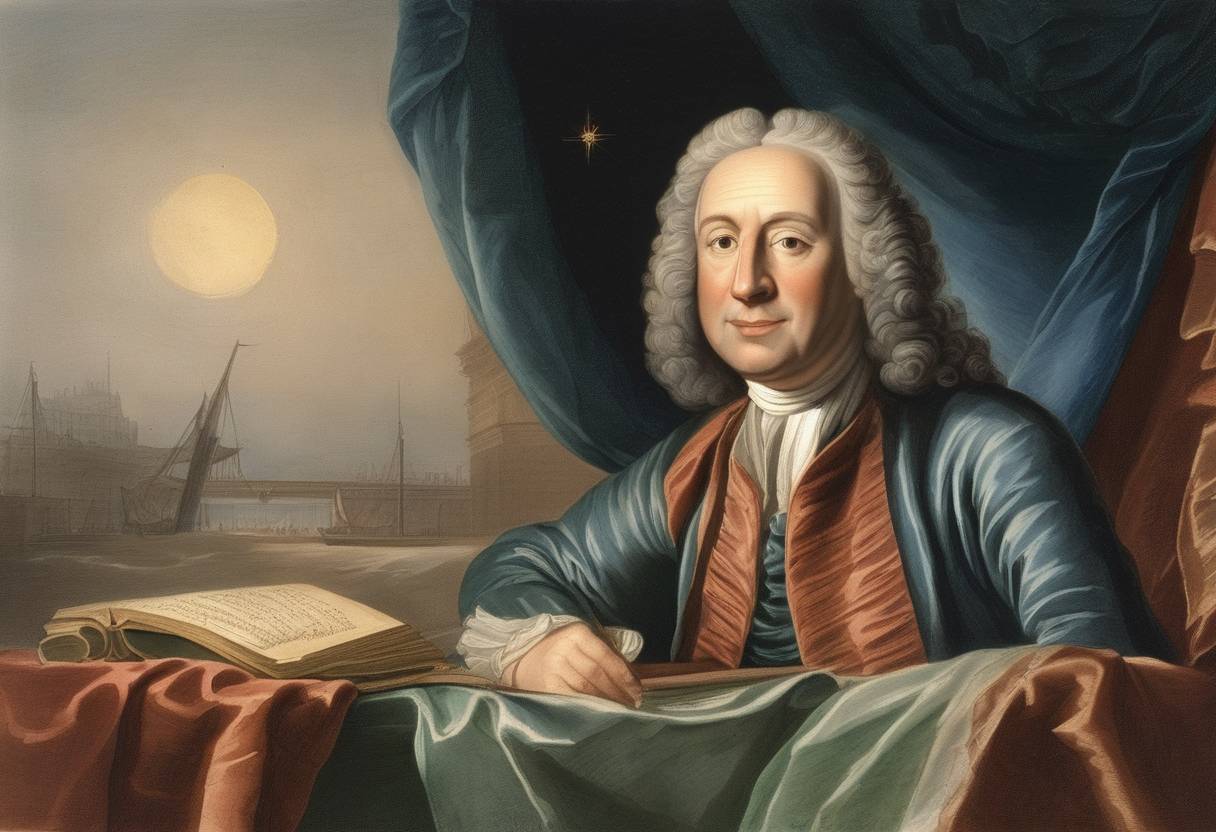
Death of Edmund Halley
On January 14, 1742, the renowned English astronomer and scientist Edmund Halley passed away. Halley is best known for his work in predicting the return of the comet that now bears his name, Halley’s Comet.
Early Life and Education
Edmund Halley was born on October 29, 1656, in Haggerston, Shoreditch, England. He was educated at The Queen’s College, Oxford, where he developed an interest in astronomy. His early work involved the cataloging of stars in the Southern Hemisphere, which led him to publish a star catalogue in 1678, significantly enhancing the accuracy of positions for the southern stars.
Contributions to Science
Halley’s contributions to science extended beyond astronomy. He was a prominent figure in various domains:
Astronomy: Apart from predicting the orbit of the comet that bears his name, Halley’s work with Sir Isaac Newton on celestial mechanics was pivotal. He encouraged Newton to publish “Philosophiæ Naturalis Principia Mathematica,” often regarded as one of the most important works in the history of science.
Geophysics: Halley suggested theories related to the Earth’s magnetic field and proposed the idea of a hollow Earth to explain the variations in its magnetic properties.
Meteorology: He made significant observations regarding trade winds and tides, being one of the first to systematically chart meteorological data.
Mathematics and Physics: His work in mathematics included developing the method of continuous compound interest, now fundamental in financial calculus.
Halley’s Comet
Halley’s most famous achievement came in 1705 when he applied Newton’s laws of motion to calculate the orbits of several comets. He discovered that the comets observed in 1531, 1607, and 1682 were the same one returning every 76 years. He correctly predicted its return in 1758, although he did not live to see it.
Legacy
Halley’s extensive contributions laid significant groundwork for the development of modern astronomy and natural sciences. He served as the Astronomer Royal from 1720 until his death and was an influential member of the Royal Society. His work continues to be celebrated for its breadth and depth, significantly impacting scientific thought and exploration.
Halley’s passing in 1742 marked the end of an era of adventurous inquiry into the natural world, but his legacy endures, particularly through the comet that appears periodically in our skies, reminding us of the pivotal role he played in bridging 17th-century science with modern understanding.