Ratification of the Articles of Confederation
1781 · Annapolis, United States
The Articles of Confederation were ratified after Maryland became the last state to sign them, establishing the United States' first constitution.
May 16, 1771
The Battle of Alamance, a pre-Revolutionary War battle between local militia and a group of rebellious farmers known as the Regulators, occurred in North Carolina.
Alamance, United States | Colonial Militia
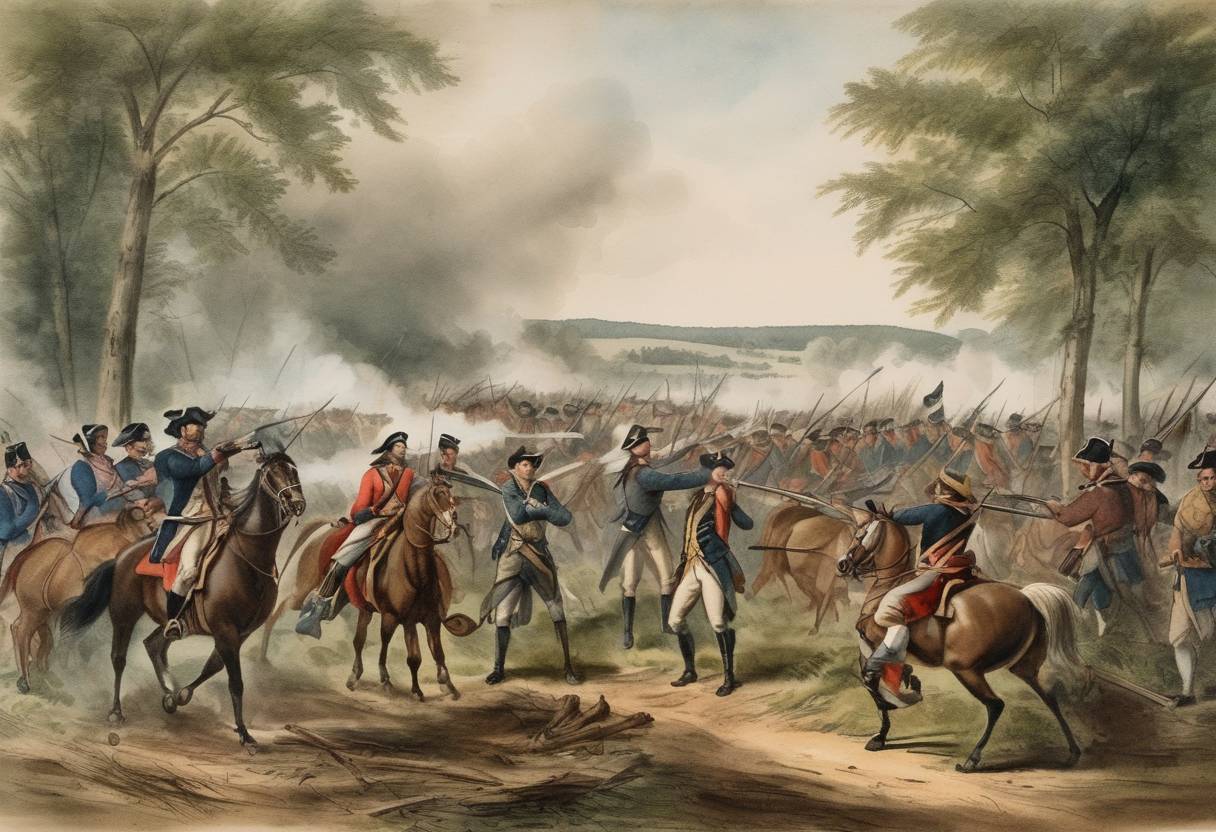
The Battle of Alamance occurred on May 16, 1771, in the backcountry of North Carolina. It was a pivotal pre-Revolutionary War conflict between the colonial militia and the Regulator Movement, a group of disaffected and rebellious farmers. This confrontation took place approximately nine miles south of present-day Burlington, North Carolina.
The Regulator Movement emerged in the late 1760s as a response to widespread grievances against corrupt local officials and unfair taxation policies. Many settlers in the inland regions of North Carolina felt oppressed by the colonial government, particularly by officials who exploited their positions for personal gain, levying excessive taxes and fees. The Regulators sought to reform the corrupt practices of these local authorities through petitioning and direct action.
Throughout the late 1760s and early 1770s, tensions escalated between the Regulators and the colonial government, led by Royal Governor William Tryon. Unable to reach a peaceful solution, and after several incendiary incidents where violence and vandalism were reported, Governor Tryon raised an armed militia to confront the growing Regulator threat. In an attempt to quash the rebellion, Tryon marched westward with around 1,000 militia troops.
The battle began on the morning of May 16, 1771. The Regulators, numbering approximately 2,000, were poorly organized and inadequately armed compared to the disciplined and well-equipped colonial militia. The engagement lasted roughly two hours, during which the Regulators, lacking effective leadership and strategic advantage, were ultimately dispersed by the superior firepower and tactics of Tryon’s forces.
Governor Tryon issued offers of amnesty to those Regulators who agreed to pledge loyalty to the crown, but he executed several of the leaders as a warning to others.
The Battle of Alamance effectively ended the Regulator Movement. It represented the colonial government’s determination to exercise control over the distant backcountry and quelled what was considered one of the earliest acts of organized resistance against British authority in the Americas.
The consequences of the battle and the harsh repressions in its aftermath sowed increased distrust of the colonial government, laying early groundwork for revolutionary sentiments. For some historians, the struggle of the Regulators is viewed as a precursor to the larger conflict that would erupt during the American War of Independence.
While the Regulators did not achieve their immediate goals, their struggle highlighted significant social and economic inequalities in colonial society, contributing to the broader discourse that would eventually lead to the American Revolution. The site of the battle is preserved as a North Carolina State Historic Site, commemorating the complex legacy of this confrontation.
Source: en.wikipedia.org