The October Revolution: November 6-7, 1917
1917 · Petrograd, Russia
The Bolshevik Party, led by Vladimir Lenin, launched the October Revolution in Russia, which led to the overthrow of the Provisional Government and the establishment of Soviet rule.
October 25, 1917
The October Revolution begins in Russia with the Bolshevik-led assault on the Winter Palace, marking a crucial turn in the Russian Revolution.
Petrograd, Russia | Bolshevik Party
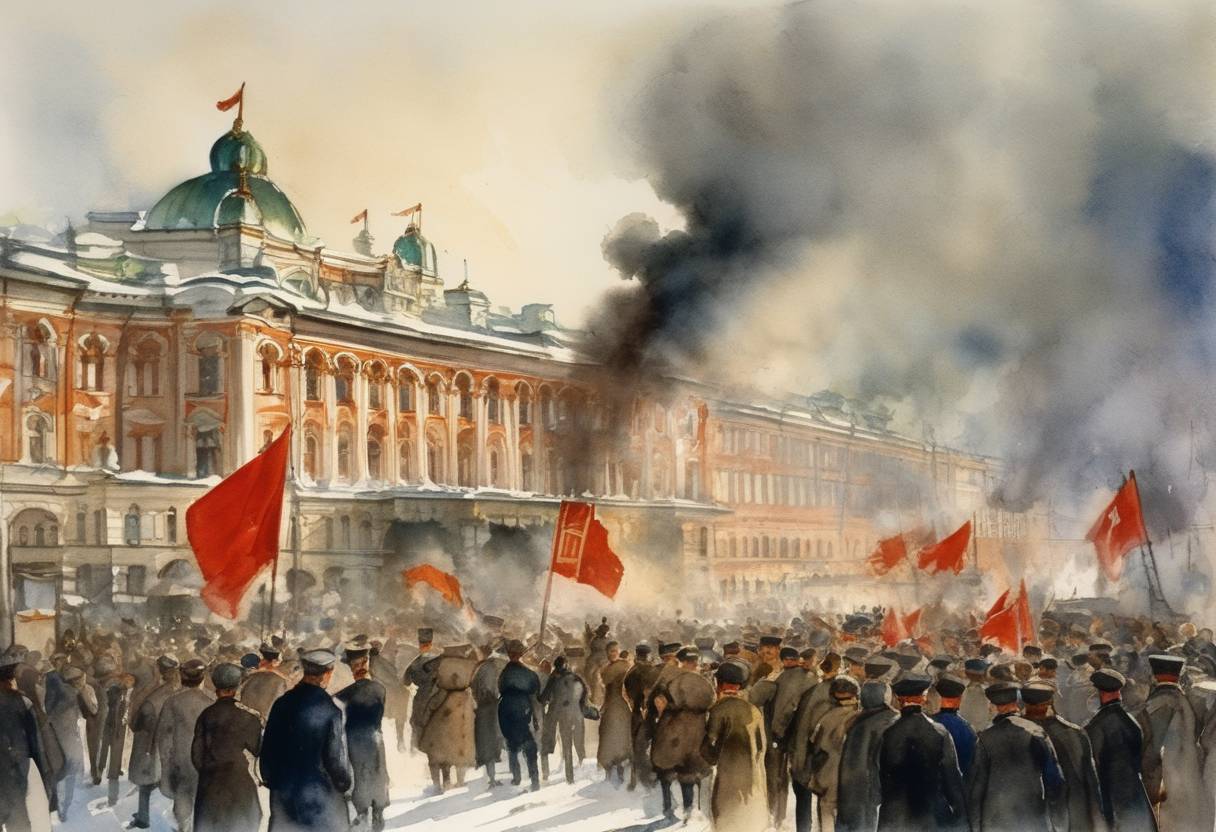
On October 25, 1917 (Julian calendar, November 7 by the Gregorian calendar), the Bolsheviks, led by Vladimir Lenin, initiated a pivotal and decisive event in the Russian Revolution by launching an assault on the Winter Palace in Petrograd (modern-day St. Petersburg). This event marked the beginning of the Bolshevik takeover and the establishment of Soviet power in Russia.
Following the February Revolution earlier in 1917, which led to the abdication of Tsar Nicholas II and the end of the Romanov dynasty, the Provisional Government was established to temporarily govern Russia. However, the Provisional Government faced widespread criticism for its continuation of Russian involvement in World War I, economic hardships, and inability to implement meaningful reforms.
During this turbulent period, the Bolshevik Party, led by Lenin, gained significant support among workers, soldiers, and peasants. The Bolsheviks advocated for “peace, land, and bread” and called for the power to revert to the Soviets—councils of workers’ and soldiers’ deputies—rather than the Provisional Government.
On the evening of October 25, the Bolshevik forces, supported by the Petrograd Soviet and the Red Guards, moved to take control of key locations across the capital. The Winter Palace, a symbol of tsarist autocracy and the seat of the Provisional Government, became their primary target.
The successful seizure of the Winter Palace effectively marked the overthrow of the Provisional Government and established the Bolshevik-led Soviet state. This event is regarded as one of the most significant moments in 20th-century history, leading to the creation of the world’s first socialist state and eventually, the formation of the Soviet Union in 1922.
The October Revolution fundamentally changed Russia’s political landscape and had a profound influence on global politics, inspiring communist movements worldwide and altering the course of history throughout the century.
The Bolshevik takeover initiated a period of civil war and social upheaval in Russia, as forces loyal to the deposed regime, known as the White Army, opposed the Bolshevik Red Army. This intra-national conflict continued until 1923, solidifying Bolshevik power and leading to the establishment of a government focused on socialist and communist ideologies under the leadership of Lenin.
Source: www.britannica.com