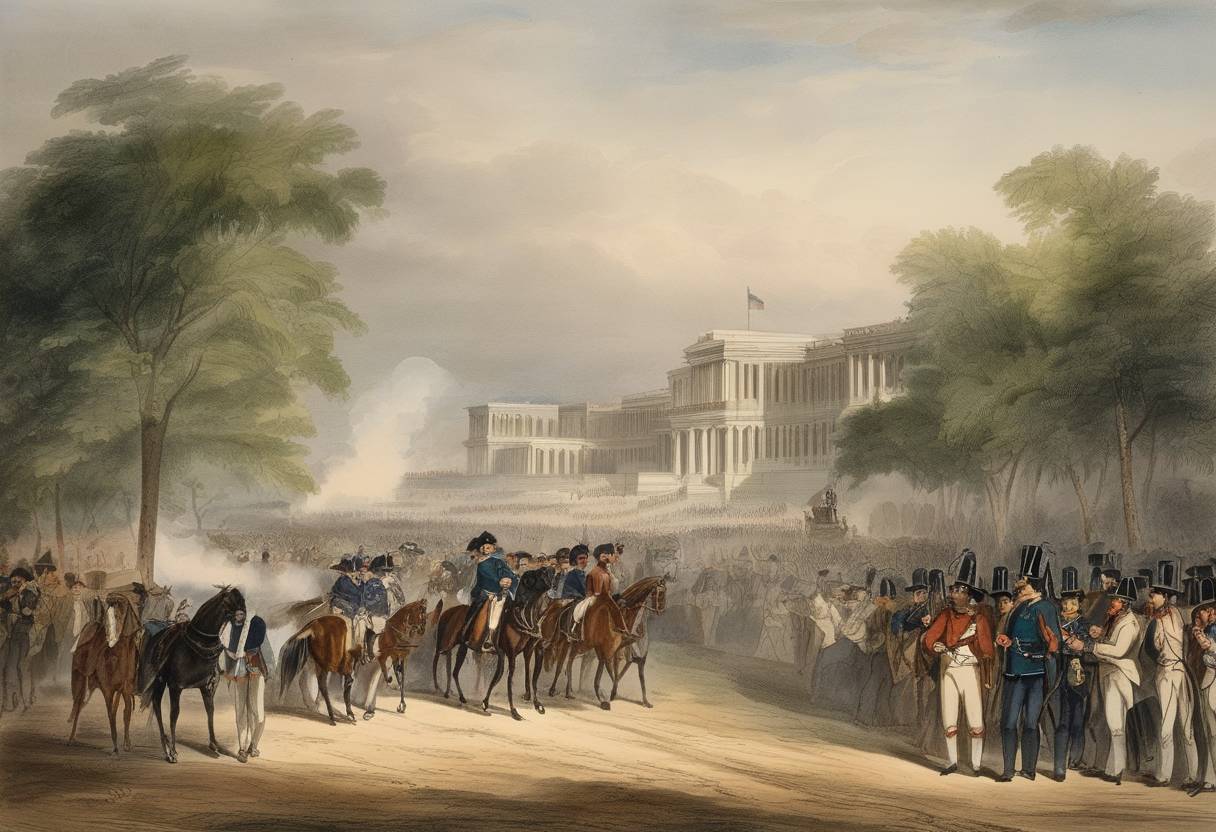
United States Declares War on Mexico - May 25, 1846
On May 25, 1846, the United States Congress formally declared war on Mexico after a period of escalating tensions between the two nations, primarily regarding the annexation of Texas and boundary disputes. This declaration was part of a broader conflict known as the Mexican-American War.
Background
The roots of this conflict can be traced back to the 1836 Texas Revolution, when Texas gained independence from Mexico. The United States annexed Texas in 1845, a move that Mexico viewed as an act of aggression, since it still considered Texas part of its sovereign territory despite the Texan revolution.
Tensions further escalated over disputed territory between the Rio Grande and Nueces River. The United States, supporting Texas’s claim, recognized the Rio Grande as the border, whereas Mexico argued it was the Nueces River.
Prelude to War
President James K. Polk sought to secure the disputed territories through negotiation but was prepared to use military force. In 1846, Polk ordered General Zachary Taylor to move U.S. troops into the contested region between the two rivers. This move was provocative and on April 25, 1846, a skirmish between Mexican and American troops resulted in casualties on both sides. Polk used this incident to claim that American blood had been shed on American soil and urged Congress to declare war.
Declaration of War
Responding to President Polk’s request, the United States Congress voted on May 13, 1846, to declare war on Mexico, but the formal announcement of this declaration was made on May 25, 1846. The declaration marked the beginning of a two-year conflict that would have significant territorial implications for both countries.
Consequences
The Mexican-American War resulted in a decisive American victory and led to the signing of the Treaty of Guadalupe Hidalgo in 1848. Under the terms of the treaty, Mexico ceded approximately half of its territory to the United States, including present-day California, Nevada, Utah, Arizona, New Mexico, Colorado, and Wyoming, in exchange for $15 million and the assumption of Mexican debts.
This conflict and the subsequent territorial gains fueled debates within the United States over the expansion of slavery into new territories, a contributing factor to the sectional conflicts leading up to the American Civil War.
The war remains a significant episode in the history of U.S.-Mexico relations, leaving a lasting impact on both nations’ trajectories.