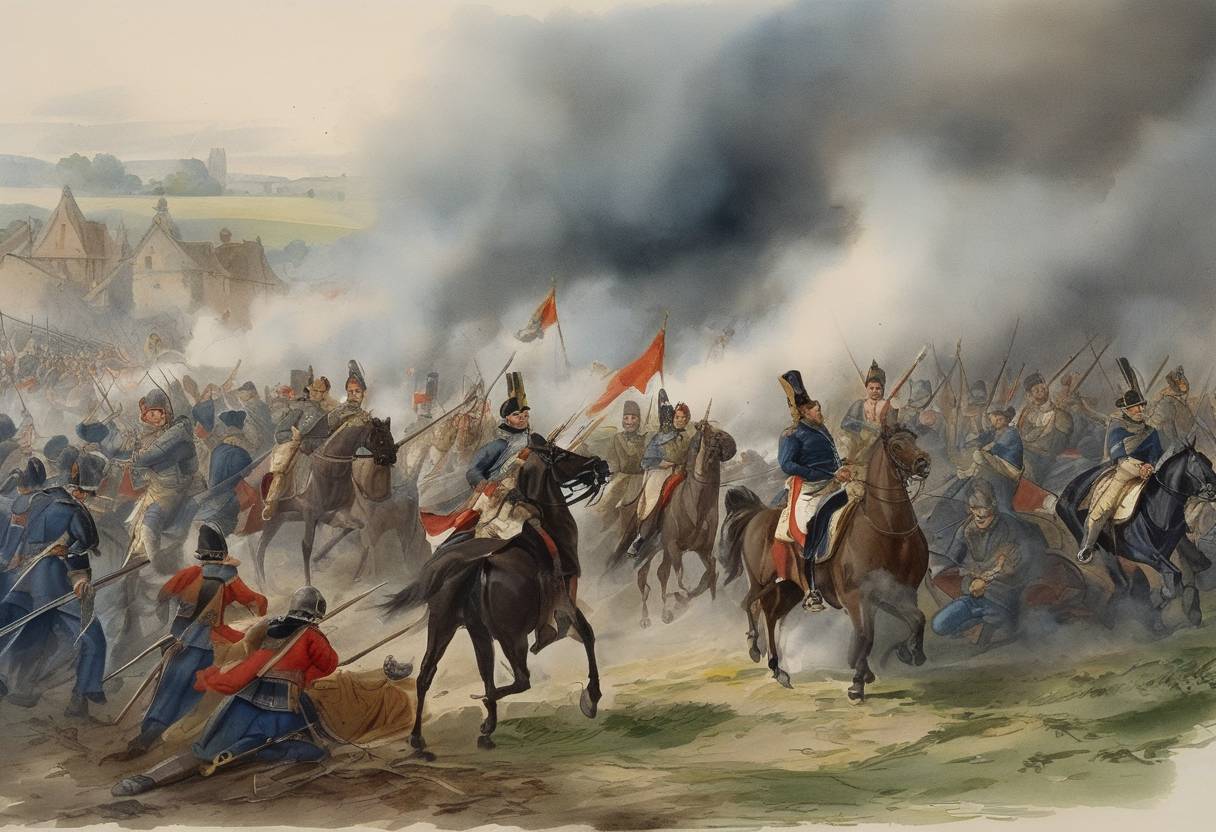
The Battle of Lincoln: August 21, 1217
The Battle of Lincoln, fought on August 21, 1217, was a crucial conflict during the First Barons’ War in England. It featured the French army, under the command of Prince Louis of France—who would later become Louis VIII of France—against English forces loyal to the young King Henry III, led by William Marshal, the Earl of Pembroke.
Context and Background
The First Barons’ War (1215-1217) arose primarily from dissatisfaction among the English barons with King John of England’s rule, particularly his heavy taxation and arbitrary justice. This unrest led to the sealing of the Magna Carta in 1215, but when King John reneged on its promises, civil war ensued. The disgruntled barons invited Prince Louis of France to claim the English throne, exacerbating the conflict.
By 1217, Prince Louis had gained substantial support among the English nobility, and his forces occupied many important territories, including London. However, the sudden death of King John in 1216 brought about a shift in the dynamics of the war. His nine-year-old son, Henry III, ascended to the throne with the regency led by William Marshal, who sought to restore royal authority over England.
The Battle
The confrontation at the city of Lincoln on August 21, 1217, was pivotal to this power struggle. Lincoln Castle was besieged by Prince Louis’s forces, placing critical pressure on the English royalists. Understanding the strategic significance of Lincoln, Marshal organized a relief force and marched to confront the besieging army.
The battle commenced with decisive action from Marshal’s forces, featuring a surprise attack executed by knights who entered the city through a side gate. This maneuver caught the French troops off guard, resulting in a rapid escalation of conflict within the city streets. The well-disciplined English forces managed to rout the French besiegers, leading to significant French casualties and the capture of numerous noble figures.
Aftermath and Significance
The defeat at Lincoln was a severe setback for Prince Louis’s campaign. The loss not only weakened his military position but also diminished his support among the English barons. Following the battle, William Marshal maintained momentum by capitalizing on the victory, further consolidating the young king’s hold on the throne.
In the months following Lincoln, peace negotiations were initiated, culminating in the Treaty of Lambeth in September 1217. The agreement effectively ended French intervention and Prince Louis renounced his claims to the English crown. The victory at Lincoln was instrumental in securing the reign of Henry III and stabilizing the English monarchy post-First Barons’ War.
The battle and its outcomes underscored the effectiveness of Marshal’s leadership, the resilience of the English royalist forces, and the importance of swift, strategic military actions during medieval warfare. It marked a turning point that led to the establishment of a more stable governance structure under Henry III, enabling the future development of constitutional practices in England.