Establishment of the Second Federal Republic of Mexico
1846 · Mexico City, Mexico
The Second Federal Republic of Mexico was established after the fall of the First Mexican Republic.
November 30, 1838
Mexico declares war on France after a dispute over debts owed to French citizens, marking the beginning of the Pastry War.
Mexico City, Mexico | Mexican government
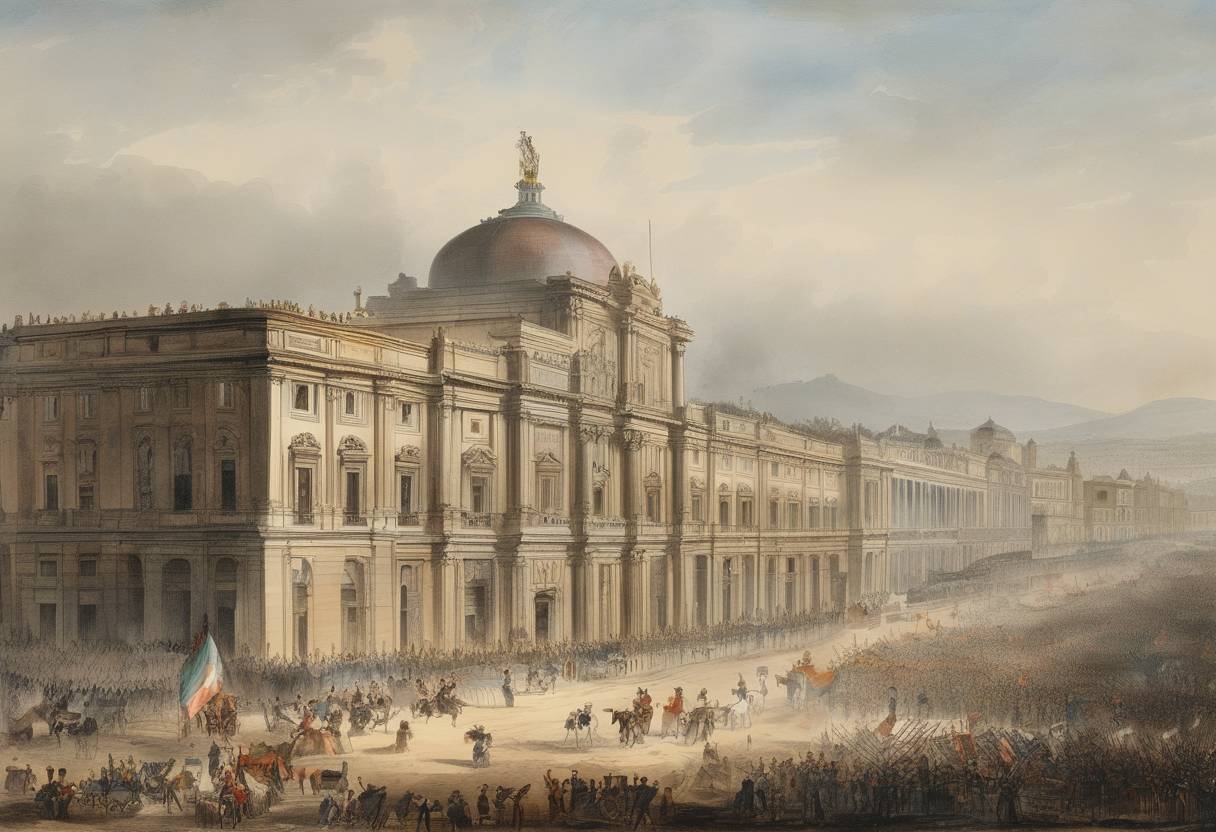
On November 30, 1838, the Mexican government formally declared war on France, initiating a conflict known as the “Pastry War” (Guerra de los Pasteles). This war marked a significant point of tension between Mexico and foreign powers during an era of political and economic instability in the nation.
The origins of the Pastry War trace back to the turmoil following Mexico’s independence from Spain in 1821. The young nation was plagued by financial difficulties, internal strife, and frequent changes in government, resulting in a struggling economy and difficulty in maintaining public order.
Amidst this chaotic environment, foreign nationals in Mexico faced the destruction and looting of their property. One notable grievance came from a French pastry chef named Monsieur Remontel. In 1832, his shop in Tacubaya, Mexico City, was reportedly looted by Mexican officers and soldiers during civil unrest. Remontel sought compensation from the Mexican government, but his claims were initially ignored.
The French government took up Remontel’s cause, seeking 600,000 pesos as recompense not just for the pastry chef’s damages but also for the losses incurred by other French nationals during various upheavals. The Mexican government was unable or unwilling to fulfill the demand, citing its dire financial situation.
In response to Mexico’s refusal to settle the claimed debts, King Louis-Philippe of France dispatched a fleet, which arrived in Mexican waters. A blockade of key ports, including Veracruz, began in April 1838, intensifying diplomatic strife.
Following failed negotiations and ongoing pressure, Mexico’s government declared war on France on November 30, 1838. This action was driven by a desire to defend national sovereignty and resist what many Mexicans perceived as foreign exploitation amidst their vulnerable circumstances.
The conflict saw French forces bombard and seize the strategic fort of San Juan de Ulúa, near Veracruz. As Mexican forces under President Anastasio Bustamante engaged the French to defend their territory, the conflict drew attention to the broader struggles Mexico faced in asserting itself on the international stage.
The Pastry War concluded on March 9, 1839, with British mediation leading to an accord. Mexico agreed to pay 600,000 pesos to France, and the French forces withdrew.
While the immediate conflict ended fairly swiftly, the war underscored the challenges of Mexico’s early years and highlighted the country’s vulnerability to foreign influence and intervention. Additionally, it illustrated the tenuous nature of international diplomacy and trade in the 19th century, shaped by complex relationships and economic interests.
The Pastry War serves as a reminder of the intricate interplay between national policy, international pressures, and local grievances during a time when young nations like Mexico were navigating their place on the global stage.
Source: www.britannica.com