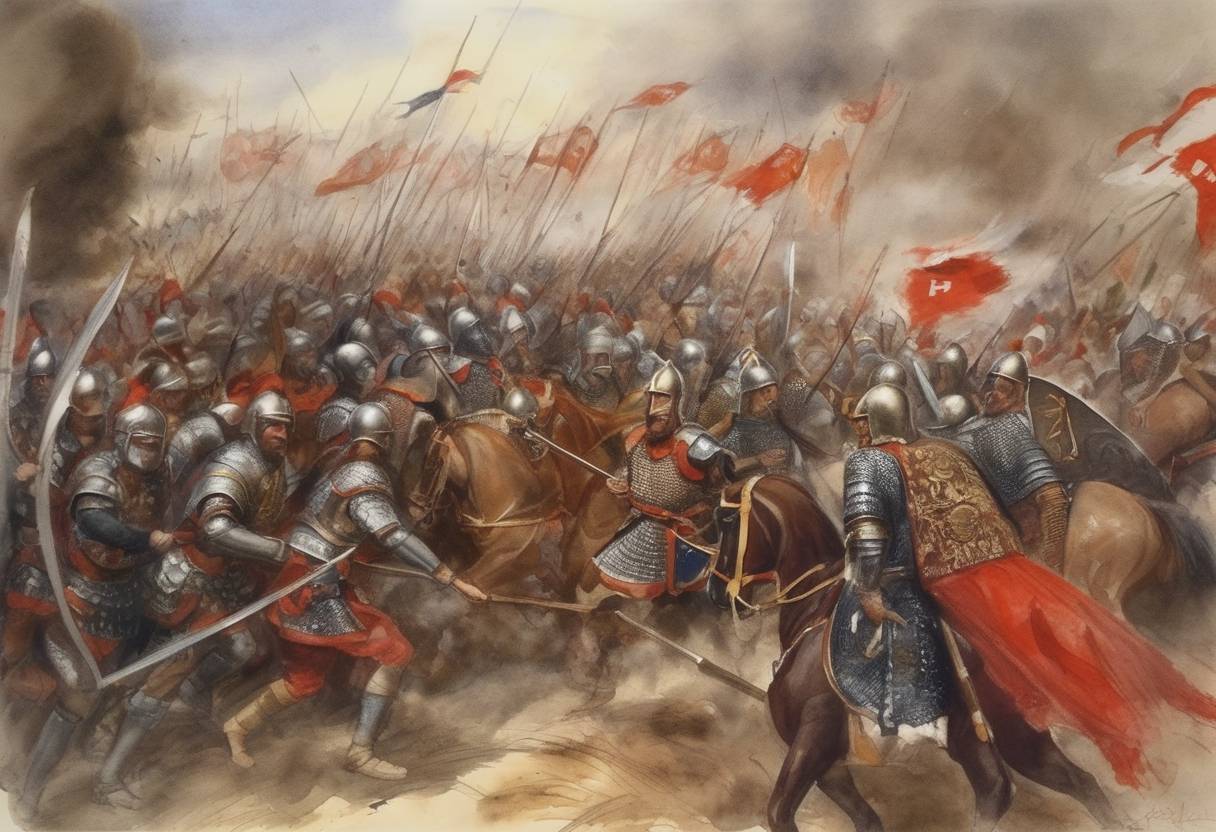
The Battle of Dyrrhachium: October 18, 1081
The Battle of Dyrrhachium occurred on October 18, 1081, between the Normans, led by Robert Guiscard, and the Byzantine Empire, commanded by Emperor Alexios I Komnenos. This confrontation was a pivotal moment during the Norman campaigns in the territories controlled by the Byzantine Empire, as the Normans aimed to expand their influence in the Balkans.
Background
In the years leading up to the battle, Robert Guiscard, a leader from the Hauteville family, sought to extend Norman power from Italy into the Balkan Peninsula. The Byzantine Empire, during this period, was experiencing internal strife and external threats, weakening its hold on its territories. The Normans took advantage of this instability, and by 1081, they set their sights on the strategic city of Dyrrhachium (modern-day Durrës, Albania), a vital entry point to the Byzantine heartlands.
- Robert Guiscard: A Norman nobleman who played a crucial role in the expansion of Norman territories in Southern Italy and the subsequent campaigns into the Balkans.
- Emperor Alexios I Komnenos: The Byzantine Emperor, who had recently ascended to power in the wake of a turbulent period for Byzantium, faced the challenge of defending his empire from Norman incursions.
The Battle
The engagement began as Robert Guiscard led a well-equipped and disciplined Norman force to besiege Dyrrhachium. The Byzantine army, under the strategic command of Alexios I, endeavored to lift the siege and repulse the Norman advance. Rising tensions reached a climax on October 18, when the two forces clashed outside the walls of Dyrrhachium.
Despite initial successes by the Byzantine forces, the Normans’ tactical acumen, spearheaded by Robert Guiscard and his son Bohemond of Taranto, ultimately led to their victory. Utilization of heavy cavalry and well-coordinated infantry assaults were pivotal in overwhelming the Byzantine defenses.
Consequences
The victory at Dyrrhachium emboldened the Normans, allowing them to consolidate their control over the western Balkans. For the Byzantine Empire, the defeat was a significant blow, though Emperor Alexios I would continue to showcase his resilience and strategic prowess in subsequent years, striving both to stabilize his realm and eventually reverse some of the territorial losses.
Historical Significance
The Battle of Dyrrhachium demonstrated the shifting balance of power in the medieval Mediterranean, highlighting the growing influence of the Normans. It also marked a critical chapter in the ongoing Byzantine-Norman conflicts. The battle underscored the challenges facing the Byzantine Empire as it grappled with both external invasions and internal challenges, setting the stage for future military and political developments in the region.