Harry S. Truman's Passing - December 26, 1972
1972 · Kansas City, United States
Harry S. Truman, the 33rd President of the United States, passed away in Kansas City, Missouri.
April 18, 1955
Albert Einstein, the renowned theoretical physicist known for developing the theory of relativity, passed away in Princeton, New Jersey.
Princeton, United States | Institute for Advanced Study
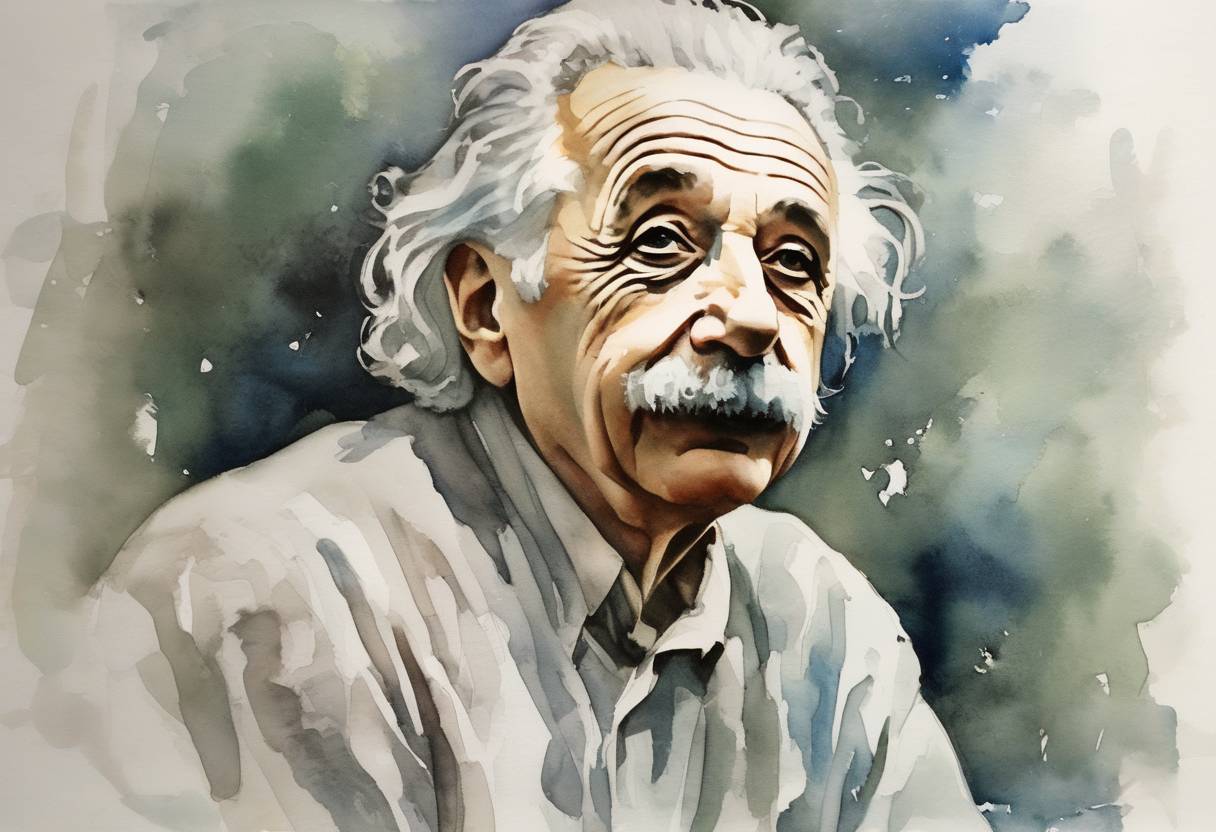
On April 18, 1955, Albert Einstein, one of the most influential physicists of the 20th century, passed away in Princeton, New Jersey, at the age of 76. His death marked the end of an era in theoretical physics and left a profound legacy that continues to influence science and culture today.
Albert Einstein was born on March 14, 1879, in Ulm, in the Kingdom of Württemberg in the German Empire. He is best known for developing the theory of relativity, particularly the equation (E=mc^2), which expresses the equivalence of mass and energy. His work laid the foundation for modern physics and revolutionized our understanding of space, time, and gravity.
Theory of Relativity: Einstein’s special theory of relativity, published in 1905, introduced the concept that the laws of physics are the same for all non-accelerating observers and that the speed of light is constant regardless of the motion of the light source. His general theory of relativity, published in 1915, expanded this principle to include gravity, describing it as the curvature of spacetime caused by mass.
Photoelectric Effect: In 1905, Einstein also published a paper on the photoelectric effect, which demonstrated that light can be understood as quanta of energy, or photons. This work was pivotal in the development of quantum theory and earned him the Nobel Prize in Physics in 1921.
Brownian Motion: Einstein’s explanation of Brownian motion provided empirical evidence for the existence of atoms and molecules, further solidifying the atomic theory of matter.
Einstein spent the latter part of his life at the Institute for Advanced Study in Princeton, New Jersey, where he continued to work on unifying the fundamental forces of physics, although he did not succeed in this endeavor. Despite his scientific focus, he was also an outspoken advocate for peace and civil rights, using his fame to promote humanitarian causes.
On April 17, 1955, Einstein experienced internal bleeding caused by the rupture of an abdominal aortic aneurysm. He was taken to Princeton Hospital, where he refused surgery, believing he had lived his life and was ready to accept his fate. He passed away the following day.
Einstein’s contributions to science have had a lasting impact, influencing various fields such as cosmology, quantum mechanics, and nuclear energy. His work continues to inspire physicists and laypeople alike, symbolizing the power of human curiosity and intellect. Beyond his scientific achievements, Einstein’s advocacy for peace and human rights remains an integral part of his enduring legacy.
Einstein’s death was widely mourned, and his brain was removed for scientific study, a controversial decision that sparked ethical debates. His ashes were scattered at an undisclosed location, in accordance with his wishes.
Albert Einstein’s life and work exemplify the profound impact that scientific inquiry can have on our understanding of the universe and our place within it.
Source: en.wikipedia.org