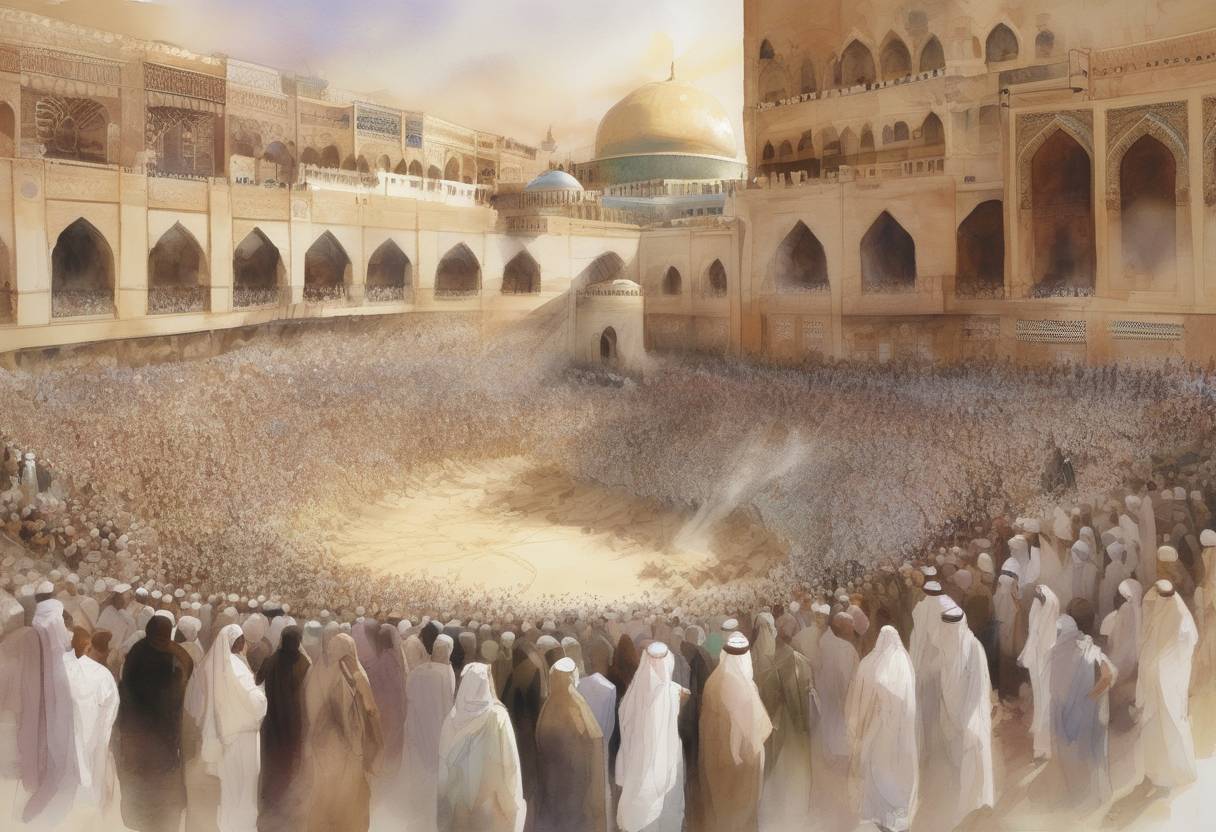
Birth of the Prophet Muhammad
According to Islamic tradition, the Prophet Muhammad was born in Mecca, in present-day Saudi Arabia. While the exact date of his birth is debated among historians and Islamic scholars, it is traditionally celebrated by many Muslims on the 12th of Rabi’ al-Awwal in the Islamic lunar calendar. This date corresponds to different dates in the Gregorian calendar due to the differences between the lunar and solar calendars. Some sources suggest a possible date of April 20, 571 CE, although this is not universally accepted.
Historical Context
Pre-Islamic Arabia
- Mecca: At the time of Muhammad’s birth, Mecca was a significant trading and religious center. It housed the Kaaba, a sacred sanctuary that attracted pilgrims from various tribes across the Arabian Peninsula.
- Society: The Arabian Peninsula was characterized by tribal societies with a polytheistic belief system. The region was marked by tribal conflicts and a lack of centralized political authority.
The Year of the Elephant
- Muhammad’s birth is traditionally associated with the “Year of the Elephant,” a year when, according to Islamic tradition, the Christian ruler Abraha attempted to attack Mecca with an army that included elephants. This event is said to have occurred around the time of Muhammad’s birth, adding to the significance of the year.
Significance of Muhammad’s Birth
- Prophethood: Muhammad is regarded as the final prophet in Islam, believed to have received revelations from Allah (God) that form the Quran, Islam’s holy book.
- Islamic Tradition: His life and teachings laid the foundation for the Islamic faith, which emphasizes monotheism, social justice, and moral conduct.
- Cultural Impact: Muhammad’s teachings and the subsequent spread of Islam had profound effects on the social, political, and cultural landscapes of the Arabian Peninsula and beyond.
Aftermath and Legacy
- Spread of Islam: Following Muhammad’s death in 632 CE, Islam rapidly expanded across the Middle East, North Africa, and parts of Europe and Asia.
- Cultural and Scientific Contributions: The Islamic Golden Age, which followed the initial spread of Islam, saw significant advancements in science, medicine, mathematics, and philosophy.
- Modern Celebrations: The birth of Muhammad is commemorated by many Muslims around the world during Mawlid al-Nabi, a celebration that includes prayers, recitations, and community gatherings.
While the exact date of Muhammad’s birth remains a topic of scholarly debate, his impact on history is undeniable, shaping religious, cultural, and political developments for centuries.