The Detonation of the Tsar Bomba: October 30, 1961
1961 · Novaya Zemlya, Soviet Union
The Soviet Union detonated the Tsar Bomba, the most powerful nuclear weapon ever tested, over Novaya Zemlya.
August 12, 1953
The Soviet Union conducted its first successful test of a hydrogen bomb, codenamed RDS-6s, at the Semipalatinsk Test Site, escalating the nuclear arms race during the Cold War.
Semipalatinsk, Soviet Union (now Kazakhstan) | Soviet Union
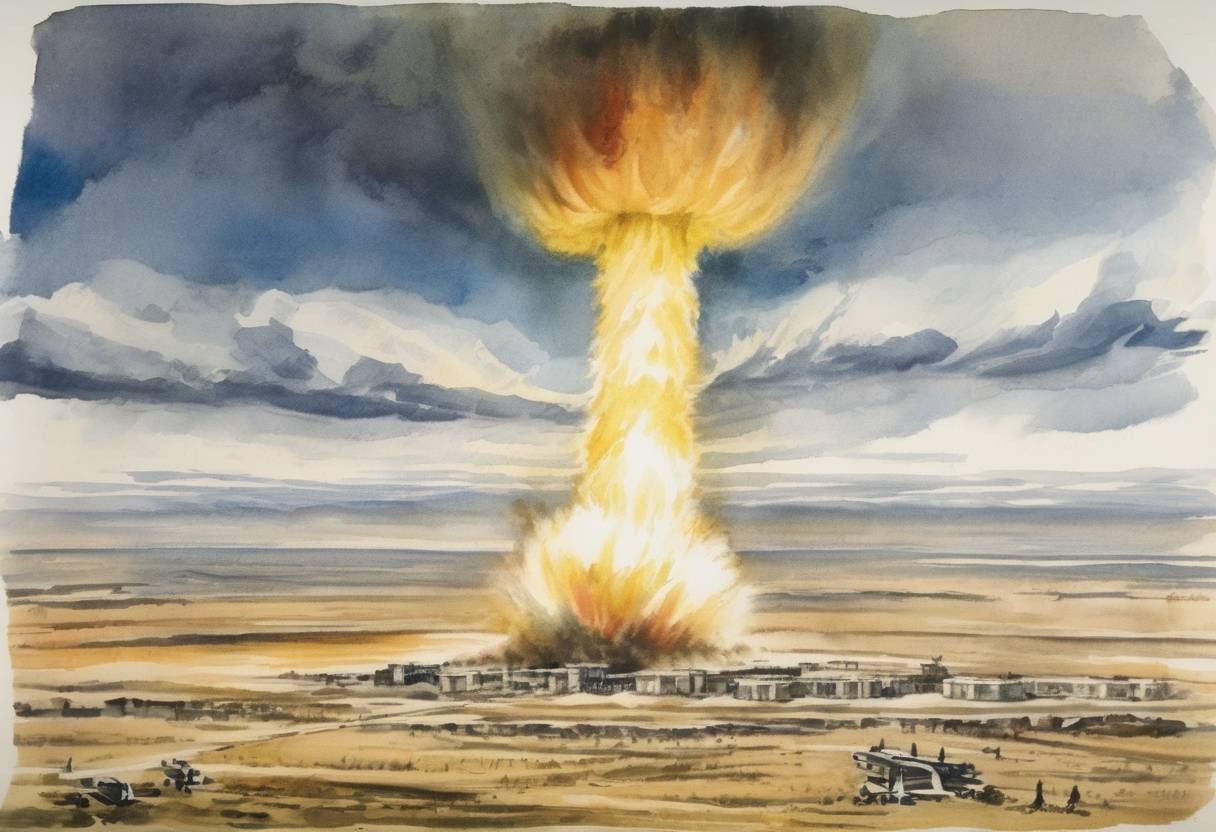
On August 12, 1953, the Soviet Union conducted its first successful test of a hydrogen bomb, codenamed RDS-6s, at the Semipalatinsk Test Site in Kazakhstan. This event marked a significant escalation in the nuclear arms race during the Cold War, as it demonstrated the Soviet Union’s capability to produce thermonuclear weapons, a technology that had been previously monopolized by the United States.
Cold War Tensions: The early 1950s were characterized by intense rivalry between the United States and the Soviet Union, with both superpowers seeking to establish military and technological superiority. The development of nuclear weapons was a critical aspect of this competition.
U.S. Advances: The United States had successfully tested its first hydrogen bomb, codenamed “Ivy Mike,” on November 1, 1952. This test demonstrated the immense destructive power of thermonuclear weapons, prompting the Soviet Union to accelerate its own hydrogen bomb program.
Soviet Development: The Soviet hydrogen bomb project was led by prominent physicists, including Andrei Sakharov and Igor Tamm. The RDS-6s design was a “layer-cake” configuration, which was a different approach compared to the American Teller-Ulam design used in “Ivy Mike.”
Location: The test took place at the Semipalatinsk Test Site, a remote area in northeastern Kazakhstan that was the primary nuclear testing ground for the Soviet Union.
Yield and Impact: The RDS-6s bomb had a yield of approximately 400 kilotons, which was significantly more powerful than the atomic bombs dropped on Hiroshima and Nagasaki but less powerful than the megaton-range yields of later thermonuclear weapons.
Significance: The successful detonation of RDS-6s confirmed the Soviet Union’s ability to produce hydrogen bombs, thereby narrowing the nuclear gap between the superpowers and intensifying the arms race.
Arms Race Intensification: The test prompted both the United States and the Soviet Union to further develop and stockpile nuclear weapons, leading to an era of mutually assured destruction (MAD) as a deterrent strategy.
Diplomatic Tensions: The successful test of the RDS-6s heightened global tensions and contributed to the ongoing geopolitical standoff between the Eastern and Western blocs.
Scientific and Ethical Debates: The development and testing of hydrogen bombs sparked debates among scientists and policymakers about the ethical implications of nuclear weapons and the potential consequences of their use.
The successful test of the RDS-6s hydrogen bomb was a pivotal moment in the Cold War, underscoring the technological and military rivalry between the United States and the Soviet Union. It highlighted the perilous nature of the nuclear arms race and set the stage for subsequent arms control negotiations, such as the Partial Test Ban Treaty of 1963, which sought to mitigate the risks associated with nuclear proliferation and testing.
Source: en.wikipedia.org