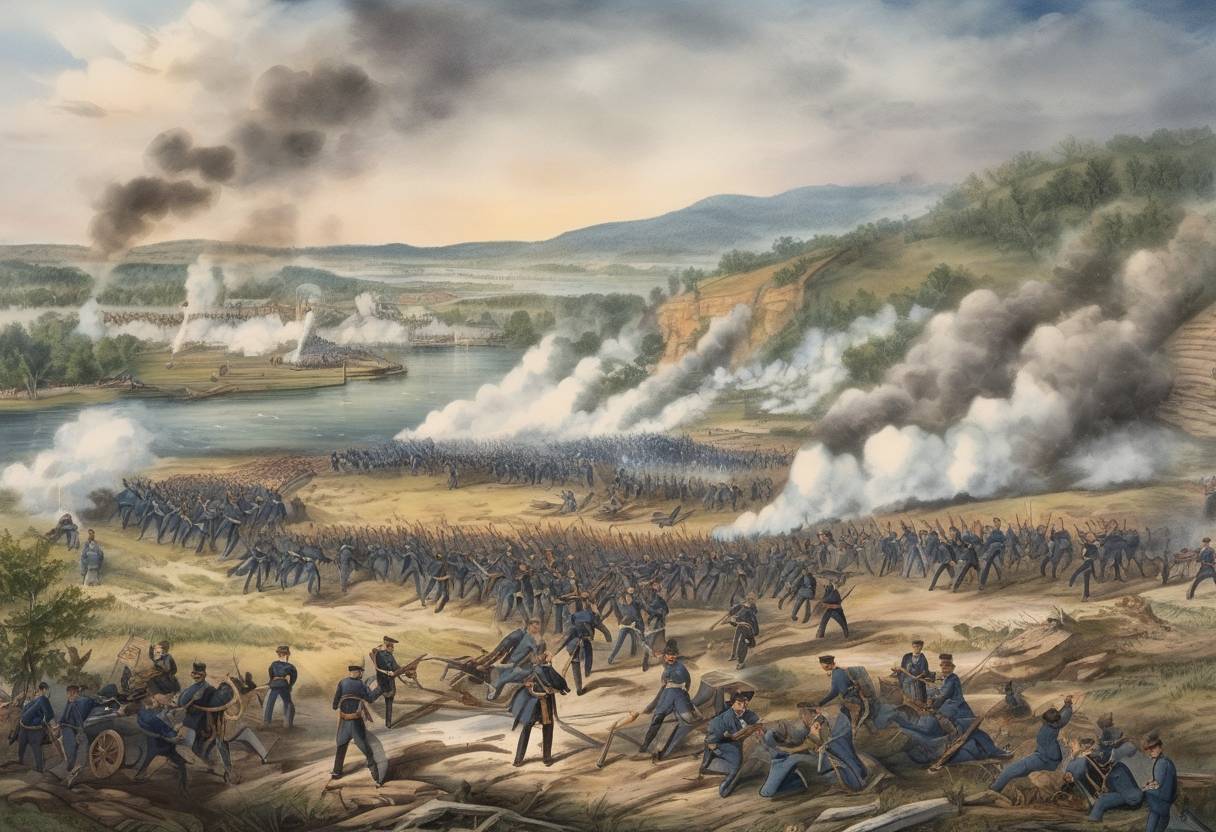
The Battle of Chattanooga: November 23, 1863
The Battle of Chattanooga, a pivotal engagement during the American Civil War, commenced on November 23, 1863. This battle marked a significant turning point in the war, as Union forces under Major General Ulysses S. Grant launched a strategic offensive against Confederate troops, ultimately leading to a decisive Union victory.
Context and Prelude
The city of Chattanooga, Tennessee, was of immense strategic importance due to its railroads and its position as a gateway to the Deep South. Prior to the battle, Confederate forces under General Braxton Bragg had besieged Union troops in Chattanooga following their defeat at the Battle of Chickamauga in September 1863. The Union army, led by Major General William Rosecrans, was trapped and in dire need of supplies and reinforcements.
In response, President Abraham Lincoln appointed Major General Ulysses S. Grant to command the newly formed Military Division of the Mississippi. Grant’s arrival in Chattanooga in October 1863 marked the beginning of a series of maneuvers to break the Confederate siege and secure the city.
Key Events of the Battle
November 23, 1863: The battle began with a Union demonstration against the Confederate center on Orchard Knob. This maneuver was designed to probe the Confederate defenses and set the stage for a larger assault.
November 24, 1863: Known as the “Battle Above the Clouds,” Union forces attacked Lookout Mountain. Despite challenging terrain and weather conditions, Union troops successfully pushed Confederate forces off the mountain, gaining a strategic advantage.
November 25, 1863: The climax of the battle occurred with the assault on Missionary Ridge. Grant ordered a frontal attack, and Union forces, driven by momentum and determination, unexpectedly broke through the Confederate lines, leading to a complete rout of Bragg’s army.
Aftermath and Significance
The Union victory at Chattanooga had several important consequences:
Strategic Advantage: The victory opened the gateway to the Deep South, paving the way for General William Tecumseh Sherman’s Atlanta Campaign and his subsequent March to the Sea.
Boost to Union Morale: The successful lifting of the siege and the defeat of Confederate forces provided a significant morale boost to the Union army and the Northern public.
Leadership Changes: The defeat led to leadership changes within the Confederate army, with General Bragg being relieved of command shortly after the battle.
Grant’s Rise: The success at Chattanooga further solidified Ulysses S. Grant’s reputation as a capable and decisive leader, eventually leading to his appointment as General-in-Chief of all Union armies.
The Battle of Chattanooga was a testament to Grant’s strategic acumen and the resilience of the Union forces, marking a turning point in the Civil War that would contribute to the eventual Union victory.