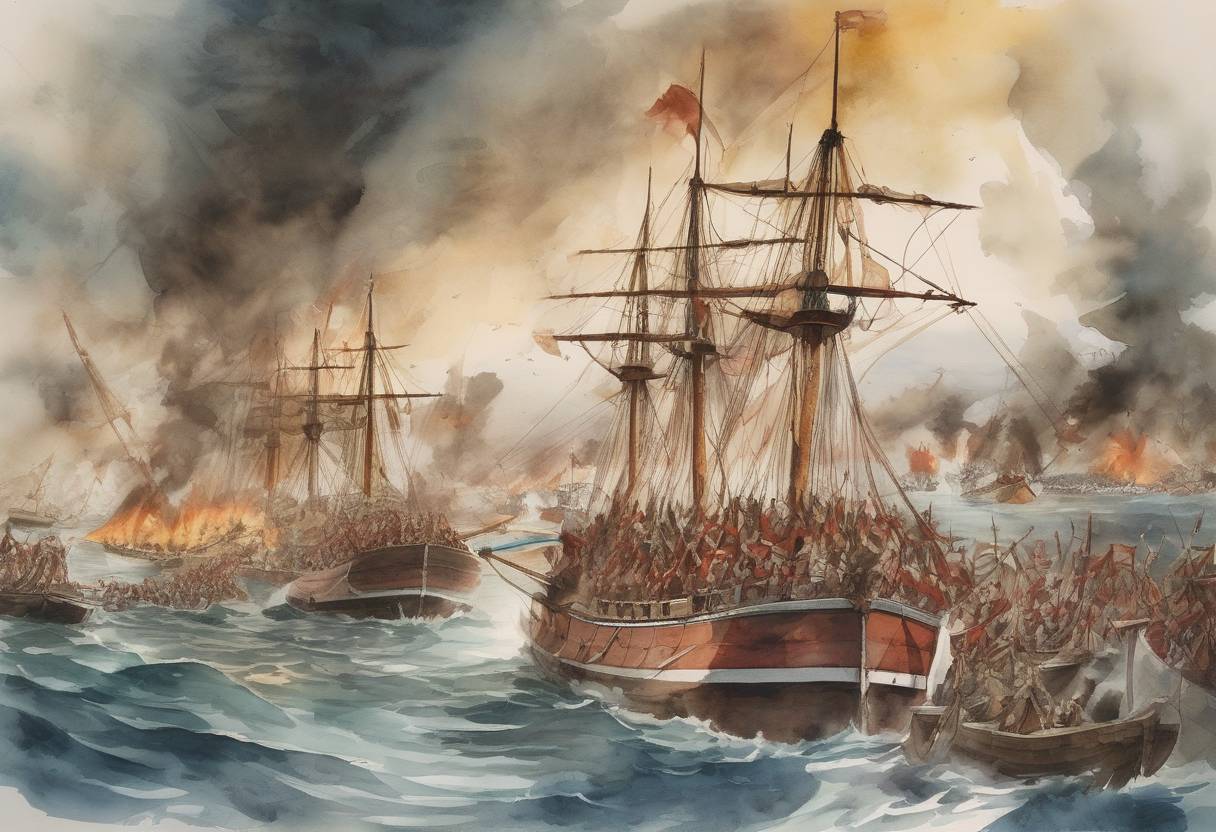
The Battle of Salamis: October 20, 480 BCE
The Battle of Salamis was a pivotal naval engagement during the Greco-Persian Wars, marking a significant turning point in the conflict between the Greek city-states and the Persian Empire. This battle took place on October 20, 480 BCE, in the straits between the mainland and Salamis, an island in the Saronic Gulf near Athens.
Context and Prelude
The Greco-Persian Wars were a series of conflicts that began in 499 BCE, as the Persian Empire sought to expand its influence over the Greek city-states. By 480 BCE, King Xerxes I of Persia had launched a massive invasion of Greece, seeking to avenge previous Persian defeats and subjugate the Greek states.
Earlier in the year, the Persians had achieved a significant victory at the Battle of Thermopylae, allowing them to advance into central Greece and capture Athens. The Greek forces, under the strategic leadership of Themistocles, an Athenian politician and general, decided to make a stand at sea, where their smaller, more maneuverable ships could counter the larger Persian fleet.
The Battle
Themistocles devised a cunning plan to lure the Persian fleet into the narrow straits of Salamis, where their numerical advantage would be negated. He sent a message to Xerxes, feigning a willingness to switch sides, and suggested that the Persians attack immediately. Believing the Greeks were in disarray, Xerxes ordered his fleet into the straits.
On the day of the battle, the Greek fleet, composed of approximately 370 triremes, faced a much larger Persian armada, estimated to be around 1,200 ships. The narrow waters of the straits limited the maneuverability of the Persian vessels, allowing the Greeks to exploit their superior naval tactics and ship-handling skills.
The Greek triremes, led by Themistocles, executed a well-coordinated attack. The heavier and less agile Persian ships struggled in the confined space, leading to chaos and collisions within their ranks. The Greeks capitalized on this disorder, sinking many Persian ships and forcing others to retreat.
Aftermath and Significance
The Greek victory at Salamis was decisive. It effectively crippled the Persian navy, preventing Xerxes from maintaining his supply lines and forcing him to withdraw the majority of his forces back to Asia. Although the war continued for several more years, the momentum had shifted in favor of the Greeks.
The Battle of Salamis is often credited with preserving Greek independence and culture, which would have profound implications for the development of Western civilization. The victory demonstrated the effectiveness of strategic naval warfare and the importance of unity among the Greek city-states in the face of a common enemy.
Themistocles emerged as a hero of the battle, his leadership and strategic acumen playing a crucial role in the Greek success. The battle also underscored the significance of naval power in the ancient world, influencing military tactics and strategies for generations to come.