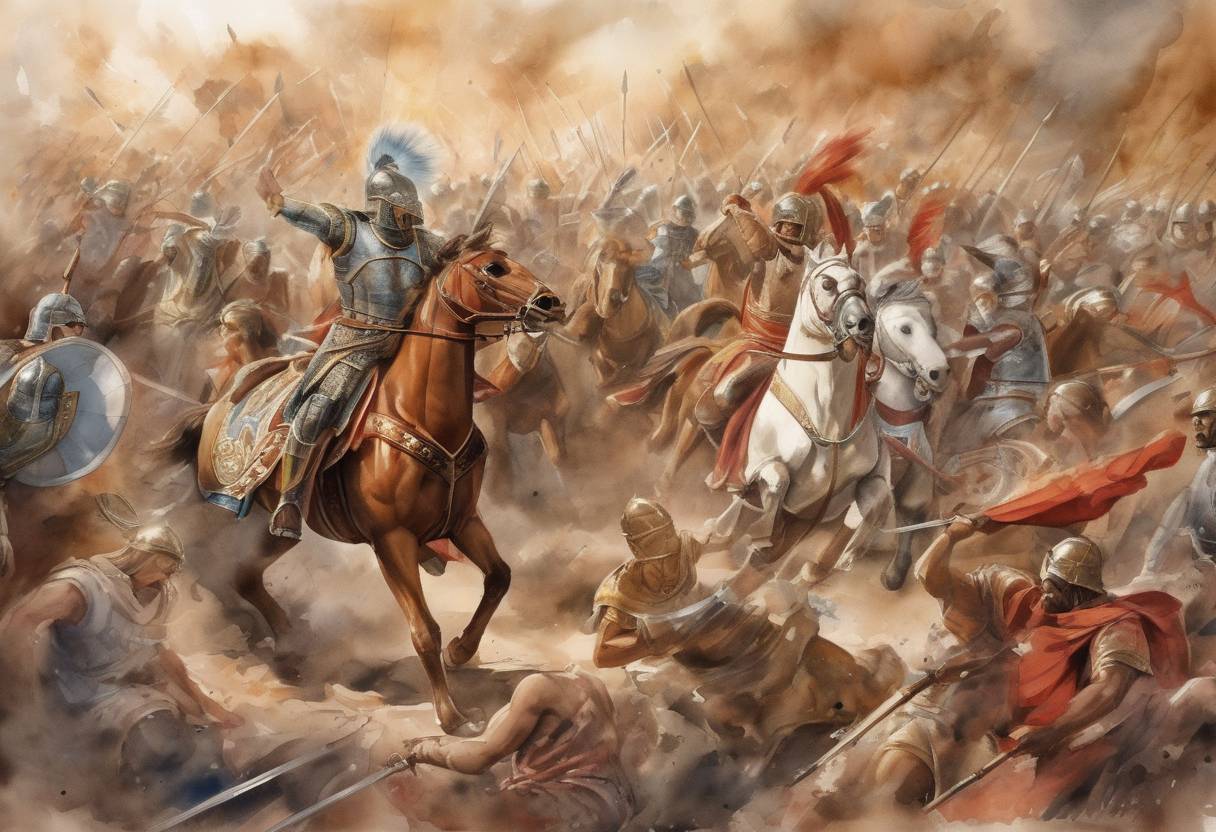
The Battle of Gaugamela: October 1, 331 BCE
The Battle of Gaugamela, fought on October 1, 331 BCE, stands as a pivotal moment in ancient history, marking a decisive victory for Alexander the Great over Darius III of Persia. This battle effectively led to the fall of the Achaemenid Empire and the expansion of Alexander’s empire.
Context and Prelude
Alexander’s Campaign: By 331 BCE, Alexander had already achieved significant victories against the Persian Empire, including the battles of Granicus and Issus. His campaign aimed to dismantle the Persian power and expand Macedonian influence.
Darius III’s Preparations: Darius III, aware of Alexander’s military prowess, amassed a large army, reportedly numbering several hundred thousand, although these figures are often debated by historians. He chose the plains of Gaugamela, near present-day Mosul in Iraq, for its favorable terrain for his chariots and cavalry.
The Battle
Strategic Positioning: Alexander’s forces, though significantly outnumbered, were highly trained and strategically adept. He employed a tactical formation known as the “hammer and anvil,” with his phalanx at the center and cavalry on the flanks.
Key Maneuvers: Alexander led a charge with his Companion Cavalry on the right flank, creating a gap in the Persian lines. This maneuver was crucial in disrupting the Persian forces and causing chaos within their ranks.
Darius’s Flight: As the battle turned in favor of the Macedonians, Darius III fled the battlefield, leading to a collapse in Persian morale and a decisive victory for Alexander.
Aftermath and Significance
Fall of the Achaemenid Empire: The defeat at Gaugamela marked the beginning of the end for the Achaemenid Empire. Alexander’s victory paved the way for his capture of Babylon, Susa, and eventually Persepolis, the ceremonial capital of Persia.
Alexander’s Empire: This victory solidified Alexander’s reputation as one of history’s greatest military tacticians and expanded his empire across three continents, from Greece to Egypt and into the heart of Asia.
Cultural Impact: The battle and subsequent conquests facilitated the spread of Greek culture and ideas throughout the known world, a period known as the Hellenistic Era, which profoundly influenced the subsequent development of Western and Middle Eastern civilizations.
The Battle of Gaugamela remains a testament to Alexander’s strategic genius and his ability to overcome overwhelming odds, reshaping the ancient world and leaving a lasting legacy that would endure for centuries.