Martha Place: First Woman Executed by Electric Chair
1899 · Ossining, United States
Martha Place became the first woman to be executed in the electric chair at Sing Sing Correctional Facility in New York for the murder of her stepdaughter.
August 6, 1890
The first execution by electric chair took place in Auburn Prison in New York, marking a significant moment in the history of capital punishment.
Auburn, United States | New York State
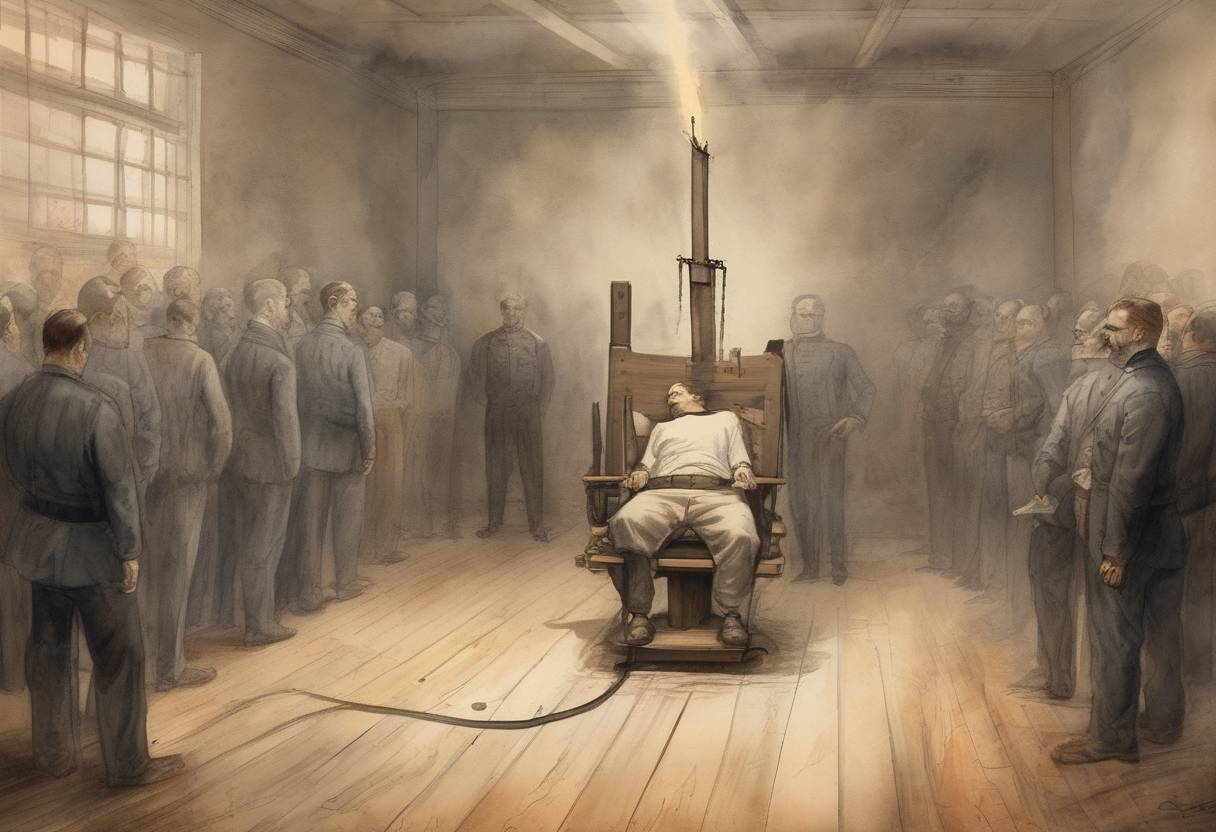
On August 6, 1890, a pivotal moment in the history of capital punishment occurred at Auburn Prison in New York: the first execution by electric chair. This event marked a significant shift in the methods used for carrying out the death penalty, reflecting broader societal changes in attitudes towards technology and humane methods of execution.
The development of the electric chair was part of a broader movement in the late 19th century to find more humane methods of execution than hanging, which was often seen as brutal and prone to error. The electric chair was invented by Harold P. Brown and Arthur Kennelly, under the supervision of Thomas Edison, who was engaged in the “War of Currents” with George Westinghouse. Edison promoted the use of alternating current (AC) for executions to demonstrate its dangers, as opposed to his own direct current (DC).
The first person to be executed by electric chair was William Kemmler, a convicted murderer. Kemmler had been found guilty of killing his common-law wife, Tillie Ziegler, with a hatchet. His case became the test for this new method of execution.
The execution of William Kemmler by electric chair was controversial. Critics argued that the method was inhumane, citing the botched nature of the execution. Despite this, the electric chair became a widely adopted method of execution in the United States throughout the 20th century.
In conclusion, the first execution by electric chair on August 6, 1890, was a landmark event that not only changed the landscape of capital punishment but also reflected the complex interplay between technology, ethics, and society.
Source: www.history.com