The Siege of Maastricht Ends: August 9, 1673
1673 · Maastricht, Netherlands
The Siege of Maastricht ends as French forces under Louis XIV capture the city during the Franco-Dutch War.
April 29, 1672
King Louis XIV of France invades the Netherlands, marking the beginning of the Franco-Dutch War.
Netherlands, Netherlands | French Army
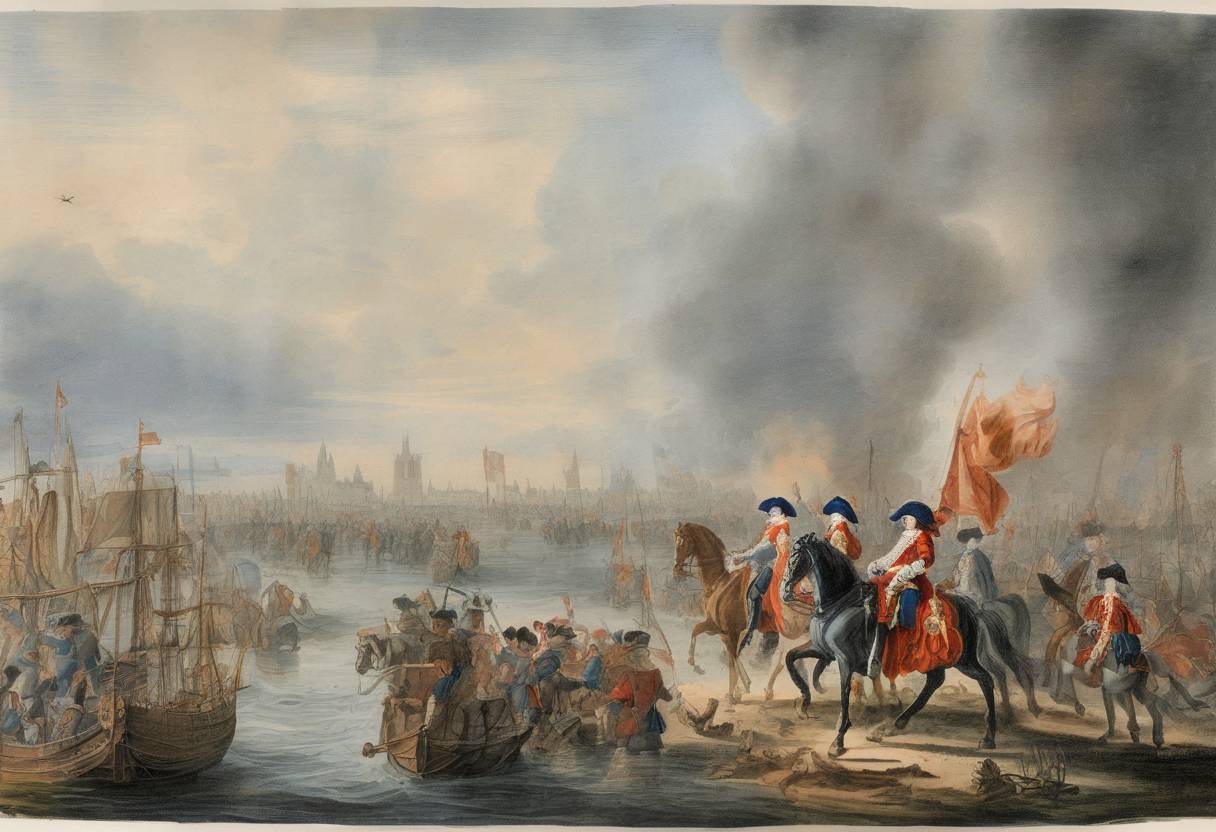
On April 29, 1672, King Louis XIV of France initiated the Franco-Dutch War by invading the Netherlands. This conflict, also known as the Dutch War, was a significant military campaign in the latter half of the 17th century, marking a pivotal moment in European history.
The Franco-Dutch War was rooted in a complex web of political, economic, and territorial ambitions. Louis XIV, known as the “Sun King,” sought to expand French territory and influence in Europe. The Dutch Republic, with its prosperous economy and strategic maritime position, was a prime target for French expansion.
Economic Rivalry: The Dutch Republic was a major economic power, dominating trade and commerce. France, under Louis XIV, aimed to challenge this dominance and secure economic advantages.
Territorial Ambitions: Louis XIV sought to extend France’s borders to the Rhine River, which required the subjugation of the Dutch territories.
Diplomatic Alliances: France formed alliances with England, Sweden, and several German states to isolate the Dutch. The Treaty of Dover (1670) between France and England was particularly significant, as it secretly aligned England with France against the Dutch.
Religious and Political Tensions: The Catholic Louis XIV viewed the Protestant Dutch Republic as a threat to Catholic hegemony in Europe.
On April 29, 1672, French forces crossed into Dutch territory, marking the official start of the Franco-Dutch War. The French army, well-organized and led by capable generals such as Marshal Turenne, quickly advanced into the heart of the Dutch Republic.
Rapid Advances: The French forces swiftly captured key Dutch fortresses and towns, exploiting the element of surprise and the initial unpreparedness of the Dutch defenses.
The Role of the Rhine: The French crossed the Rhine River, a significant military maneuver that allowed them to penetrate deeper into Dutch territory.
Dutch Response: The Dutch, under the leadership of William III of Orange, faced a dire situation. The rapid French advance led to a period known as the “Rampjaar” or “Disaster Year” in the Netherlands.
The Franco-Dutch War lasted until 1678, concluding with the Treaty of Nijmegen. The war had several important consequences:
Dutch Resilience: Despite initial setbacks, the Dutch managed to rally and defend their territory, aided by the flooding of their own lands to create defensive water barriers.
European Alliances: The war reshaped European alliances, with the Dutch eventually gaining support from Spain, the Holy Roman Empire, and Brandenburg-Prussia.
Territorial Changes: The Treaty of Nijmegen resulted in territorial gains for France, but it also solidified the Dutch Republic’s position as a resilient and enduring power.
Legacy of Louis XIV: The war marked a period of aggressive expansionism under Louis XIV, setting the stage for future conflicts in Europe.
The Franco-Dutch War exemplifies the intricate interplay of power, diplomacy, and military strategy in 17th-century Europe, highlighting the ambitions of Louis XIV and the resilience of the Dutch Republic.
Source: en.wikipedia.org