Fidel Castro Becomes Prime Minister of Cuba - February 16, 1959
1959 · Havana, Cuba
Fidel Castro becomes the Prime Minister of Cuba after overthrowing Fulgencio Batista.
January 7, 1959
The United States recognized the new Cuban government of Fidel Castro.
Havana, Cuba | U.S. Government
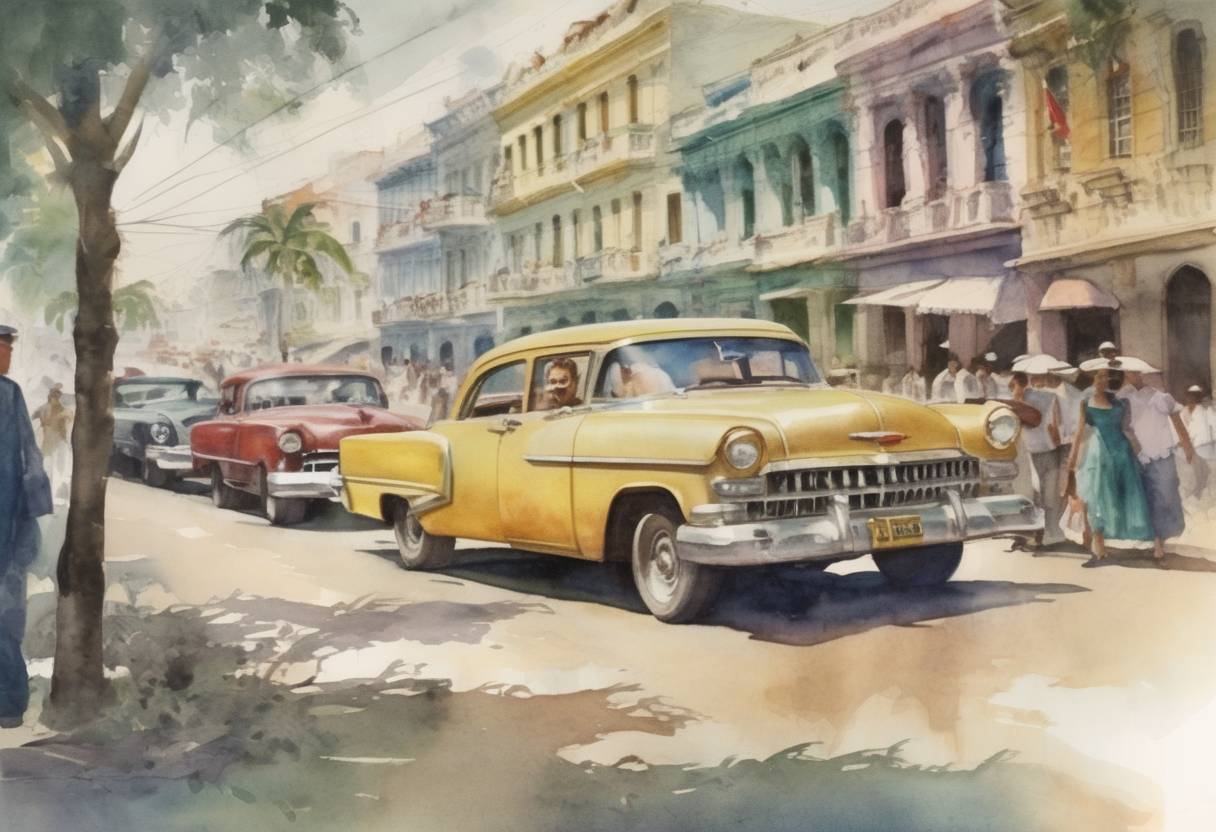
On January 7, 1959, the United States officially recognized the new government of Cuba, led by Fidel Castro. This recognition came just days after Castro’s revolutionary forces overthrew the regime of Cuban dictator Fulgencio Batista on January 1, 1959. The swift acknowledgment by the U.S. was a significant diplomatic move, reflecting the initial optimism and cautious hope that the new government might align with democratic principles and maintain friendly relations with the United States.
Fulgencio Batista’s Regime: Batista had been in power in Cuba, either directly or indirectly, since the early 1930s. His rule was marked by corruption, authoritarianism, and close ties with American business interests, which led to widespread discontent among the Cuban populace.
The Cuban Revolution: Fidel Castro, along with other revolutionaries like Che Guevara, led a guerrilla campaign against Batista’s forces. The revolution gained significant popular support, culminating in Batista fleeing the country on January 1, 1959.
Castro’s Rise to Power: After Batista’s departure, Castro’s forces quickly took control of Havana and other key areas. The revolutionary government began implementing reforms and consolidating power.
U.S. Diplomatic Moves: The United States, under President Dwight D. Eisenhower, was initially cautious but decided to recognize the new government to maintain influence and stability in the region. The recognition was also a strategic move to prevent the Soviet Union from gaining a foothold in the Western Hemisphere.
Initial Relations: Initially, relations between the U.S. and Cuba were cordial. However, tensions soon arose as Castro’s government began nationalizing American-owned properties and businesses in Cuba.
Shift Towards Communism: Over time, Castro’s government aligned more closely with the Soviet Union, adopting communist policies. This shift led to a deterioration of U.S.-Cuban relations, culminating in the severance of diplomatic ties in 1961 and the imposition of a U.S. trade embargo.
Bay of Pigs and Cuban Missile Crisis: The strained relations eventually led to significant Cold War confrontations, including the failed Bay of Pigs invasion in 1961 and the Cuban Missile Crisis in 1962, which brought the world to the brink of nuclear war.
The recognition of Castro’s government marked the beginning of a complex and often adversarial relationship between the United States and Cuba. It highlighted the challenges of U.S. foreign policy during the Cold War, particularly in dealing with revolutionary movements in Latin America. The events following the recognition had lasting impacts on U.S.-Cuban relations and contributed to the geopolitical dynamics of the Cold War era.
Source: en.wikipedia.org