Background
The Battle of Formigny, fought on April 15, 1450, was a significant engagement during the latter stages of the Hundred Years’ War, a protracted conflict between England and France that spanned from 1337 to 1453. This battle marked a crucial turning point in favor of the French, contributing to the eventual end of English territorial ambitions in France.
Context Leading to the Battle
By the mid-15th century, the tide of the Hundred Years’ War was turning against the English. The French, under the leadership of King Charles VII, had been steadily reclaiming territories lost to the English. The French resurgence was bolstered by reforms in their military and the strategic use of artillery, which played a pivotal role in their successes.
In 1449, the French launched a campaign to recapture Normandy, a region that had been under English control since the early phases of the war. The capture of Rouen in October 1449 was a significant blow to English power in the region, setting the stage for further confrontations.
The Battle
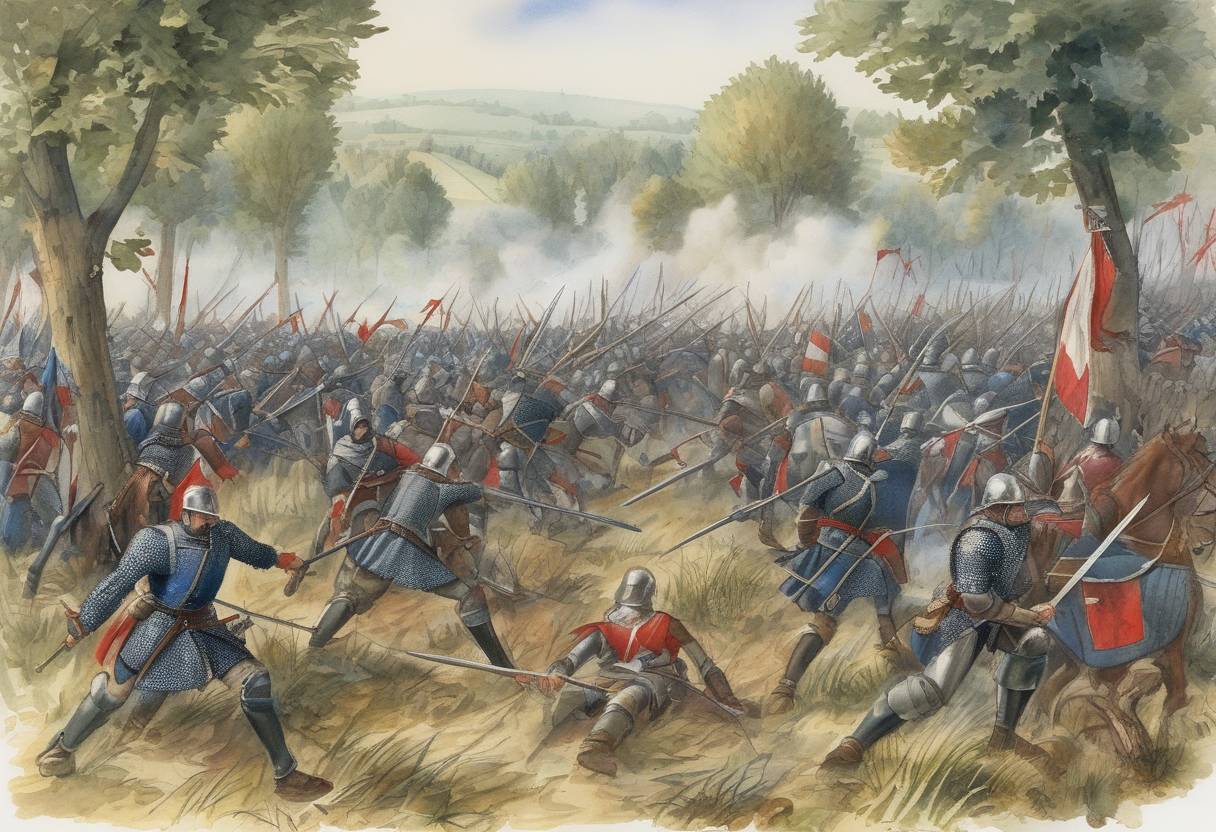
The Battle of Formigny took place near the village of Formigny in Normandy. The English forces, led by Sir Thomas Kyriell, were attempting to relieve the besieged town of Caen. Kyriell’s army, numbering around 3,500 men, was composed mainly of longbowmen, a unit that had previously given the English a tactical advantage in numerous battles.
The French forces, commanded by Charles of Bourbon, Count of Clermont, and Arthur de Richemont, the Constable of France, numbered approximately 5,000. The French employed a combination of cavalry, infantry, and artillery, the latter being a relatively new and effective addition to their military strategy.
The battle commenced with the English taking a defensive position, relying on their longbowmen to repel the French assault. However, the French artillery, strategically positioned, disrupted the English lines, causing significant casualties and disarray. The arrival of Richemont’s reinforcements further tipped the scales in favor of the French. The English forces were eventually overwhelmed, resulting in a decisive French victory.
Aftermath and Significance
The Battle of Formigny was a critical victory for the French, effectively ending English control in Normandy. This victory paved the way for the French to reclaim other territories, culminating in the eventual expulsion of the English from all French lands except Calais by 1453.
The battle demonstrated the effectiveness of artillery in warfare, signaling a shift in military tactics that would influence future conflicts. It also underscored the declining power of the English in France, contributing to the end of the Hundred Years’ War.
The success at Formigny bolstered French morale and solidified Charles VII’s reign, allowing him to consolidate power and strengthen the French monarchy. The battle remains a significant event in the history of the Hundred Years’ War, symbolizing the resurgence of French power and the decline of English influence on the continent.