Francis Drake's Expedition in St. Augustine - June 6, 1586
1586 · St. Augustine, present-day USA
Francis Drake's expedition lands in St. Augustine in present-day Florida, claiming it for England.
April 4, 1581
Francis Drake is knighted by Queen Elizabeth I aboard the Golden Hind in Deptford, England, after his successful circumnavigation of the globe.
Deptford, England | English Crown
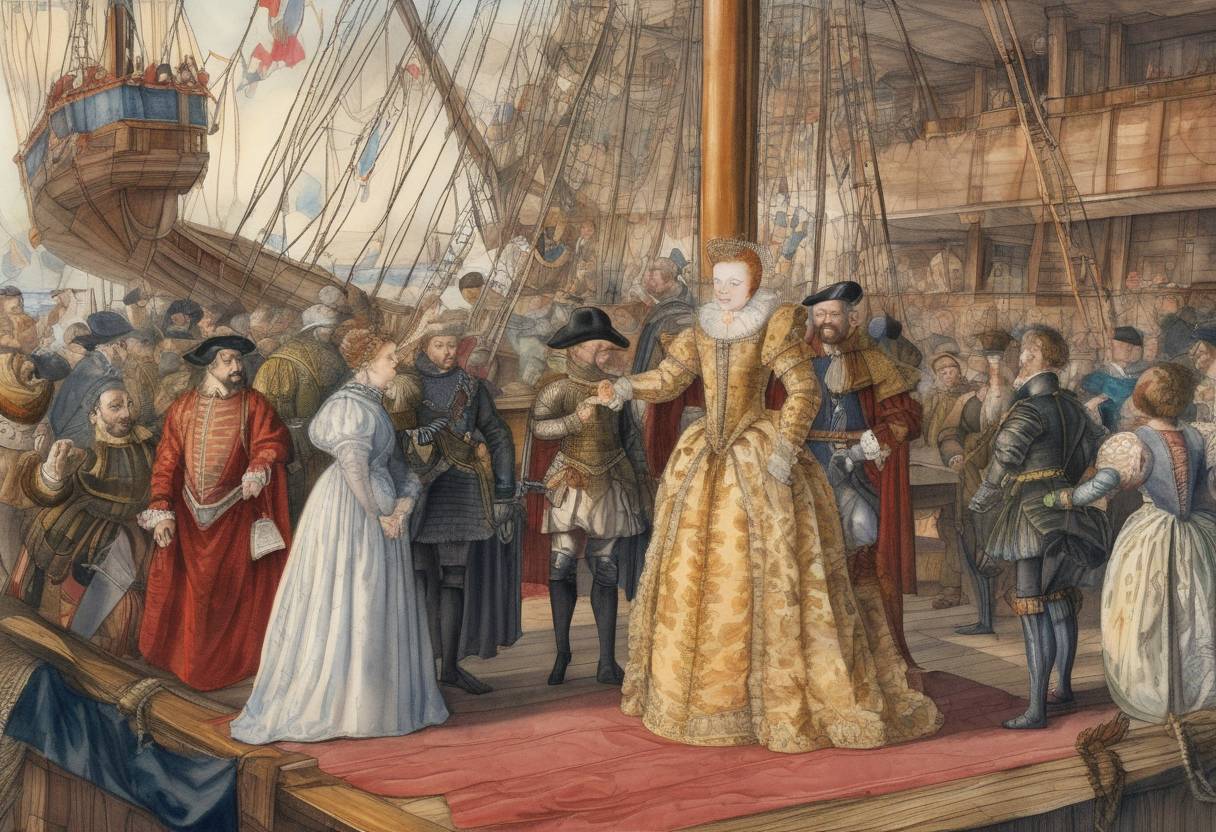
On April 4, 1581, Sir Francis Drake was knighted by Queen Elizabeth I aboard his ship, the Golden Hind, at Deptford, England. This event marked the culmination of Drake’s successful circumnavigation of the globe, a monumental achievement in the Age of Exploration.
Francis Drake, an English sea captain, privateer, and navigator, embarked on his circumnavigation journey in 1577. The expedition was initially intended to raid Spanish holdings along the Pacific coast of the Americas, as England and Spain were rivals for global dominance. Drake’s voyage was secretly commissioned by Queen Elizabeth I, who sought to challenge Spanish supremacy and expand English influence.
Drake set sail from Plymouth, England, with five ships and about 164 men. The fleet faced numerous challenges, including treacherous weather, hostile encounters, and the loss of ships. Despite these obstacles, Drake successfully navigated the Strait of Magellan and ventured into the Pacific Ocean, becoming the first Englishman to do so.
During the voyage, Drake raided Spanish settlements and captured valuable treasures, including a significant amount of gold and silver. He continued north along the western coast of the Americas, reaching as far as present-day California, which he claimed for England as “Nova Albion.”
Drake then crossed the Pacific, visiting the Moluccas (Spice Islands) and navigating through the Indian Ocean. He rounded the Cape of Good Hope and returned to England in September 1580, completing his circumnavigation.
Queen Elizabeth I’s decision to knight Drake was both a recognition of his daring achievements and a political statement. By honoring Drake, the Queen endorsed his actions against Spain and celebrated England’s growing maritime prowess. The knighting ceremony took place aboard the Golden Hind, symbolizing the significance of Drake’s voyage.
Drake’s circumnavigation had several important consequences:
In summary, the knighting of Francis Drake by Queen Elizabeth I was a pivotal moment in history, celebrating a remarkable feat of navigation and marking a turning point in England’s rise as a global maritime power.
Source: en.wikipedia.org