Mikhail Romanov Elected Tsar of Russia - February 21, 1613
1613 · Moscow, Russia
Mikhail Romanov was elected Tsar of Russia, marking the beginning of the Romanov dynasty.
March 2, 1476
Vlad the Impaler regains the throne of Wallachia for the third time.
Wallachia, Present-day Romania
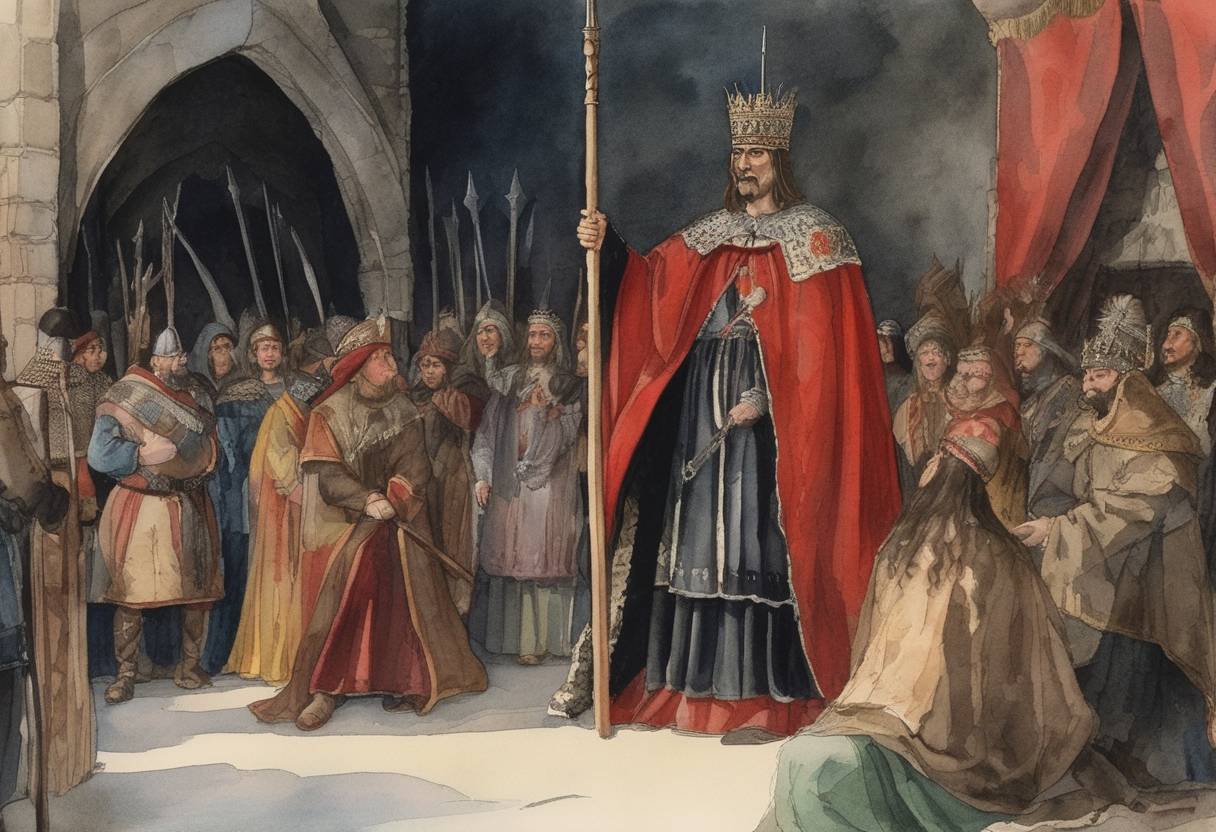
On March 2, 1476, Vlad III, commonly known as Vlad the Impaler or Vlad Dracula, regained the throne of Wallachia for the third time. Vlad’s repeated ascensions and depositions were part of a turbulent period in Eastern European history characterized by complex political and military strife involving the Ottoman Empire, Hungary, and various principalities of the Balkans.
Wallachia, situated between the powerful Ottoman Empire and the Kingdom of Hungary, was strategically significant and frequently contested. Vlad’s earlier reigns were marked by fierce opposition both from Ottoman forces and local boyars (nobility). His initial rise to power occurred in 1448, and he briefly occupied the throne again from 1456 to 1462, a period marked by his notorious campaigns against the Ottomans and local rivals.
Vlad’s third accession was the result of intricate maneuvers and shifting alliances. Following his detention by Hungarian forces for over a decade—a period during which he maintained a position of influence through military and diplomatic skill—Vlad re-entered Wallachian politics leveraging support primarily from Hungarian King Matthias Corvinus.
During the late 15th century, the Ottomans were a dominant force, and Vlad’s reputation as a fierce and ruthless defender against Ottoman advances had earned him conditional support in Europe. Consequently, in 1476, with the backing of Hungarian forces and a coalition of local allies, Vlad seized the opportunity to reclaim the Wallachian throne from Basarab Laiotă, an Ottoman-supported rival.
Vlad’s final reign was brief, lasting only a few months, beset by continuous conflicts. By the end of 1476, Vlad was killed in battle or betrayed and assassinated, with historical records providing differing accounts. Vlad’s dramatic life and association with the Dracula legend have endowed him with an enduring, albeit controversial legacy.
His steadfast resistance against the Ottomans and the harsh methods he employed have been subjects of extensive historical analyses and folklore, rendering him a complex figure emblematic of the broader conflicts between Christian and Ottoman forces during the late medieval era. His story remains a testament to the turbulent and often brutal political landscape of Southeast Europe in the 15th century.
Source: en.wikipedia.org