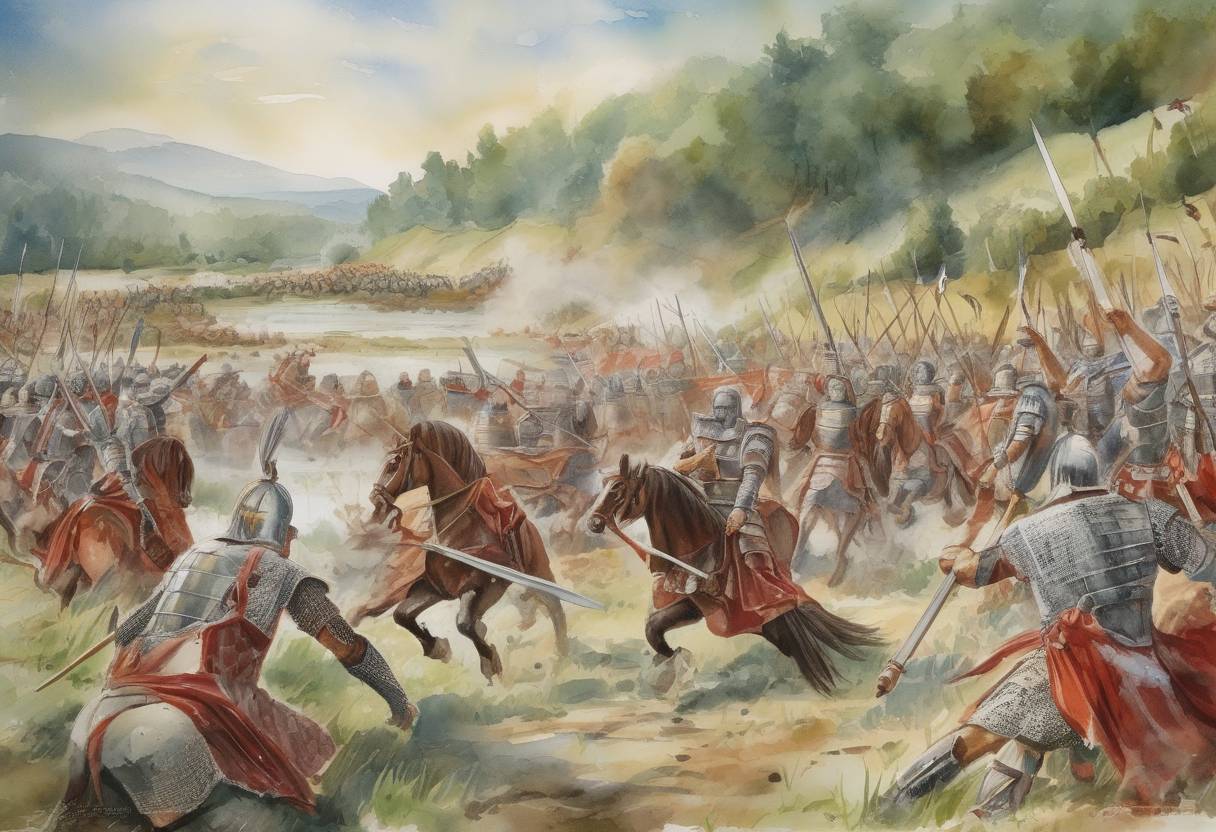
The Battle of the Frigidus: September 6, 394
The Battle of the Frigidus, fought on September 6, 394, was a pivotal conflict in Roman history, marking the last significant military engagement between rival factions within the Roman Empire. This battle saw the Eastern Roman Emperor Theodosius I defeat the Western Roman usurper Eugenius, leading to the reunification of the Roman Empire under a single ruler.
Context and Prelude
Division of the Empire: By the late 4th century, the Roman Empire was divided into Eastern and Western halves, each governed by its own emperor. This division was primarily administrative but often led to political and military conflicts.
Rise of Eugenius: Eugenius, a former teacher and bureaucrat, was elevated to the position of Western Roman Emperor in 392 by the powerful general Arbogast, following the mysterious death of Emperor Valentinian II. Eugenius was seen as a puppet ruler, with Arbogast wielding real power.
Religious Tensions: Theodosius I was a staunch supporter of Nicene Christianity, while Eugenius and Arbogast were more tolerant of pagan practices, which had been suppressed under Theodosius. This religious divide added a layer of ideological conflict to the political struggle.
The Battle
Location: The battle took place near the Frigidus River, in the Julian Alps, present-day Slovenia. The terrain was challenging, with narrow passes and rugged landscapes.
Forces: Theodosius commanded a large and diverse army, including Gothic and Hunnic auxiliaries. Eugenius’s forces were primarily composed of Roman legions and Frankish troops loyal to Arbogast.
Tactics and Outcome: The battle lasted two days. On the first day, Eugenius’s forces held the advantage, but on the second day, a sudden and fierce bora wind blew against Eugenius’s troops, disrupting their formations. This natural phenomenon was seen by Theodosius’s men as divine intervention. Theodosius capitalized on this opportunity, launching a decisive attack that overwhelmed Eugenius’s forces.
Aftermath and Significance
Death of Eugenius and Arbogast: Eugenius was captured and executed, while Arbogast committed suicide. Their defeat effectively ended the resistance against Theodosius.
Reunification of the Empire: The victory at the Frigidus allowed Theodosius to reunite the Eastern and Western Roman Empires under his sole rule, albeit briefly, as he died in 395, leading to another division.
Religious Impact: Theodosius’s victory reinforced the dominance of Nicene Christianity within the empire. Pagan practices faced further suppression, and Christianity became more deeply entrenched as the state religion.
Legacy: The Battle of the Frigidus is often seen as a turning point that marked the end of significant pagan influence in the Roman political sphere and underscored the increasing role of religion in imperial politics.
The Battle of the Frigidus thus stands as a significant event in the late Roman Empire, illustrating the complex interplay of politics, religion, and military power during this tumultuous period.