Opening of the Manhattan Bridge
1909 · New York City, United States
The Manhattan Bridge, a suspension bridge connecting Manhattan and Brooklyn in New York City, officially opened to traffic.
May 24, 1883
The Brooklyn Bridge, connecting Manhattan and Brooklyn in New York City, opens to traffic after 14 years of construction.
New York City, USA | New York City Department of Bridges
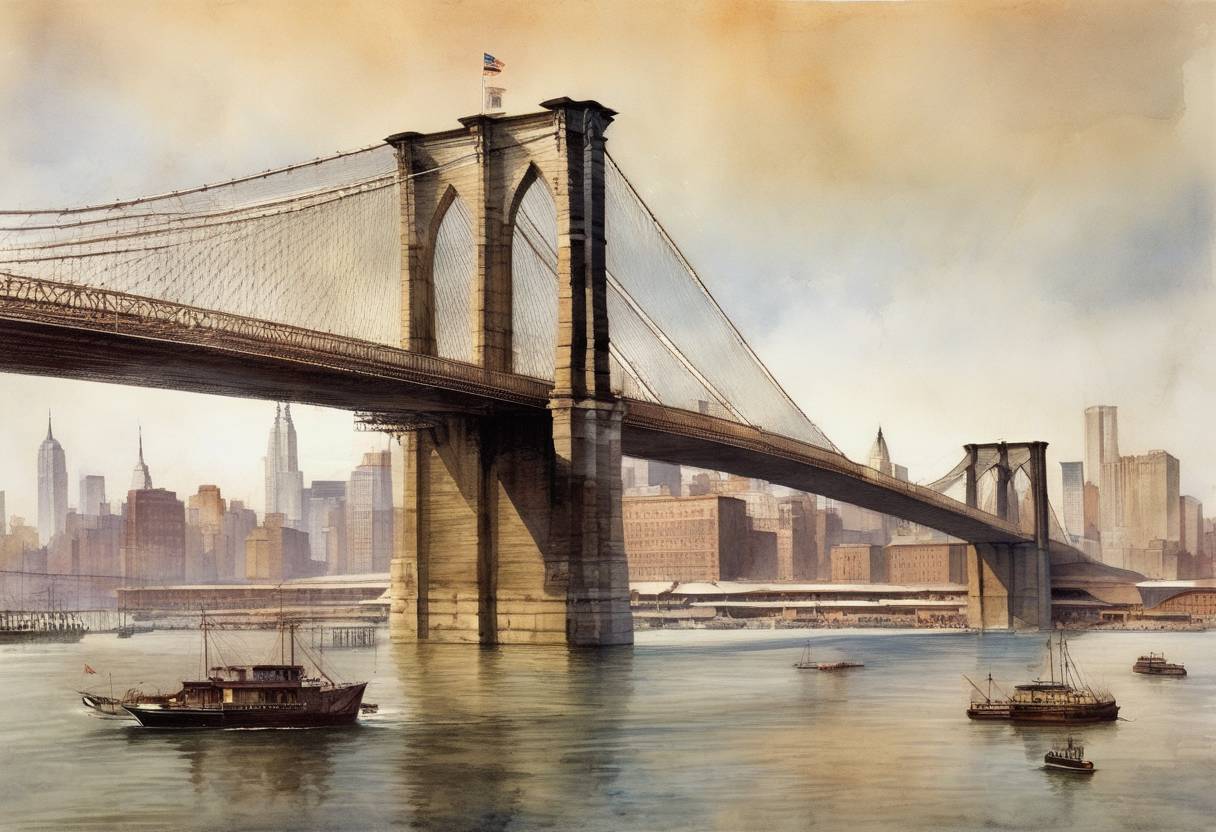
On May 24, 1883, the Brooklyn Bridge, an iconic feat of engineering, officially opened to traffic, connecting the boroughs of Manhattan and Brooklyn in New York City. This monumental event marked the culmination of 14 years of construction and was celebrated with great fanfare.
Visionary Design: The bridge was designed by John Augustus Roebling, a German immigrant and a pioneering engineer known for his work with suspension bridges. Tragically, Roebling died in 1869 from an injury sustained during the bridge’s early construction phase. His son, Washington Roebling, took over the project.
Challenges and Innovations: The construction faced numerous challenges, including difficult working conditions and the need for innovative engineering solutions. Washington Roebling himself suffered from decompression sickness, known as “the bends,” due to working in caissons beneath the river. Despite his illness, he continued to oversee the project from his home with the help of his wife, Emily Warren Roebling, who played a crucial role in communication and project management.
Engineering Marvel: At the time of its completion, the Brooklyn Bridge was the longest suspension bridge in the world, with a main span of 1,595.5 feet (486.3 meters). It was also the first steel-wire suspension bridge, showcasing the potential of steel in large-scale construction.
Ceremonial Events: The opening ceremony was attended by numerous dignitaries, including President Chester A. Arthur and New York Governor Grover Cleveland. The event was marked by a grand procession and fireworks, reflecting the bridge’s significance as a symbol of progress and innovation.
Public Reception: Thousands of people crossed the bridge on its first day, eager to experience the new connection between Manhattan and Brooklyn. The bridge quickly became a vital transportation link and a beloved landmark.
Economic Impact: The Brooklyn Bridge facilitated commerce and communication between Manhattan and Brooklyn, contributing to the economic growth of both boroughs. It played a key role in the eventual consolidation of New York City in 1898.
Cultural Icon: Over the years, the Brooklyn Bridge has become an enduring symbol of New York City and American ingenuity. It has been featured in countless works of art, literature, and film, capturing the imagination of people worldwide.
Legacy: The bridge’s successful completion set new standards for engineering and urban infrastructure, influencing the design and construction of future bridges globally.
The opening of the Brooklyn Bridge on May 24, 1883, remains a landmark moment in the history of New York City and engineering, celebrated for its technical achievements and its lasting impact on the city’s development.
Source: www.history.com