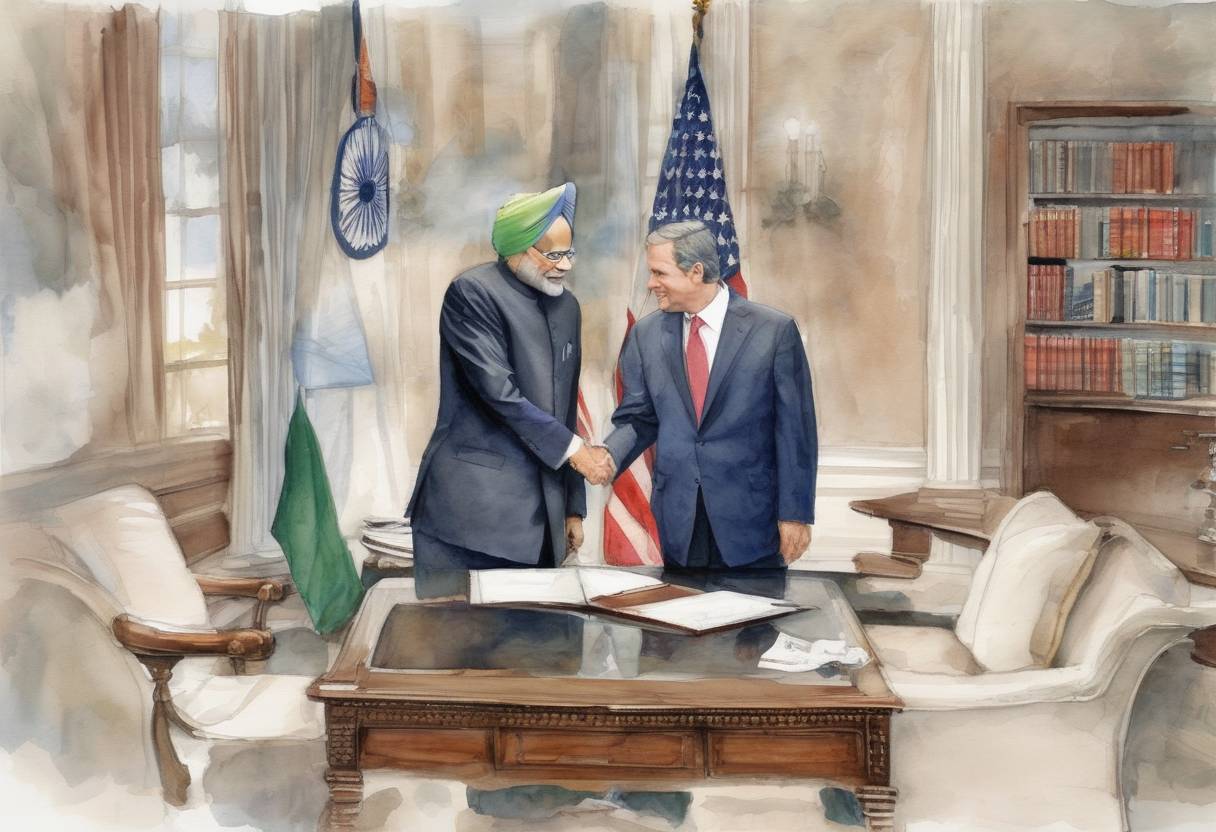
U.S.-India Civil Nuclear Agreement Announcement (July 18, 2005)
On July 18, 2005, a landmark agreement was announced between Indian Prime Minister Manmohan Singh and U.S. President George W. Bush, known as the U.S.-India Civil Nuclear Agreement. This agreement marked a significant step in the strategic partnership between the United States and India, fundamentally altering the global nuclear landscape and bilateral relations between the two nations.
Context and Background
India’s Nuclear Status: India conducted its first nuclear test in 1974 and subsequently developed a nuclear weapons program. However, India did not sign the Nuclear Non-Proliferation Treaty (NPT), which aims to prevent the spread of nuclear weapons and promote peaceful uses of nuclear energy.
U.S.-India Relations: Prior to the agreement, U.S.-India relations were often strained due to India’s nuclear weapons program and its non-signatory status to the NPT. The U.S. had imposed sanctions on India following its nuclear tests in 1998.
Strategic Shift: By the early 2000s, both countries recognized the potential for a strategic partnership, driven by mutual interests in economic growth, security, and counter-terrorism.
Key Elements of the Agreement
Civilian Nuclear Cooperation: The agreement allowed India access to U.S. civilian nuclear technology and fuel, despite its non-signatory status to the NPT. This was contingent upon India separating its civilian and military nuclear facilities and placing the former under International Atomic Energy Agency (IAEA) safeguards.
Non-Proliferation Commitment: India agreed to maintain its moratorium on nuclear testing and to work towards the conclusion of a Fissile Material Cut-off Treaty (FMCT).
Energy and Economic Benefits: The agreement aimed to help India meet its growing energy demands through nuclear power, reducing its reliance on fossil fuels and supporting its economic growth.
Significance and Consequences
Strategic Partnership: The agreement was a cornerstone in strengthening U.S.-India relations, fostering cooperation in areas such as defense, trade, and technology.
Global Nuclear Order: It challenged the traditional non-proliferation regime by recognizing India’s nuclear program and integrating it into the global nuclear order without requiring NPT adherence.
Criticism and Support: The agreement faced criticism from non-proliferation advocates who argued it undermined the NPT. However, it was praised for bringing India closer to the international nuclear community and enhancing global energy security.
Legislative Approval: The U.S. Congress passed the Hyde Act in 2006, enabling the agreement’s implementation. The IAEA and the Nuclear Suppliers Group (NSG) also granted India-specific waivers, further facilitating the deal.
In summary, the U.S.-India Civil Nuclear Agreement of July 18, 2005, was a pivotal moment in international relations, reflecting a strategic realignment and a pragmatic approach to nuclear diplomacy. It underscored the evolving dynamics of global power structures and the importance of bilateral cooperation in addressing 21st-century challenges.