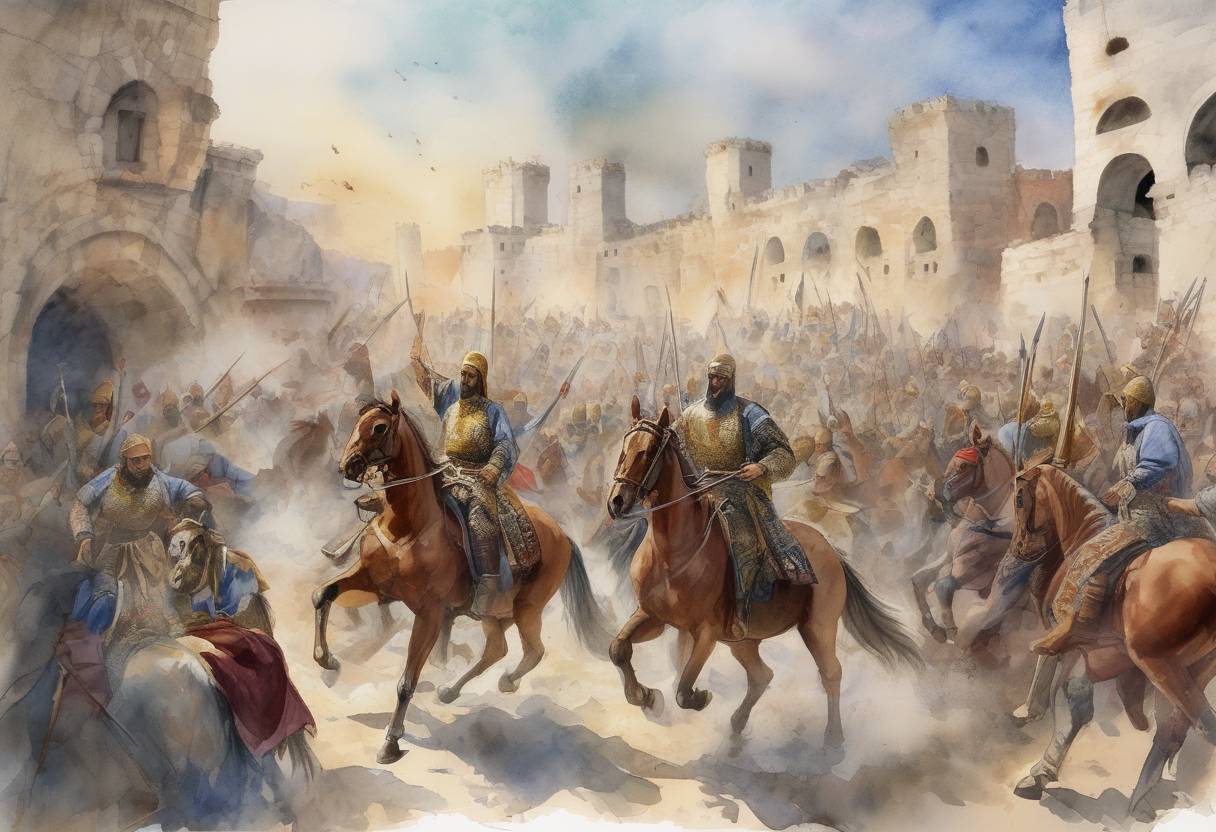
The Beginning of the Muslim Conquest of Hispania: April 29, 711
On April 29, 711, a pivotal moment in European history unfolded as Umayyad forces, led by the Berber general Tariq ibn Ziyad, began their invasion of the Iberian Peninsula. This event marked the start of the Muslim conquest of Hispania, which would have lasting impacts on the cultural, religious, and political landscape of the region.
Context and Background
The Iberian Peninsula, prior to the invasion, was under the rule of the Visigothic Kingdom. The Visigoths, a Germanic people, had established their dominance in the region following the decline of the Roman Empire. However, by the early 8th century, the kingdom was weakened by internal strife, including disputes over succession and power struggles among the nobility.
The Umayyad Caliphate, based in Damascus, was at the height of its power, having expanded its territories across the Middle East, North Africa, and parts of Asia. The conquest of Hispania was partly motivated by the desire to extend Islamic influence and control over new territories, as well as to capitalize on the internal divisions within the Visigothic Kingdom.
The Invasion
Tariq ibn Ziyad, a skilled military leader of Berber origin, was appointed by the Umayyad governor of North Africa, Musa ibn Nusayr, to lead the expedition into Hispania. On April 29, 711, Tariq and his forces, estimated to be around 7,000 troops, crossed the Strait of Gibraltar. The landing site, a prominent rock, was later named “Jabal Tariq” (Mountain of Tariq), which evolved into the name “Gibraltar.”
Upon landing, Tariq’s forces quickly engaged the Visigothic army. The most significant battle occurred at the Battle of Guadalete, where Tariq’s forces defeated King Roderic, the last Visigothic ruler of a united Hispania. This victory opened the way for further Muslim advances into the peninsula.
Consequences and Significance
The successful invasion led to the rapid expansion of Muslim control over much of the Iberian Peninsula. Within a few years, the majority of Hispania was under Umayyad rule, with only a few northern regions remaining in Christian hands. This period of Muslim rule, known as Al-Andalus, lasted for several centuries and was characterized by significant cultural and scientific advancements.
The Muslim conquest of Hispania had profound effects on the region’s cultural and religious landscape. It introduced new agricultural practices, architectural styles, and intellectual pursuits, contributing to a rich cultural synthesis. The coexistence of Muslims, Christians, and Jews in Al-Andalus is often cited as a period of relative tolerance and cultural flourishing.
The legacy of the Muslim conquest of Hispania is still evident today in the architectural, linguistic, and cultural influences that remain in modern Spain and Portugal. The event also set the stage for the later Reconquista, a centuries-long effort by Christian kingdoms to reclaim the peninsula.
In summary, the invasion led by Tariq ibn Ziyad on April 29, 711, was a turning point in the history of the Iberian Peninsula, marking the beginning of a new era that would shape the region’s history for generations to come.