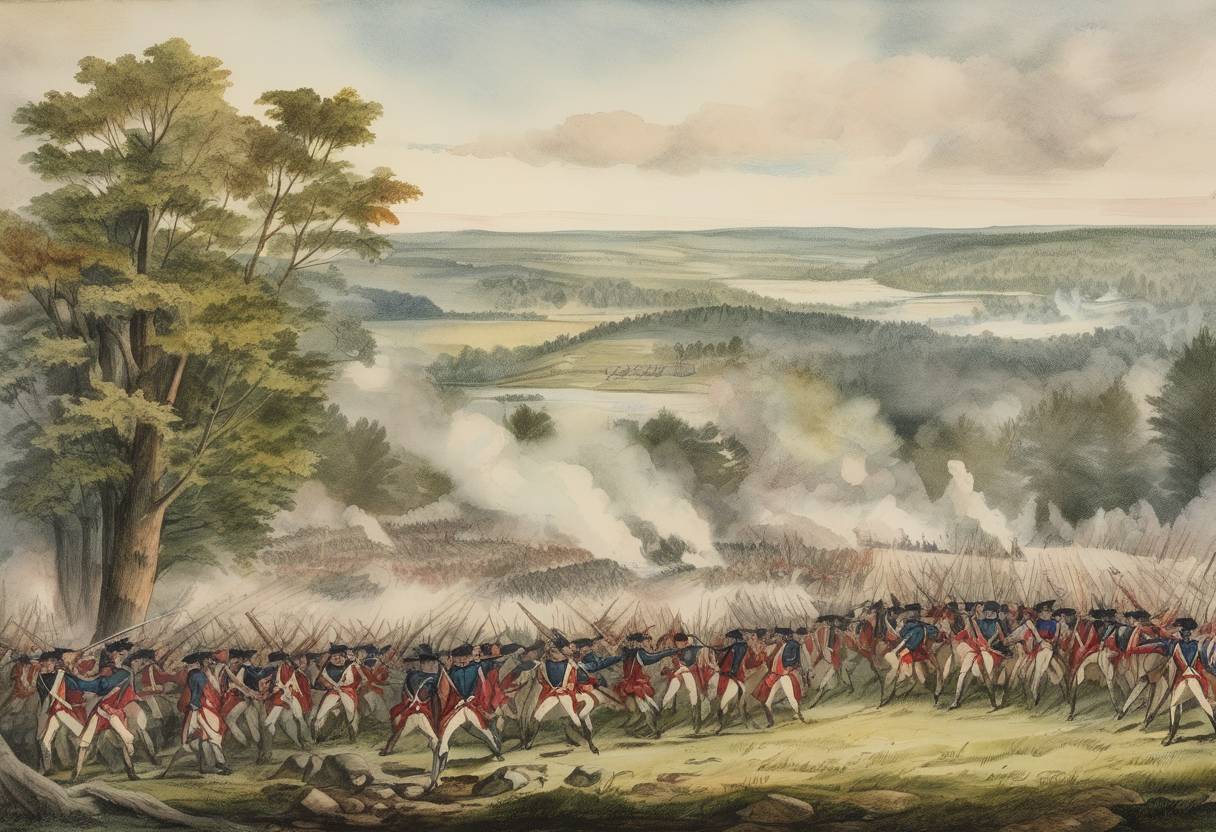
The Battle of Bennington: August 16, 1777
The Battle of Bennington was a pivotal engagement during the American Revolutionary War, marking a significant victory for the American forces over British and Hessian troops. This battle played a crucial role in the larger Saratoga campaign, which ultimately contributed to the turning point of the war in favor of the American cause.
Context and Prelude
In the summer of 1777, British General John Burgoyne embarked on a campaign to gain control of the Hudson River Valley, aiming to isolate New England from the other colonies. As part of this strategy, Burgoyne’s forces moved south from Canada, capturing Fort Ticonderoga in early July. However, the campaign faced logistical challenges, particularly in securing supplies.
To address this, Burgoyne dispatched a detachment led by Lieutenant Colonel Friedrich Baum, composed of British, Hessian, Loyalist, and Native American troops, to raid the American supply depot at Bennington, located in present-day Vermont. Baum’s mission was to seize horses, cattle, and other provisions critical for the British army’s sustenance.
The Battle
On August 16, 1777, the American forces, primarily composed of New Hampshire and Massachusetts militia under the command of General John Stark, engaged Baum’s troops near Bennington. Stark, a veteran of the French and Indian War, famously rallied his men with the words, “There are your enemies, the Redcoats and the Tories. They are ours, or this night Molly Stark sleeps a widow.”
The battle unfolded in two main phases:
Initial Engagement: Stark’s forces, numbering around 2,000, executed a flanking maneuver, surrounding Baum’s position. The Americans attacked with ferocity, and despite Baum’s attempts to hold his ground, his troops were overwhelmed by the superior numbers and tactical advantage of the Americans.
Reinforcements and Conclusion: As the battle raged, British reinforcements under Lieutenant Colonel Heinrich von Breymann arrived. However, the Americans, bolstered by additional militia reinforcements, managed to repel this second wave. The British and Hessian forces suffered heavy casualties, with many captured or killed, including Baum, who was mortally wounded.
Aftermath and Significance
The Battle of Bennington was a decisive victory for the American forces, resulting in the capture of nearly 700 enemy troops and a significant blow to Burgoyne’s campaign. The defeat deprived the British of much-needed supplies and weakened their position in the Saratoga campaign.
The victory at Bennington boosted American morale and demonstrated the effectiveness of militia forces against professional European troops. It also contributed to the eventual surrender of Burgoyne’s army at the Battle of Saratoga in October 1777, which proved to be a turning point in the Revolutionary War. The success at Saratoga helped secure French support for the American cause, which was instrumental in the ultimate victory of the United States in the war.
In summary, the Battle of Bennington was not only a tactical triumph but also a strategic victory that had far-reaching implications for the American struggle for independence.