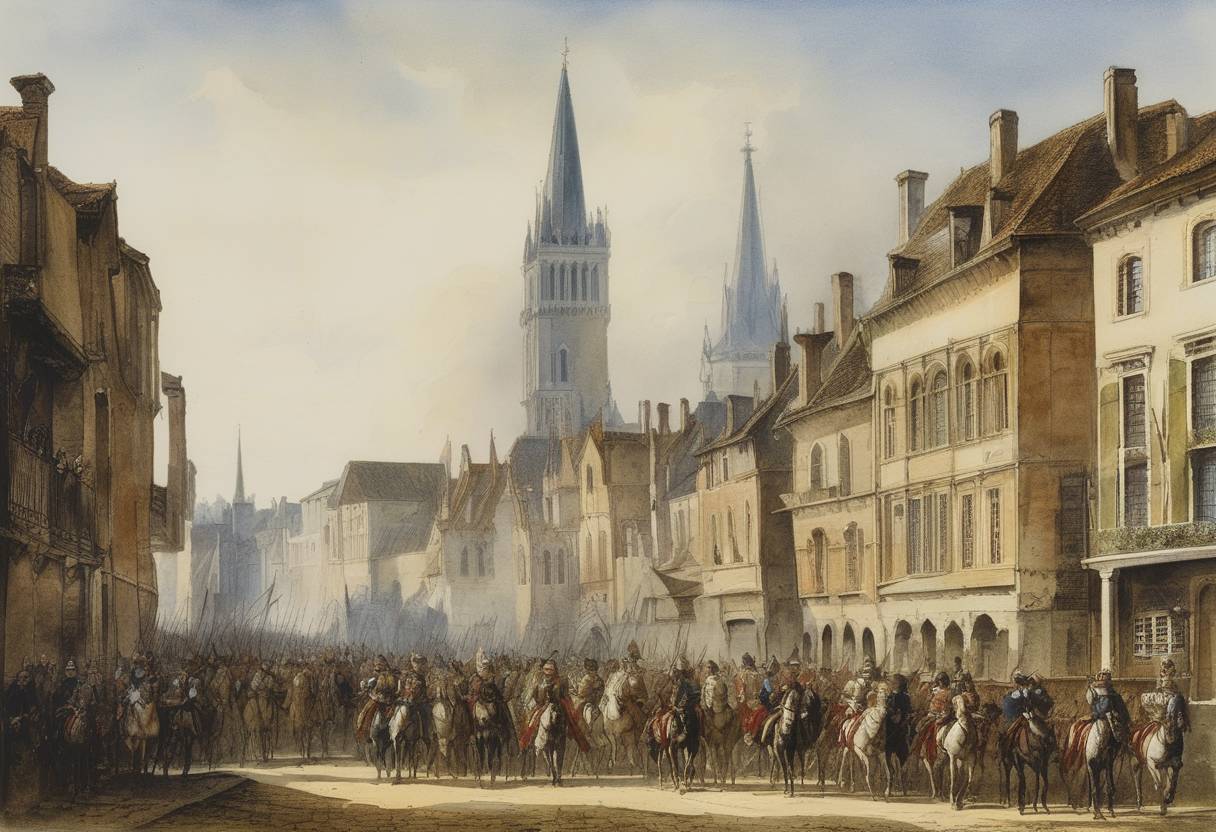
The League of Cambrai, a significant coalition of European powers, was officially formed on November 30, 1508. This alliance was orchestrated primarily by Pope Julius II and included the Holy Roman Empire, France, Spain, and several Italian states. The league’s primary objective was to curtail the territorial and economic dominance of the Republic of Venice in Northern Italy.
Historical Context
In the early 16th century, Venice was a formidable maritime and territorial power. Its strategic location and thriving commerce enabled it to exert considerable influence over the Adriatic and Mediterranean trade routes. This growing power, however, provoked jealousy and fear among neighboring states.
Papal Interests: Pope Julius II aimed to recover territories in the Romagna region that Venice had previously seized from the Papal States.
French and Imperial Goals: King Louis XII of France sought to reassert control over territories in Milan that Venice had taken. Similarly, Holy Roman Emperor Maximilian I aimed to reestablish his influence over regions in the Veneto that were within the Empire’s claimed dominion.
Negotiations took place in Cambrai, a city in present-day northern France. On November 30, the formal agreement established a strategic alliance against Venice, setting aside former rivalries between the parties involved. The League’s formation was marked by a remarkable convergence of interests around the common goal of diminishing Venetian power.
Aftermath and Consequences
The War of the League of Cambrai commenced in 1509, leading to significant military campaigns. The allied forces achieved a pivotal victory over Venice at the Battle of Agnadello on May 14, 1509. This battle marked the rapid disintegration of Venice’s territory on the mainland. However, the coalition proved fragile, as conflicting interests soon surfaced among the allies.
Venice managed to recover and reestablished its dominant position by exploiting the internal divisions of the League members. The city-state endured as a leading player in Italian politics, although the conflict marked the beginning of its gradual decline in maritime supremacy.
Ultimately, the formation of the League of Cambrai epitomized the volatile nature of Renaissance politics in Europe, highlighting the intricate web of alliances and rivalries that characterized the era.